An education project planned for a medical surgical unit with 46 nurses on the roster reaches 19 of them, runs twice instead of three times, and loses its skills station to a room that was reassigned on the morning of the second session. None of that sinks the project. What sinks reports is failing to write the difference between the plan and the delivery as an analysis with causes and consequences attached. Variance writing is a distinct graduate skill: it treats departure from plan as data about feasibility rather than as a confession. Your section may print this as NR 622 or NR622; it is the same course. Chamberlain publishes no syllabi outside Canvas. The placement here is our teaching judgment from the course's catalog arc; your section's rubric decides what your week actually asks.
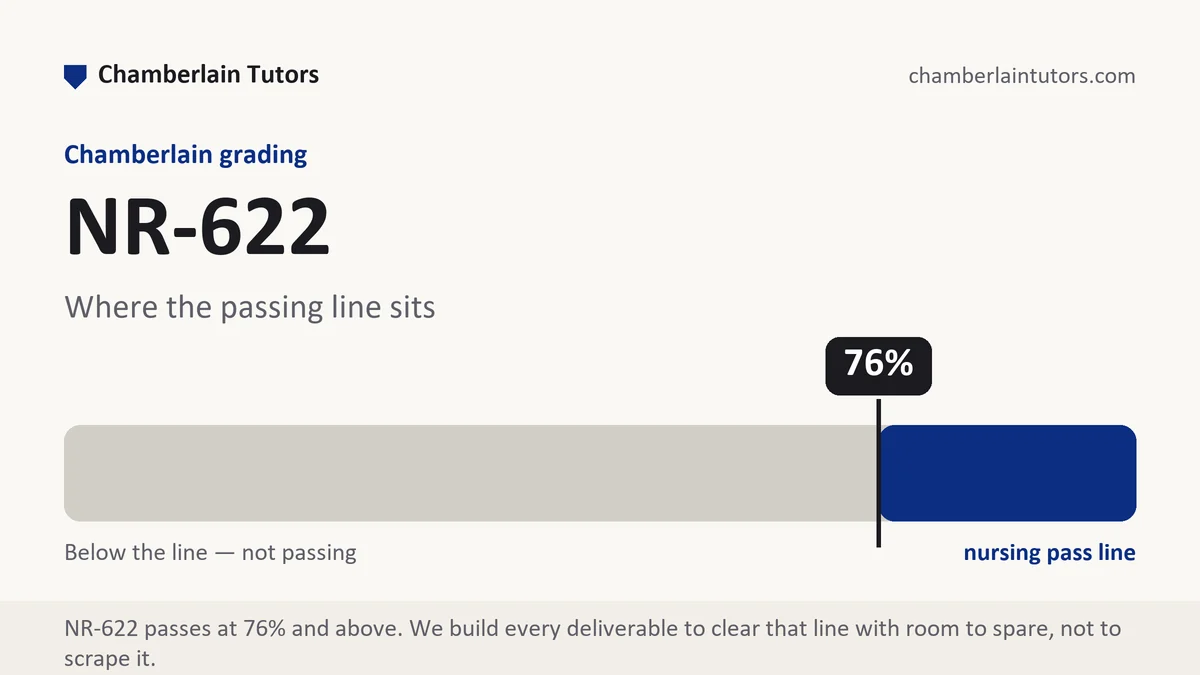
What NR-622 Week 3 asks for
By the middle third of a completion course you have a plan on one side and an implementation record on the other, and the written work turns to the space between them. This is where reports separate into bands. A weak report either denies the gap or apologizes for it. A strong one treats each departure as a small finding: something about this setting, this learner group or this design made the planned version impossible, and knowing that is genuinely useful to anyone who would repeat the project.
The analytic structure of a variance paragraph has four parts and they belong in a fixed order. What was planned. What occurred. Why the difference happened, stated as a mechanism rather than a mood. What the difference does to the project's claims. Miss the fourth and the paragraph becomes explanation without consequence, which is the most common way this section under-scores. A session shortened by fifteen minutes is not an interesting fact by itself; a session shortened by fifteen minutes that removed the second practice repetition, on which an objective pitched at application depended, is an analysis.
The stage also asks you to distinguish between the two species of variance, because they carry different weight. Deliberate adaptation is a choice you made in the room based on what you saw: you dropped the third scenario because the group had not consolidated the first two. Forced variance is imposed by circumstances: a room reassigned, a census surge, a learner pulled to cover a floor. Adaptations show instructional judgment and generally strengthen a report when they are justified. Forced variance shows the operating environment and generally strengthens a report when it is quantified. Presenting the first as though it were the second discards credit you have already earned.
Deliverables at this depth are usually a written analysis section, sometimes a table, and possibly a posted response about the challenges encountered. Write any post to the same standard as the paper. Posts do not reopen after submission in Canvas, and a post that describes an adaptation as a failure will sit permanently beside a paper that describes it as a judgment call.
Where our help stops in a practicum course
Everything that produced the variance is your own practicum work. The 72 hours, the log that records them, attendance records, mentor and preceptor evaluations, site documentation and every signature are the student's own record and are never drafted, reconstructed, or estimated with help. We do not reconstruct what happened in a session, invent a reason a room was lost, or supply detail about an event we did not witness. A variance analysis is only worth writing when the facts inside it are the student's own.
The written layer we do support is the reasoning: separating adaptation from imposition, stating mechanisms instead of feelings, quantifying reach against target, and carrying each departure through to its effect on what the project can claim. Where the analysis touches real learners or real clinical pressure on the unit, de-identify fully. Describe the census as a number rather than naming the night, describe learners by role and count rather than by any characteristic that would identify one person, and keep patient circumstances out of the text entirely unless they are essential and stripped of every identifier.
The NR-622 Week 3 method, in six analytic moves
Six moves that convert a list of things that went wrong into a graded analysis.
-
Tabulate planned against delivered before writing prose
Two columns, one row per element: sessions, duration, participants, methods, materials, data collection. The rows that differ are your section. Building the table first stops you from writing paragraphs about the one departure you feel worst about while ignoring three others.
-
Classify each departure as adaptation or imposition
Did you choose it in response to what you observed, or did circumstances remove the option. The classification determines how the paragraph is framed, and mislabeling a considered instructional decision as a setback costs you credit for judgment you actually exercised.
-
State a mechanism, not a mood
Because the unit admitted four patients between 14:00 and 15:30, two of the eleven expected learners left before the return demonstration. That is a mechanism. Things got hectic is a mood, and it cannot be assessed, compared or learned from.
-
Trace each departure to the objective it touches
Name which objective is affected and how. A departure with no consequence for any objective deserves a sentence at most; a departure that removed the only planned evidence for an objective deserves a paragraph and a note in the results section.
-
Quantify reach against the target population
Nineteen of the 46 nurses on the roster attended at least one session. That single fraction tells a reader more about the project's real footprint than several paragraphs of description, and it is the number a practice setting would actually care about.
-
Convert each variance into a recommendation you would defend
If the departure would recur, say what design change would prevent it. Recommendations grounded in a documented departure are far stronger than the generic suggestions that fill weak discussion sections, because they arise from something that demonstrably happened.
A layout and word budget for a variance analysis
Our frame for the plan-versus-delivery analysis in a capstone completion report, sized for roughly 900 to 1,200 words plus the comparison table. It is our own outline rather than anything the university issues, and your week's rubric outranks it wherever they disagree.
| Section | What belongs in it | Word target |
|---|---|---|
| Comparison table | Planned and delivered side by side across sessions, duration, participants, methods and data collection. | Table plus 60 to 90 |
| Adaptations you chose | Each instructional change you made in response to what you observed, with the observation that prompted it. | 230 to 280 |
| Constraints imposed | Each departure forced by the setting, quantified, with the operational cause stated plainly. | 200 to 250 |
| Effect on objectives | Objective by objective, what the departures did to the evidence available for each. | 220 to 270 |
| Reach achieved | Participants as a fraction of the target population, with any pattern in who did and did not attend. | 120 to 160 |
| Design recommendations | Two or three changes a repeat of this project should make, each tied to a documented departure. | 150 to 190 |
Evidence craft for variance writing
Support the adaptation with education literature. A decision to drop a third scenario in favor of a second repetition of the first two is a defensible instructional choice, and a source on practice distribution or cognitive load turns it from an instinct into an argued one. Name the source and its year in the sentence.
Quantify constraints in operational units. Census, admissions, staffing ratio and hours are the language a practice setting uses about itself. Reporting that the unit ran two nurses short across the evening carries more evidential weight than reporting that staffing was difficult.
Keep the tense consistent and past. Variance sections slide into the conditional easily, which reads as if you are still deciding. The session was shortened, and the practice repetition was omitted, is a record. The session would have included is an unfinished plan.
Report reach against the true denominator. The target population is everyone the gap applied to, not everyone who could be scheduled. A project reaching 19 of 46 nurses that reports 19 of 20 invited has quietly redefined success and a careful grader will notice the substitution.
Five mistakes that cost points in this week's territory
- Apologizing instead of analyzing. Unfortunately and I had hoped signal a student assessing themselves; the row is asking you to assess the project.
- Departures with no traced consequence. Listing what changed without saying what it did to the evidence leaves the most heavily weighted half of the section unwritten.
- Blaming the setting in general terms. Staffing challenges as a phrase explains nothing; the number short, on which shift, and what it prevented explains everything.
- Adaptation reported as failure. A deliberate instructional change framed as a shortfall throws away the judgment credit the change actually earned.
- Recommendations detached from evidence. Suggesting more institutional support when nothing in your record points to it is filler; a recommendation should name the departure it would prevent.
Before you submit
- A planned versus delivered comparison exists for every major element
- Each departure is classified as a chosen adaptation or an imposed constraint
- Every departure carries a stated mechanism rather than an impression
- Each affected objective is named alongside the evidence the departure cost it
- Reach is reported against the full target population
- Every recommendation points back to a documented departure
- No learner, colleague or patient is identifiable in any example
Analyzing variance for NR-622?
Send the scoring guide, your approved plan and your implementation notes. A premium original draft comes back in 24 to 48 hours with adaptations argued as judgment, constraints quantified in operational units, and revisions run until the grade lands.