NR-621 is the first half of the nurse educator concluding graduate experience: 1.5 theory credits, 1.5 practicum credits and 72 practicum hours spent inside the educator role while a scholarly project gets started. The hours are the setting. The grade lives in the writing, and the row that decides it is almost always the one asking for learning objectives, because an objective that cannot be measured makes every section after it unmeasurable too.
What NR-621 actually grades
The first strand is the learner gap. An education project starts from evidence that a specific group of learners cannot yet do something they are expected to do, and the evidence has to be shown: exam item performance, a clinical evaluation pattern, orientation feedback, a preceptor's recurring complaint. Projects that open with a topic instead of a gap lose points before the teaching is even described.
The second strand is objectives. This is the technical heart of the course. Objectives are graded on whether they name an observable behavior, the conditions under which it is performed and the standard that counts as achieving it. Understand and appreciate cannot be observed. Demonstrate, calculate, prioritize and explain can, and each one implies a different way of checking.
The third strand is the role itself. The immersion writing asks what the educator actually does, seen up close: how a lesson is built, how learners are evaluated, how a course sits inside a program, how faculty handle a learner who is not progressing. Reports that summarize the job description score in the middle band. Reports that analyze specific decisions and say what they cost score above it.
How we help in this course
The boundary comes first. We do not complete practicum hours, contact your mentor, school or unit, sign placement paperwork, fill an hour log or teach or assess anyone on your behalf. Those are yours.
The writing is where we work. Send the prompt and the scoring guide from Canvas and a premium original draft returns in 24 to 48 hours: objectives written to survive an assessment row, the gap evidenced from sources a grader can check, the teaching strategy defended against the one you rejected. Both quality passes and the floor check run before delivery, and revision stays free until the piece lands.
Writing this course's deliverables from the rubric
Chamberlain publishes no syllabus for this course, and the scoring guide arrives attached to each assignment inside Canvas rather than in advance, so there is no honest week by week grid to hand you. What transfers is the method: how an education project proposal is scoped, budgeted, evidenced and checked before submission. Keep your own guide beside this page and draft first whichever row it names that this page does not.
In NR-621 right now?
Send the week and the rubric from Canvas. First premium sample free, floor-checked, back in 24 to 48 hours.
The passing line, and the approval clock
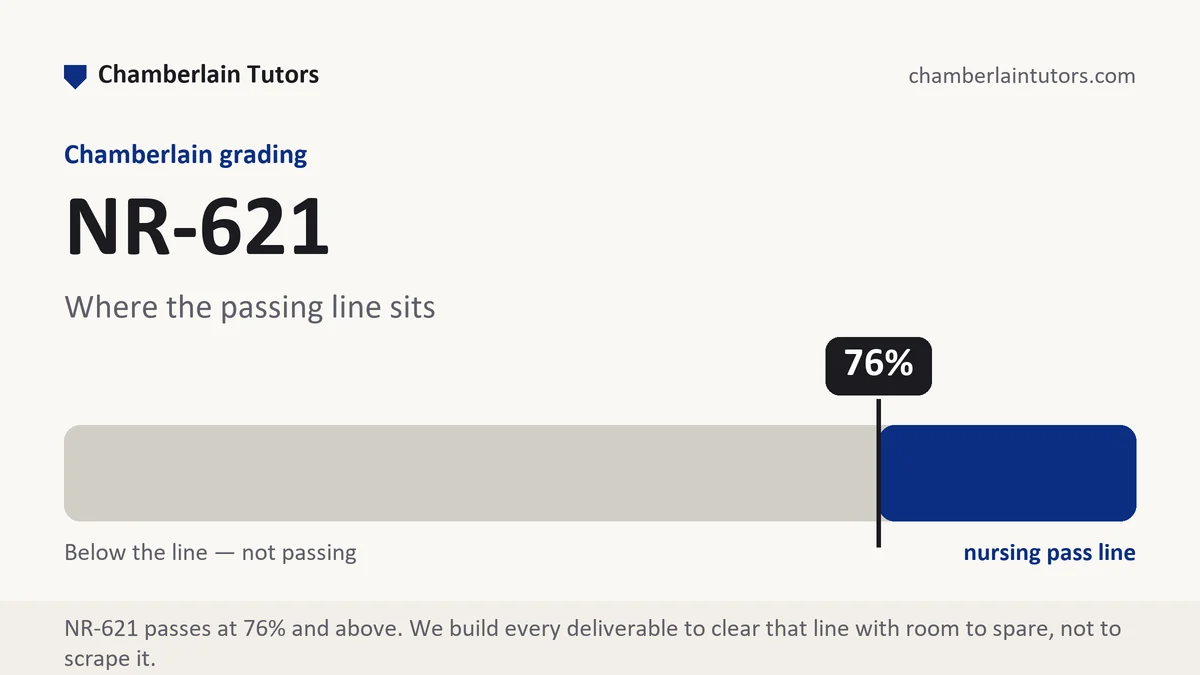
Core nursing courses pass at 76 percent. The specialty scale with no C band applies to nurse practitioner specialty courses, not to this track, so 76 is the number you are protecting. The grade remains a weighted average that supplementary work cannot repair, and in a two course sequence a weak first half also hands you a weaker project to finish.
Sixteen week semesters split into two eight week sessions, up to six starts a year, and something due most weeks. What breaks educator projects is not the writing pace, it is permission. A school or a unit deciding whether a student may teach a session, use a learner group or collect evaluation data can take longer than the session leaves you. Ask in week one, in writing, and draft the sections that need nobody else while you wait.
One more structural fact worth planning around: discussion posts cannot be edited once submitted at Chamberlain. Objectives posted for peer feedback are permanent in the form you posted them, so write them in a document, test each verb against whether you could observe it, and paste once.
Turn the criterion rows into a section plan
Copy the rows into a blank file in printed order and strip each to its verb: assess, describe, formulate, justify, evaluate. Use those as headings and keep the guide's sequence, because a grader scanning for the row they are scoring should find it without searching.
Then turn weights into words. Say the proposal is capped at 1,800 words with five rows weighted 25, 25, 20, 15 and 15 percent. That is 450 words, 450, 360, 270 and 270. The pairing at the top is the warning: in this course the two heaviest rows are usually the needs assessment and the objectives, and objectives look short because they are written as a list. Four objectives take five lines. A 450 word row containing five lines is an under-answered row, and the missing words belong to the paragraph explaining why each objective sits at the level it does and how each will be checked.
Where your guide allows a lesson outline, a table of objectives or an evaluation instrument as an appendix, put them there and spend the prose on justification. Check whether appendices, title page and references sit outside the count before you budget, since education proposals carry more attachments than most papers.
The shape of an education project proposal
Most graded writing here is a proposal for a teaching intervention, whether it appears as a needs assessment, a project plan, a lesson design or a board post defending an approach. These parts recur, and each is one a grader hunts for.
| Part | What it has to establish | How the thin version reads |
|---|---|---|
| The learners, defined | Which group, at which stage, how many, and what they are already expected to be able to do. | Nursing students, or new graduate nurses, with no stage and no number. |
| The gap, evidenced | The specific shortfall with the evidence that revealed it, sourced to data rather than to impression. | A statement that this content is difficult for students. |
| Purpose of the project | One sentence connecting the gap to what your teaching will change, and for whom. | A purpose to improve knowledge and enhance learning. |
| Learning objectives | Observable behavior, conditions and standard, each pitched at the thinking level the gap requires. | Objectives beginning with understand, know or appreciate. |
| Teaching strategy, justified | The method chosen, the alternative rejected, and the reason the choice fits these learners and this gap. | Simulation or a lecture chosen first, then argued for afterwards. |
| Evaluation method | How you will know each objective was met, including the instrument and who administers it. | A promise to evaluate learner satisfaction at the end. |
| Feasibility and approvals | Whose permission is needed, what the session costs in time and space, and the constraint most likely to stop it. | A note that the project will be conducted with faculty support. |
Draft the evaluation method immediately after the objectives, not at the end. If an objective cannot be paired with a way of checking it, the objective is the problem, and fixing it early saves rewriting the whole proposal.
Evidence craft when the literature is nursing education
Education evidence is weaker than clinical evidence and the rows scoring your sources know it. Handling that openly is what separates a graduate proposal from a report of opinions.
- Cite the study, not the textbook chapter. A chapter is where you learn the framework; the finding you are leaning on came from a study, and the study is what a grader expects to see next to a claim about effectiveness.
- Design and sample before the finding. Write that one cohort of 68 prelicensure students at a single school over one term scored higher after the change, then say what changed. Most nursing education research is single site and small, and stating that up front is appraisal rather than weakness.
- Separate self-report from performance. Learners reporting more confidence is not learners performing better, and the two are often measured in the same study. Say which one your source measured, and which one your project will.
- Verbs the design can pay for. Was associated with, followed and reported are honest for pretest posttest work without a control group. Improved and produced belong to controlled designs.
- Denominator and window on every rate. An evaluation completed by 41 of 63 enrolled students in one term is a finding with a response rate. A satisfaction figure of 87 percent with no base and no period is decoration.
- Currency runs on revision cycles. Accreditation documents, program standards and licensure blueprints are revised on schedules, so name the edition year in the sentence and confirm it is the current one before building objectives on it.
What separates a passing proposal from a strong one
A passing NR-621 proposal names a real topic, describes a reasonable teaching plan and finishes with an evaluation. It is pleasant and interchangeable. Read closely, it could be about any content for any learners, and that is what keeps it mid band.
Strong proposals do three visible things. They evidence the gap with something a reader could verify, so the project is answering a problem rather than presenting a preference. They write objectives sharp enough that the evaluation writes itself, which is why strong proposals often have fewer objectives than weak ones. And they defend the teaching strategy against a named alternative, explaining what the rejected method would have cost these learners in this setting. The 76 percent floor leaves room, but the proposal you write here is the thing you have to finish next session, so precision now is worth more than the points.
Six mistakes that cost points here
- Objectives that cannot be observed. Understand, know and appreciate cannot be evaluated, and every later row inherits the problem.
- Choosing the teaching method first. Deciding on simulation and then finding a gap that fits it is visible to graders and undercuts the justification row.
- Confusing evaluating learners with evaluating teaching. One asks whether the learner met the objective, the other whether the session worked. Name which you mean each time.
- Too many objectives. Seven objectives for a one hour session guarantees that most go unevaluated, and unevaluated objectives read as padding.
- Using employer material without checking. Course documents, question banks and orientation packets usually belong to the organization. Ask before reproducing them, and cite what you are permitted to use.
- Describing the role instead of analyzing it. A summary of what your mentor does is not the immersion analysis. Pick decisions, explain the reasoning behind them and say what you would do differently.
Questions NR-621 students ask
How do I write objectives a rubric will accept as measurable?
My mentor's site will not let me teach a live session. Can I still do the project?
Can I build my project on my employer's existing course materials?
Where NR-621 sits in Chamberlain's programs
Open the exact program map for sequence, credit, and option context. The current student schedule and syllabus remain authoritative after transfer evaluation, electives, state rules, and approved plan changes.
The weeks, one by one
Week 1
The opening stage of the nurse educator concluding graduate experience is where a mentored immersion gets planned on paper: what you will observe and do inside the educator role, what scholarly project the immersion will support, and what permissions have to exist before either can happen. Read the full Week 1 manual.
Week 2
An early stage of the educator practicum belongs to the needs assessment: proving, on paper, that a specific group of learners cannot yet do something they are expected to do. Read the full Week 2 manual.
Week 3
Objectives are the technical heart of an education project, and the stage that produces them is where most points are won or lost. Read the full Week 3 manual.
Week 4
Somewhere in the middle of the session the project has to acquire a theoretical and evidentiary spine: a learning theory that explains why your teaching should work on this gap, and a body of education literature that says whether it has worked elsewhere. Read the full Week 4 manual.
Week 5
By the middle of the session the project needs a teaching design and, more importantly, a defence of it. Read the full Week 5 manual.
Week 6
An education project is only as good as its evaluation, and this stage asks how you will know whether learners can now do what they could not before. Read the full Week 6 manual.
Week 7
Late in the practicum the writing turns to the role itself: what you saw an educator actually do, what you did, and what either taught you about the work. Read the full Week 7 manual.
Week 8
The closing stage assembles the parts written across the session into one proposal and prepares it to be carried into the concluding course. Read the full Week 8 manual.