NR-601 sits in Chamberlain's FNP primary-care sequence, on the MSN-FNP path. This is its help page: what the course really grades and how our team carries it, floor check included.
What NR-601 actually grades
The primary-care management sequence begins, adult and older-adult care written as case analyses with guideline-anchored plans. The cases lengthen, the expectations sharpen, and the scale never softens.
How we help in this course
Sequence continuity is the quiet advantage here: the same team drafting 601 through 603 keeps frameworks, terminology, and your voice consistent, so each course inherits the last one's momentum instead of restarting.
Deliverables run the standard promise: a premium original draft in 24 to 48 hours, targeted at the A band of your course's actual scale, through the eight-person pipeline with both QA passes and the floor check, revised free until it lands.
How to write this course's management cases
There is no public NR-601 syllabus to build a week-numbered manual from. Chamberlain keeps course documents inside Canvas, where the scoring guide travels attached to each assignment and gets reweighted from section to section. So this section teaches what does transfer: how an adult and older adult management case is planned, built, defended and checked before it goes in. Put your own guide beside the outline below. Any row your guide names that this page does not mention is the row you should draft first, because it is the one nobody warned you about.
In NR-601 right now?
Send the week and the rubric from Canvas. First premium sample free, floor-checked, back in 24 to 48 hours.
Opening the management sequence without surrendering points
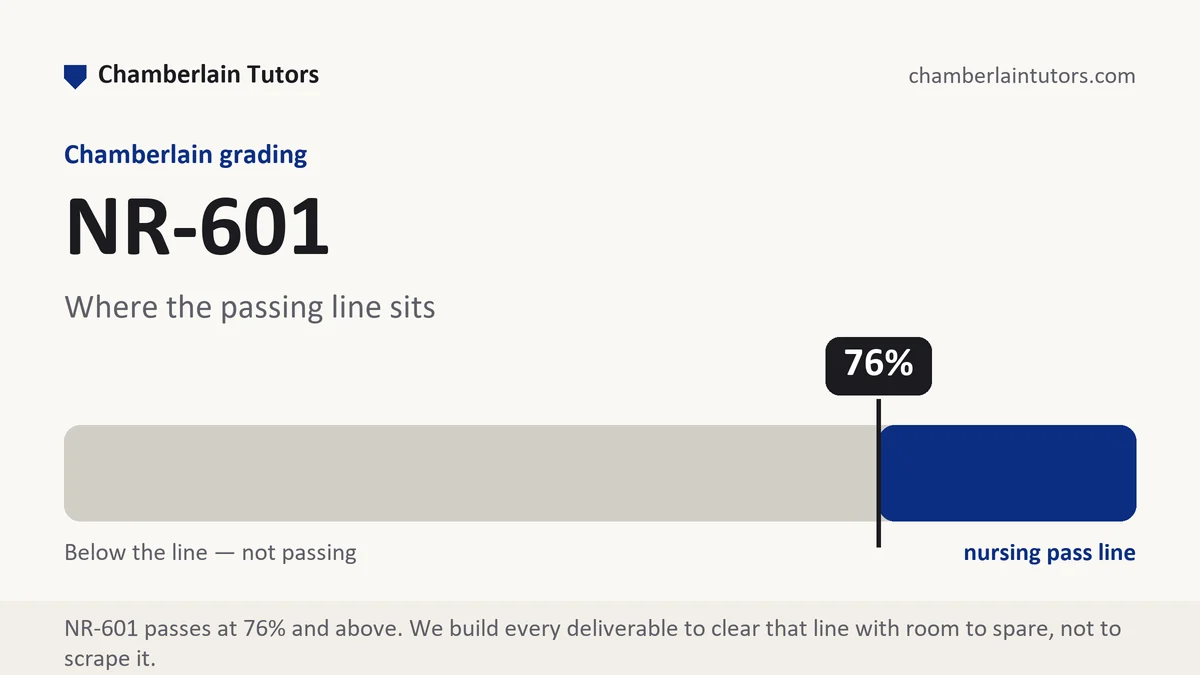
NR-601 begins the primary-care management run, and its early weeks set the pattern the next two courses inherit: case analyses that lengthen, guideline-anchored plans that sharpen, a scale that never softens below its 84 line. The desk's play here is deliberate continuity, the same team drafting from the sequence's first case so frameworks, terminology, and your voice stay consistent through 603 instead of resetting each session.
How a management case earns its grade under the rules
The rubric rows want the workup shown and the plan defended, and the scale prices any shortcut severely: there is no C band to absorb a summary-voiced case, no curve, no extra credit, and a failure spends one of the two lives the dismissal rule counts. So each draft carries its reasoning openly, cites current guidelines, and clears the floor check against the 94-plus band before delivery, inside the standard 24 to 48 hours.
Does starting help in 601 lock me into ordering every week?
No. Plenty of clients order the heavy weeks and self-write the rest; the walkthroughs are designed to make that graduation happen, not prevent it. Order shape stays yours, week to week.
What arrives with the free first case draft?
The complete premium draft plus a walkthrough of how it earns each rubric row, pre-scored on the specialty scale, delivered ahead of your Mountain-Time deadline. Read it against the rubric yourself; the case for the desk should survive your own audit or it is not a case.
Turn the criterion rows into a word budget
Open the scoring guide before the case materials. Read it once for content and a second time only for weights, because those two readings produce different plans. Then build your outline out of the rows themselves, using the row's own wording as your heading. Graders scan for the row they are scoring, and a paper organized by the rubric is easier to score generously than one organized by narrative.
Weight becomes length by simple multiplication. Suppose your guide carries five rows weighted 30, 25, 20, 15 and 10, and the case runs to 2,000 words. The budget is roughly 600, 500, 400, 300 and 200 words. A 300 word row is about a page double spaced, so if your plan for that row is three bullet points, the row is under-planned and will score in the middle band by default. Your own guide will split differently; run the same multiplication on it.
One trap is specific to management rubrics: two rows that sound alike, one asking for the plan and one asking for the justification of the plan. Writing a superb plan once answers one row and leaves the other empty. Give each its own heading, and put the heaviest row first in your drafting order while your attention is still fresh.
The shape of an adult and older adult case
Most graded writing in NR-601 is a management case: a patient, a set of active problems, and a defended plan. These are the parts that rubric rows tend to sit on.
| Section | What you write | What the grader is checking |
|---|---|---|
| Snapshot and problem list | Age, pertinent history, and the active problems in priority order with the reason for that order stated | That you can triage. A list in chart order is not a problem list. |
| Data that anchors the case | Baselines, vitals, functional and cognitive status, living situation and support, current medicines with doses | That the plan will rest on data. Missing baselines are where the later rows collapse. |
| Assessment of each problem | Severity or stage, controlled or not, and where this patient falls inside the category the evidence describes | That you can tell controlled from uncontrolled and act on the difference. |
| Plan, problem by problem | Nonpharmacologic and pharmacologic steps, each with the reason it was chosen over the alternative you rejected | That the plan was reasoned rather than defaulted. Naming and rejecting an alternative is top-band behavior. |
| Medicine review | Reconciliation, interactions, renal and hepatic dosing questions, and anything you would stop, reduce or replace, with reasons | That you treat the existing list as part of the problem instead of as background furniture. |
| Monitoring and escalation | What gets rechecked, at what interval, and which result would change the plan or trigger referral | That the plan has a future. Undated follow-up reads as a plan with no owner. |
Older adult cases fail in a predictable way: the writer builds an excellent plan for a healthy forty year old and attaches it to a patient with four conditions, eight medicines and a fall history. Every row above exists to stop that. One practical order of work: draft the assessment and plan first, then write the snapshot last, since the snapshot only becomes accurate once you know which problem ended up driving the case.
Evidence craft when the patient is older
Say the design and the sample before you say the finding. A randomized trial in adults under seventy-five with a single condition and a registry of multimorbid patients support different claims, and the sentence that names the enrolled population is the sentence that earns the evidence row.
When your patient sits outside that enrolled population, write it down. Naming the gap and explaining why the extrapolation is still reasonable is graduate reasoning; extrapolating silently is what gets marked. Give absolute numbers alongside relative ones, because a thirty percent reduction means nothing without the baseline risk and the follow-up window it was measured over.
Watch the verb and the denominator. Cohort and registry data support was associated with; only randomized designs support reduced or prevented. Any rate you quote needs how many out of how many, over what period, in which population. Screening and treatment recommendations carry versions, so name the year in the sentence and check that the edition you are citing has not been superseded.
Passing versus strong in a management case
A passing NR-601 case gives every active problem a plan, and the plan is safe. A strong one ranks the problems against each other and says why, reconciles the medicine list instead of reprinting it, raises at least one question about stopping or reducing something, defends each choice against the option it displaced, dates every recheck, and states the result that would force a change.
The scale rewards that gap. On the specialty ladder there is no C band, so 84 is the first passing number, and the grade is a weighted average rather than a count of submissions. Heavy rows deserve most of your drafting hours, and supplementary work cannot repair an average built from middle-band cases.
Where points leak in this course
- A problem list that grows but never ranks. Six problems in the order the chart listed them tells the grader nothing about your judgment.
- A medicine list copied rather than reviewed. The list is background; the reconciliation is the graded work.
- Silent extrapolation. Applying a trial to a patient the trial excluded, without a sentence acknowledging it.
- Relative risk with no absolute number. Percentages without baselines and windows read as marketing rather than appraisal.
- Follow-up with no date and no trigger. Recheck in the future is not a monitoring plan.
- Writing to the middle band. Describing what is usually done, where the row asked you to defend what you chose.
Three questions NR-601 students send
How do I write about a patient the research excluded?
How detailed does the medication section need to be?
My weighted average is under 84 with a few weeks left. What now?
The weeks, one by one
Week 1
NR-601 Week 1 sets the baseline the rest of the session will manage against. Read the full Week 1 manual.
Week 2
NR-601 Week 2 opens the chronic disease run with the condition most of your panel will carry. Read the full Week 2 manual.
Week 3
NR-601 Week 3 takes on the condition where tighter is not automatically better. Read the full Week 3 manual.
Week 4
NR-601 Week 4 works the chronic breathlessness that fills middle-aged and older primary care panels. Read the full Week 4 manual.
Week 5
NR-601 Week 5 works the cluster that decides whether an older adult keeps their independence. Read the full Week 5 manual.
Week 6
NR-601 Week 6 handles the three conditions that get mistaken for one another more than any others on an older adult panel. Read the full Week 6 manual.
Week 7
NR-601 Week 7 turns the whole medicine list into the clinical problem. Read the full Week 7 manual.
Week 8
NR-601 Week 8 closes the session with the patient no single guideline was written for. Read the full Week 8 manual.
Where NR-601 sits in Chamberlain's programs
Open the exact program map for sequence, credit, and option context. The current student schedule and syllabus remain authoritative after transfer evaluation, electives, state rules, and approved plan changes.