NR-601 Week 8 closes the session with the patient no single guideline was written for. The territory is multimorbidity and goals of care: five conditions whose recommendations collide, a family carrying part of the load, and a plan built around what the patient says matters rather than around what each guideline demands separately. Your section may print this as NR 601 or NR601; it is the same course. Chamberlain publishes no syllabi outside Canvas. The placement here is our teaching judgment from the course's catalog arc; your section's rubric decides what your week actually asks.
Final weeks of an eight-week session run short, and deadlines often fall earlier in the week than students expect, so build in a day. The scope line one last time: the coursework is ours to draft and revise with you, and every practicum hour, evaluation and site signature stays where it belongs, with you and your preceptor.
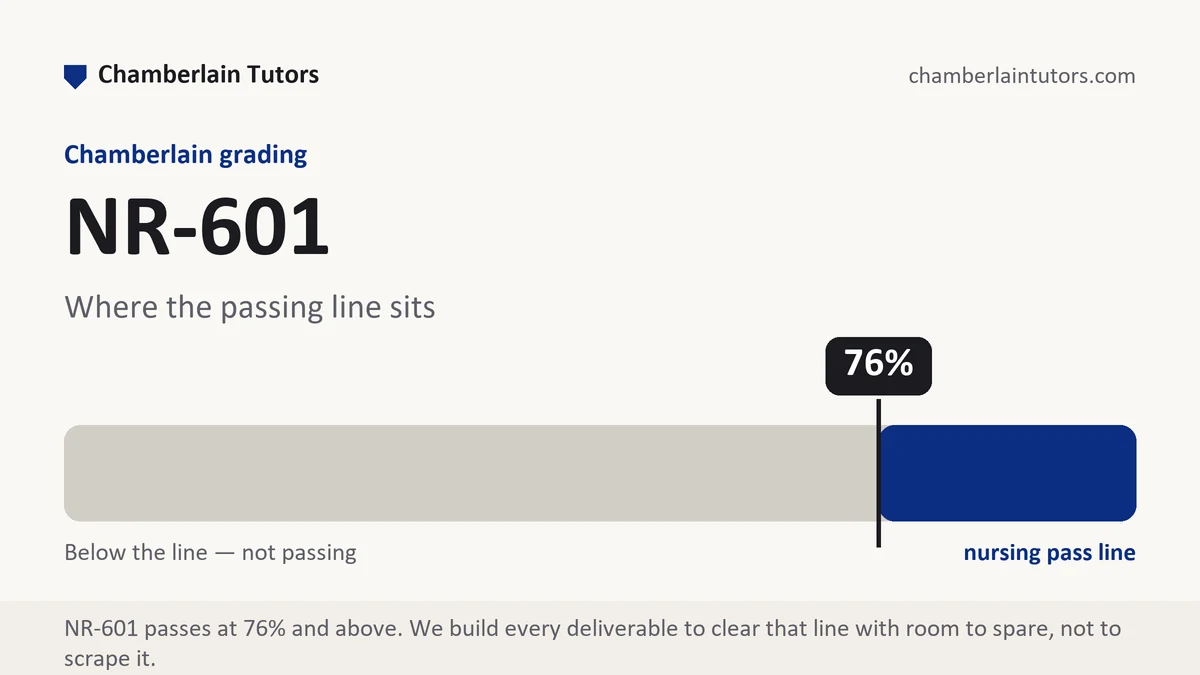
What NR-601 Week 8 asks for
Expect the territory to gather the session into one patient: several chronic conditions interacting, guidance that conflicts when applied at once, treatment burden counted as a harm in its own right, priorities set with the patient rather than for them, the family unit as both resource and stressor, care coordination across specialists, transitions after a hospital stay, advance care planning and the naming of a decision maker, and the point at which comfort and function outrank disease targets.
Written shapes at this stage commonly include a synthesis case managing one complex older patient across every problem, a paper on reconciling conflicting recommendations for a specific combination of conditions, or a goals of care write-up that documents a conversation and the plan that followed from it. If your section runs a discussion this week, it often asks which recommendation you would drop first when two guidelines disagree.
What separates the top band is the willingness to choose. A paper that applies every guideline fully to a patient who cannot absorb them all has avoided the decision the week exists to teach.
The NR-601 Week 8 method, step by step
Six moves for writing a plan that fits one whole person.
-
Ask what the patient is optimizing for
Independence, staying at home, a specific event to reach, comfort, or keeping a role in the family. Write it in their words near the top, because every trade-off later in the paper gets judged against that statement.
-
Rank the conditions against each other
Which problem threatens the stated goal soonest, and which one is currently causing the most symptom burden. A problem list in chart order tells a grader nothing; a ranked list with the ranking defended tells them everything.
-
Find the collisions and name them
Where one condition's recommended therapy worsens another, where two guidelines both claim priority, where a target for one measure raises risk for a different problem. Naming the collision is the paragraph the whole paper is built to reach.
-
Count the treatment burden
Appointments per month, doses per day, tests per quarter, transport required, and hours of family time consumed. Burden is a harm, and totaling it turns an intuition about too much into an argument a rubric can score.
-
Decide, then say what you gave up
Choose the priority, state the recommendation you are relaxing, and name the risk you accepted by relaxing it. That sentence is the highest-scoring sentence available in this territory, and most papers never write it.
-
Document the planning conversation and the handoffs
Who the decision maker is, what was discussed and agreed, what other clinicians need to know, and what happens at the next transition. Then format: current APA, headings in your rubric's wording, and references checked one to one against citations.
A multimorbidity synthesis case, section by section
Targets assume a closing case near 1,700 words. Rescale to your prompt, and let the collision and decision blocks carry the most weight whatever the total.
| Section | What belongs there | Word target |
|---|---|---|
| Patient and stated goal | Situation, support, and what the patient says they are trying to protect, in their words | 190 to 230 |
| Ranked problem list | Every active condition ordered by threat to the stated goal, with the ranking defended | 280 to 340 |
| Collisions between recommendations | Each conflict named, with what each guidance says and why they cannot both be followed here | 340 to 400 |
| Treatment burden count | Doses, visits, tests and transport totaled, with the family hours it consumes | 200 to 250 |
| The decision | What you prioritized, what you relaxed, the risk accepted, and how it will be watched | 320 to 380 |
| Planning, coordination and transitions | Decision maker named, conversation documented, specialist coordination, and the plan for the next transition | 280 to 340 |
A useful drafting order for this one: write the decision block first, then build the ranked list and the collisions backward from it. The paper reads as an argument that way rather than as a survey that eventually reaches a conclusion.
Citing evidence for patients no trial enrolled
Complex older patients are systematically excluded from the trials that generate the recommendations applied to them, so this is the week to say that out loud. When you cite, name the enrolled population and the exclusions, then write the sentence that acknowledges your patient would not have qualified and explains why the finding still informs the decision or why it does not.
Prefer sources that address the interaction. Guidance written for a single condition rarely tells you what to do when two conditions collide, while work on multimorbidity, treatment burden and shared decision making speaks to exactly that problem. Citing the right kind of source is half the evidence row in this territory.
Keep numbers usable and verbs matched to designs. Absolute benefit with its follow-up window, denominators behind every rate, was associated with for observational work and reduced only where a design assigned the intervention. Where a professional body publishes current guidance on advance care planning or on managing multiple chronic conditions in older adults, cite the current edition with its year inside your own sentence.
Five mistakes that cost points in a closing week
- Every guideline applied in full. A plan that follows all recommendations for all conditions is a plan no patient could carry out.
- No stated goal from the patient. Without it, none of the trade-offs in the paper can be defended against anything.
- Collisions smoothed over. Writing each condition separately so that no conflict ever surfaces avoids the entire point of the week.
- Burden never counted. Treatment burden asserted as heavy rather than totaled in doses, visits and hours.
- Advance planning reduced to a form. Naming a document without documenting a conversation misses what the row is scoring.
Before you submit
- The patient's own goal appears near the top in their words
- The problem list is ranked and the ranking is defended
- At least two collisions between recommendations are named explicitly
- Treatment burden is counted in doses, visits, tests and family hours
- The decision states what was relaxed and what risk was accepted
- A decision maker is named and the planning conversation is documented
Closing case and a short week?
Send the prompt and the rubric from Canvas. An original draft returns inside 24 to 48 hours with the collisions named and the trade-off decided in the text.