NR-588AI is the artificial intelligence concentration version of the complex systems leadership course, four theory credits with no practicum. The subject is what happens when an algorithmic tool spans organizations: a model built on one system's patients running at another, information crossing legal boundaries, and an outcome that several parties can influence but none of them owns.
What NR-588AI actually grades
Everything difficult about algorithmic tools gets harder at the boundary. A model that performs well where it was built can degrade at a partner site whose patients, coding habits and documentation practices differ. Data that may be used for care inside one organization may not automatically be used to train or run a tool for another. And when the output is wrong, the question of who answers has more than one plausible answer, which in practice often means nobody does.
The rubric rows reward writing that settles those questions in advance. Which party validates performance and how often. Which population the figures are reported for. What happens when the vendor updates the model. What each organization is permitted to do with the data it receives, and what it must delete. Papers that discuss governance as a value rather than as a set of commitments have very little for those rows to score.
Equity is graded at system scale here rather than at the level of an individual encounter. A tool that performs worse for a group concentrated at one partner site produces unequal care across the system even when each site's own numbers look acceptable. Noticing that is one of the strongest moves available in this course.
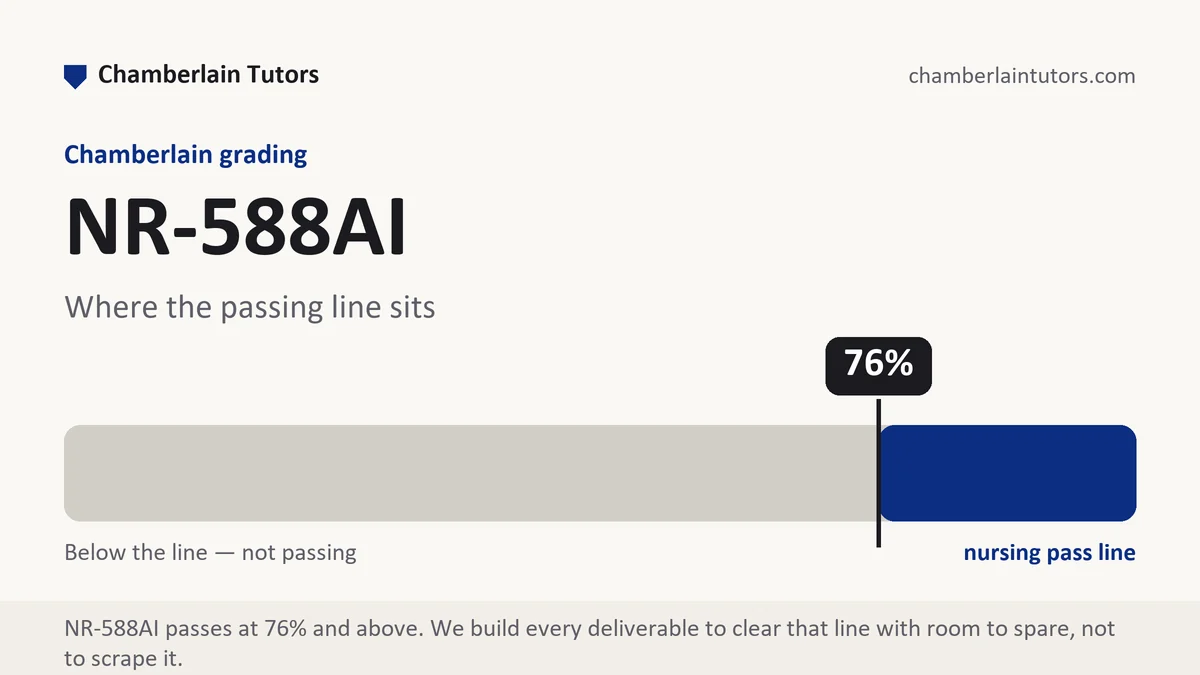
At four credits inside an eight-week session, plan the first week carefully. Chamberlain's floor in core nursing courses is 76, and supplementary work cannot rescue a weak weighted average.
How we help in this course
Send the prompt and the rubric from Canvas plus the arrangement you want to analyze: two organizations sharing a predictive tool, a vendor model deployed across several sites, a regional programme using pooled data, or a partner service whose triage decisions your patients inherit. We build the draft as a set of commitments with owners and intervals rather than as a discussion of principles.
We keep every organization in the paper described by type and relationship rather than by name, and we mark clearly which arrangements are proposed rather than in force, which is what these rubrics expect and what keeps the paper safe to submit.
Writing the governance framework?
Send the rubric and the arrangement you have in mind. We will scope the commitments today.
Read the rubric before the prompt
Read the rows looking for two words in particular: across and accountability. Rows containing either one cannot be satisfied by describing a tool, however thoroughly. They need a named party, an obligation and a consequence for not meeting it. Mark those rows first and let them determine your structure.
Then price the sections. A 3,000-word cap with rows weighted 35, 25, 25 and 15 percent gives 1,050, 750, 750 and 450 words. A thousand-word section is a real piece of writing, and in this course it usually belongs to the systems analysis or the governance framework rather than to the technology description. If your outline gives the largest share to explaining what the tool does, the paper is built upside down.
Hold back roughly a hundred words for the exit provision. What happens to the arrangement, and to the data inside it, when one party withdraws or the tool is retired. It is almost never in student drafts and it is exactly the kind of clause that reads as governance rather than enthusiasm.
The commitments of a cross-system framework
The dominant deliverable is a framework several organizations could actually sign. Each commitment closes a dispute that would otherwise happen later.
| Commitment | What it must fix | The version that settles nothing |
|---|---|---|
| Purpose and scope | The clinical decision the tool supports, at which sites, for which patients. | A broad statement about improving care across the network. |
| Data authority | What information moves between parties, on what legal basis, and what may not be reused. | An assumption that partners may share whatever the tool needs. |
| Provenance of the model | Whose patients it was built on, in what years, and how those differ from each receiving site. | Performance quoted with no mention of where it came from. |
| Local validation | Who measures performance at each site before go-live, on how many cases, and what result blocks deployment. | A single system-wide figure accepted everywhere. |
| Subgroup reporting | Which groups are reported separately, at what interval, and what gap triggers action. | A commitment to monitor for bias, unscheduled. |
| Change control | What happens when the vendor updates the model, who is told, and whether validation repeats. | Silence, so a silent update changes clinical behaviour unannounced. |
| Accountability | Which party answers for harm following the output, and what documentation supports each clinician's decision. | Shared responsibility, which in practice means none. |
| Exit and data return | What ends, what is deleted or returned, and how patients under the tool are handled during wind-down. | No provision at all, as though arrangements do not end. |
Evidence craft when a model crosses a boundary
The technical content you need is small, specific and easy to get wrong.
Performance is site-dependent. The same model applied where a condition is rarer will produce more false alarms per true case, even with identical accuracy. Say what the frequency is at each site rather than quoting one figure for the network.
Multi-site validation is the evidence that matters. A tool tested at several independent sites has shown it can travel. One tested only where it was developed has not. Where multi-site evidence does not exist, report that absence as a finding and let it drive your local validation clause.
Verbs the design can pay for. Retrospective and observational deployment studies support "was associated with" and "was followed by". Prospective controlled evaluations support "reduced". Vendor material supports claims about intent, never results.
Every rate keeps its denominator and window. "Across the three partner sites the tool flagged 2,050 of 26,400 encounters in six months, and at the smallest site fewer than 1 in 10 flags preceded the outcome" is a sentence a governance committee could act on. "Alert performance varied" is not, and the difference is usually a whole rubric row.
Passing and strong in a cross-system course
A passing paper is current and abstract. It surveys the governance conversation, cites recent sources, and concludes that oversight, transparency and accountability are needed when these tools are used across organizations. Nobody could disagree, and nobody could implement it.
The quickest diagnostic is the verb count. Weak drafts are full of should, must and needs to. Strong ones are full of will, within and reports to, because those are the words obligations are written in. Rewriting three sentences from the first form into the second usually exposes what is still undecided, which is the material the governance rows are waiting for.
A strong paper writes the arrangement. It names parties by role, gives each an obligation, attaches an interval to every monitoring promise, and specifies what happens when the obligation is missed. It notices that a model good enough for the largest partner may be unsafe at the smallest, and says who is empowered to stop the deployment there. It handles the vendor as a party with its own interests rather than as a supplier of truth. And it plans for the arrangement ending, which is the clearest signal in this literature that the author has thought past the launch.
Six habits that cost marks in NR-588AI
- Writing about the technology rather than the arrangement. The rows here are about parties and obligations, not about what a model can do.
- One performance figure for a whole network. Different sites have different populations, and a single number conceals exactly what the paper is meant to surface.
- No change control. An updated model is a new tool. A framework that does not notice updates has no control over what clinicians are shown.
- Data sharing assumed. Say on what authority information crosses the boundary and what the receiving party may not do with it.
- Accountability spread evenly. Shared responsibility with no named party is the version that fails in the first serious incident.
- Posting an unfinished discussion response. Posts do not reopen once submitted at Chamberlain, so draft it elsewhere and paste once.
Questions NR-588AI students ask
I cannot see any real contracts. How do I write the governance sections?
The partner organizations use different record systems. Does that break the analysis?
How is this different from the earlier artificial intelligence leadership course?
Where NR-588AI sits in Chamberlain's programs
Open the exact program map for sequence, credit, and option context. The current student schedule and syllabus remain authoritative after transfer evaluation, electives, state rules, and approved plan changes.
The weeks, one by one
Week 1
Ask a director of nursing in a skilled facility how many algorithms are running in the building and the honest answer is usually that nobody has counted. Read the full Week 1 manual.
Week 2
A post-acute network agrees to receive a nightly file from an acute partner so that a placement model can rank incoming referrals. Read the full Week 2 manual.
Week 3
A model that predicts which residents need extra clinical attention is built on prior utilization, because utilization is easy to extract and correlates with illness. Read the full Week 3 manual.
Week 4
A supplier's summary sheet reports that its deterioration model discriminates well, cites a single figure with two decimal places, and does not say which patients it was tested on, whether the test data came from the same institution that supplied the training data, or how many of the people it. Read the full Week 4 manual.
Week 5
A deterioration score turns a resident's name amber on a dashboard at 02:40. Read the full Week 5 manual.
Week 6
A resident with a low predicted risk score is not placed on the enhanced monitoring list, deteriorates overnight and is transferred in the morning. Read the full Week 6 manual.
Week 7
An upstream partner changes the assessment template so that a functional status item is now captured as a dropdown rather than free text. Read the full Week 7 manual.
Week 8
Picture the room the finished framework has to survive. Read the full Week 8 manual.