Picture the room the finished framework has to survive. A joint oversight group with a clinical lead from each organization, somebody from contracting, somebody from information security, an account representative for the supplier and a nurse executive who will be asked to sign. They will not evaluate your scholarship. They will look for the sentences that commit their own organization to something, and they will negotiate those. NR-588AI Week 8 usually asks for the academic synthesis and the version that room could act on, plus an honest account of what the framework cannot do. Your section may print this as NR 588AI or NR588AI; it is the same course. Chamberlain publishes no syllabi outside Canvas. The placement here is our teaching judgment from the course's catalog arc; your section's rubric decides what your week actually asks.
What NR-588AI Week 8 asks for
The closing stage of an eight-week graduate session usually carries the heaviest single deliverable, and in this concentration it is a governance framework assembled from everything the session has built: the inventory, the data provisions, the equity audit, the validation appraisal, the workflow design, the accountability allocation and the monitoring plan. The common failure is not weak content but weak assembly, and rubrics at this stage often carry a coherence or integration row that finds it immediately.
A framework is a different genre from a paper, and knowing the difference is much of the grade. A paper argues; a framework commits. Every provision should be readable as an obligation with a party, an action, an interval and a consequence, and the surrounding prose exists to justify why each obligation is there. Students who write a good essay about responsible artificial intelligence and append a list of principles have produced something no committee could adopt.
Synthesis means the parts explain each other. The equity audit is the reason subgroup reporting appears in the monitoring section. The validation appraisal is the reason local revalidation is required before deployment. The workflow analysis is the reason the accountability section assigns the override review to a role who actually sees the alerts. One sentence at each junction converts seven components into one document.
The limits paragraph is where graduate judgment shows most clearly. A governance framework does not make a model accurate, it makes its behavior visible and its consequences owned. Saying that plainly, and naming what would still go wrong under your framework, is a stronger close than any assurance of safe and ethical use. It is also the paragraph that distinguishes a leader who has thought about implementation from one who has written a wish list.
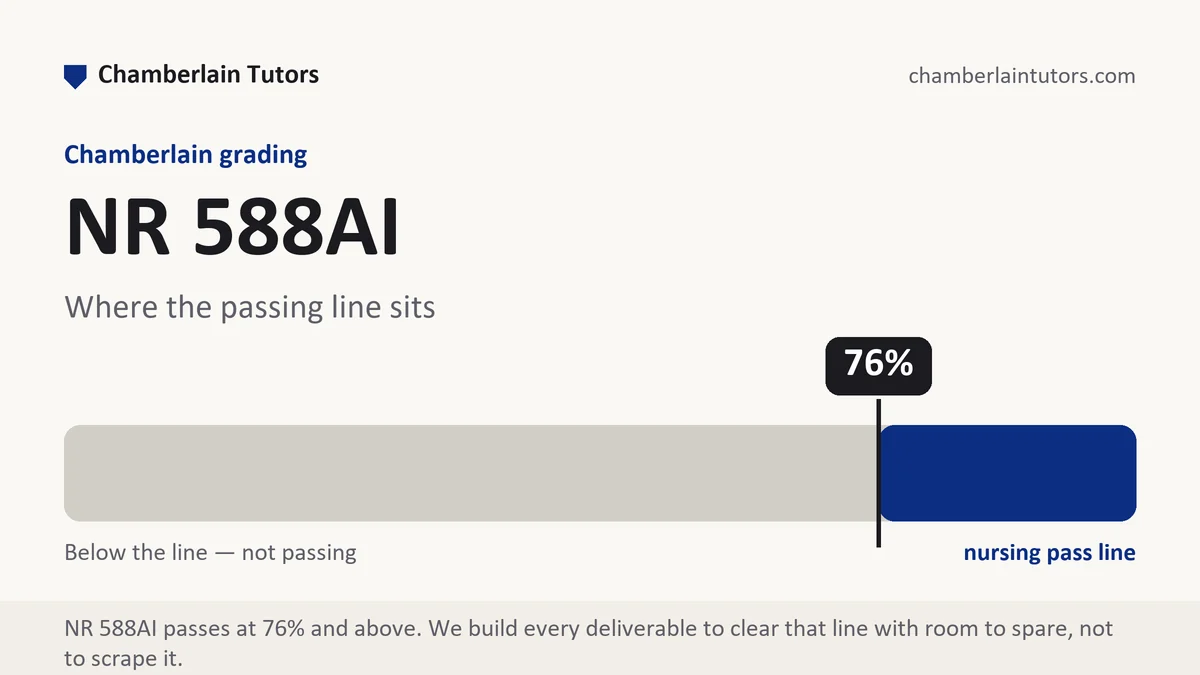
Two practical notes about closing stages. The word budget is most often blown here, because every earlier component wants to be included in full; the fix is a hard cut against your rubric's weights rather than an even trim across sections. And since this is the last score in the session, the 76 percent floor arithmetic is now fully visible, so check what you actually need from this submission before deciding how much of your remaining time it deserves.
The NR-588AI Week 8 method, step by step
Six moves for assembling a governance framework that could be adopted rather than admired.
-
Convert rubric weights into words before you assemble anything
A 3,000-word cap with rows at 35, 25, 25 and 15 percent gives 1,050, 750, 750 and 450. If your draft spends its largest section explaining what the technology does, the document is built upside down, and sentence-level editing will not repair it.
-
Rewrite every provision as party, action, interval, consequence
Go through the draft and test each commitment against those four fields. Anything missing a field is a value rather than a provision. This single pass usually removes more weak sentences than any other edit available at this stage.
-
Write the joins between components
One sentence at each seam saying why the next section follows from the last: because the model was validated only internally, deployment is conditioned on local validation; because the outputs reach staff who cannot act unilaterally, the escalation provision names an external contact and a window.
-
Cut background hard and keep commitments
Everything a reader needs to follow the argument stays. Everything that proves you did the reading goes. In this course the material to sacrifice is almost always the general discussion of artificial intelligence in health care, which by the closing stage the reader has accepted several times over.
-
Add the exit provision
What happens to the arrangement, the data and the outputs already recorded when the tool is retired, the supplier is replaced or one party withdraws. Hold roughly a hundred words for it. It is almost never in student drafts and it is exactly the clause that reads as governance rather than enthusiasm.
-
Produce the decision version and run the mechanical pass last
Two pages leading with the ask, the obligations each party takes on, the cost and the risk of doing nothing. Then check citations both directions, headings, tables, model version references, de-identification and the conditional language marking everything proposed as proposed.
A layout and word budget for a closing governance framework
Our frame for a final synthesis, sized for roughly 2,500 to 3,000 words with a separate two-page decision version. It is our own outline rather than anything the university issues, and your week's rubric outranks it wherever the two disagree.
| Section | What belongs in it | Word target |
|---|---|---|
| Scope and purpose | Which tool, which decision, which sites, which residents, and what the framework does and does not cover. | 230 to 290 |
| Data provisions | Flows, purposes, minimization, reuse prohibitions, retention and destruction, each with an owner. | 400 to 480 |
| Validation and equity | Local validation before go-live, subgroup reporting, intervals, and the gap that blocks deployment. | 450 to 550 |
| Use and accountability | Influence level, response path, override design, documentation and the four assigned roles. | 450 to 550 |
| Monitoring and change control | Monitored quantities, notice obligations, change categories and what a material change triggers. | 400 to 480 |
| Limits and exit | What the framework cannot prevent, and what happens on withdrawal, replacement or retirement. | 250 to 320 |
| Decision version, separately | Ask, obligations per party, cost, risk of inaction, decision date, with the evidence in a table. | 500 to 700 |
Evidence craft for a closing synthesis
Every claim in the conclusion must already exist in the body. Closing sections attract new assertions because the writer thought of something in the last hour, and anything appearing first in a conclusion is unsupported by construction. Graders in this territory look there first.
Keep performance figures in the same units and with the same bases throughout. A discrimination figure quoted in the appraisal section should appear identically in the framework, with the same population attached. Numbers that drift as a long document proceeds are checkable and expensive.
Check the version and year on every standard and framework at the end. Guidance in this field is revised quickly, and a synthesis assembled across seven weeks of drafting can easily carry a reference that has been superseded since you first cited it.
State what the framework cannot achieve. It cannot make a proprietary model transparent, cannot guarantee a supplier's cooperation and cannot substitute for clinical judgment at two in the morning. Naming those limits with the compensating controls beside them is stronger than any assurance of responsible use.
Mark the boundary between what exists and what you recommend one final time. This is the document most likely to be read by someone outside your course. Present tense for the current arrangement, explicit conditional language for every proposal, and every organization, supplier and resident de-identified throughout.
Five mistakes that cost points in this week's territory
- Principles in place of provisions. A framework whose sections announce values rather than obligations cannot be adopted by anybody and cannot be scored against accountability rows.
- Components stapled together. Seven sections in sequence with no joins is the failure this stage exists to test.
- Background consuming the budget. Six hundred words re-establishing that artificial intelligence is transforming health care come directly out of the sections carrying the most weight.
- No exit provision. A framework that assumes the arrangement is permanent has not addressed the moment when the data and the recorded outputs need a destination.
- A decision version that is just a shorter paper. Committees act on asks, obligations and costs; a condensed academic argument does not translate and will not be signed.
Before you submit
- Each section is sized against its rubric weight rather than by how much you enjoyed writing it
- Every provision carries a party, an action, an interval and a consequence
- A join sentence connects each component to the one before it
- No claim appears for the first time in the conclusion
- The limits paragraph names what the framework cannot prevent
- An exit provision covers withdrawal, replacement and retirement
- Citations match both directions and every proposed element is still marked as proposed
Assembling the final NR-588AI framework?
Send the rubric, the cap and whatever you have from earlier weeks. A premium original draft comes back in 24 to 48 hours with every provision carrying an owner and an interval, the components joined and a decision version attached, and revisions run until the grade lands.