NR-586 is three theory credits covering epidemiological and population health principles, and it extends into disaster response and recovery from local to global scale. The writing is quantitative in a specific, modest way: nothing advanced, but every claim has to arrive with a denominator, a population and a time window attached, and preparedness sections have to survive being read by someone who has run an incident.
What NR-586 actually grades
Epidemiology is a discipline of definitions. Before a number exists, someone had to decide what counts as a case, who belongs to the population at risk, and over what period the counting runs. Rubric rows in this course reward writing that shows those decisions rather than hiding them, and they penalize confident numbers whose origin cannot be traced.
The disaster material adds a different pressure. Preparedness writing has an emotional pull toward narrative, and narrative is not what the rows are scoring. What is being scored is whether you can characterize a hazard, identify who is most exposed and least able to leave, describe how information would flow, and say what recovery costs after the news crews go home. Recovery is the phase students underwrite most often, and it is usually the phase the rubric treats most seriously.
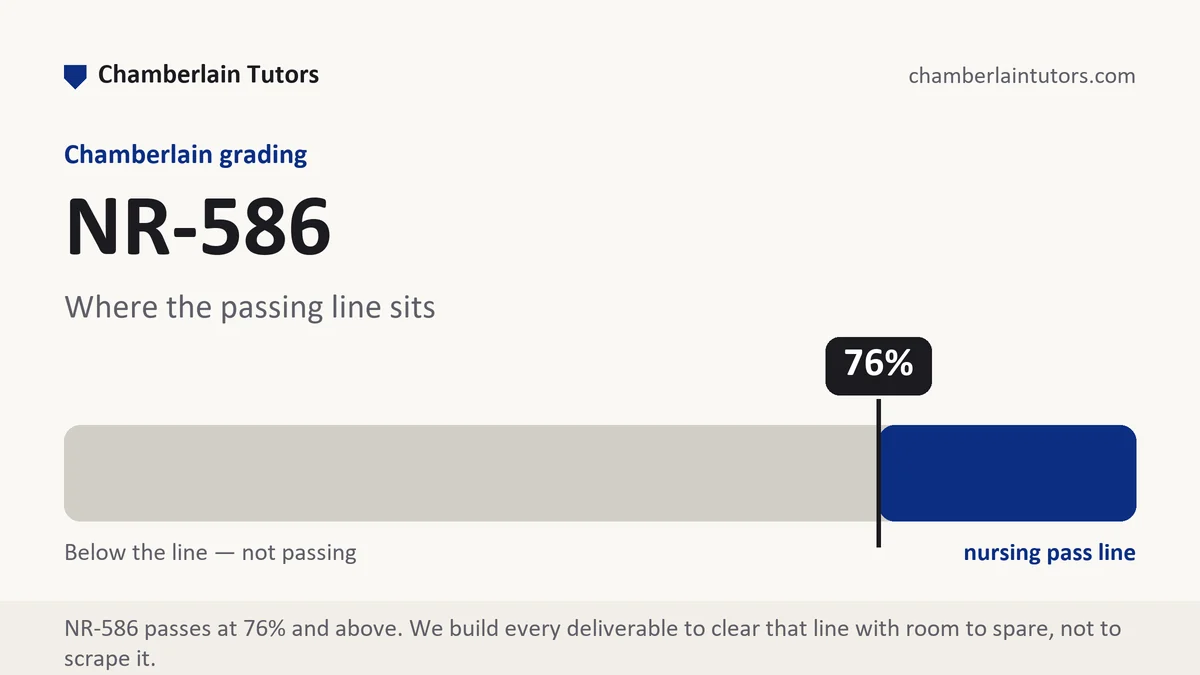
There is also a scale question running through the course. Local, regional and global framings use different data with different reliability, and moving between them without saying so weakens an otherwise good analysis. Chamberlain passes core nursing courses at 76, while nurse practitioner specialty sections run a scale with no C in it at all, which puts the last passing number at 84 for those students.
How we help in this course
Send the prompt and the rubric from Canvas with the hazard or the population you have in mind, plus the geography you want to work in. Geography drives the data available, and choosing a scale where public figures exist is the difference between an analysis and a set of assertions. We build the draft with sourced numbers, defined denominators and a preparedness section that names who acts.
If your section is working on a communicable disease topic rather than a disaster topic, the same discipline applies and we approach it the same way, starting from the case definition and building outward.
Working the preparedness piece?
Send the rubric and your hazard or population. We will find the data and scope the analysis today.
Read the rubric before the prompt
Population health rubrics tend to hide their difficulty in mild verbs. Analyze means compare against something. Examine means take apart into components. Evaluate means reach a judgment and defend it. Copy the rows into a blank document, translate each verb into its operation, and note which rows require a number to be satisfied. Those rows cannot be filled with prose and should be planned around the data you can actually find.
Then set the budget. Take a 1,500-word cap with four rows weighted 35, 25, 25 and 15 percent, which allocates 525, 375, 375 and 225 words. Do the data hunting before you commit to that plan, because a 525-word row resting on a figure that turns out not to exist is a rewrite rather than an edit. One hour spent locating three usable public figures is the best-spent hour in this assignment.
Where a table or a small figure is permitted, use it. A table of rates by subgroup carries what would otherwise be 200 words of comparison and leaves the prose free to explain why the difference exists.
The phases of a preparedness and recovery analysis
The dominant deliverable here runs from a hazard to a plan and then past it into recovery. Each phase answers a question the next one assumes.
| Phase | What it must establish | The thin version |
|---|---|---|
| Hazard characterized | What the event is, how often it occurs in this area, and what it does to health specifically. | A description of the event with no frequency or health pathway. |
| Population at risk | Who lives in the affected area, in numbers, with the subgroups that cannot easily evacuate identified. | A reference to the community, undefined and uncounted. |
| Vulnerability analysis | Why exposure and consequence fall unevenly: mobility, income, housing, language, dependence on power or dialysis. | A statement that vulnerable populations are disproportionately affected. |
| Case definition and surveillance | What would be counted, by whom, how quickly, and what the reporting delay would be. | An assumption that cases would be known as they happen. |
| Response capacity | What exists now in beds, staff, supplies and transport, against the demand the hazard would create. | A list of agencies with no capacity numbers attached. |
| Communication | How information reaches people who do not share the dominant language or trust official channels. | A plan to issue public advisories. |
| Recovery | What continues for months: chronic disease interruption, mental health, displacement, workforce attrition. | A closing sentence noting that recovery takes time. |
| After-action measures | What would be counted afterwards to judge the response, with denominators and intervals. | A commitment to review lessons learned. |
Evidence craft with population numbers
Every technical error students make in this course traces to a missing definition.
Case definition before any count. Say what qualifies as a case, including the time window and the confirmation standard. Counts built on different definitions are not comparable, and a paper that compares them without noticing loses the analysis row rather than a style mark.
The denominator is the argument. A rate expresses events over a population at risk over a period. "In the 2022 season, 84 heat-related emergency visits were recorded among the roughly 61,000 residents of the county" is usable; "heat-related visits rose sharply" is not. Where you compare areas, say whether the rates were adjusted for age, because an older population will look sicker for reasons that have nothing to do with the hazard.
Surveillance data lags and undercounts. Reported figures reflect who was tested, who sought care and who was documented. Name that limitation once and use the data for pattern rather than for magnitude.
Verbs the design can pay for. Ecological and surveillance data supports "was associated with", "occurred more often in" and "coincided with". Reserve "caused" for evidence that can carry it. Population comparisons are especially vulnerable to attributing to one factor what belongs to the composition of the group.
Passing and strong in a population course
A passing paper is well-meaning and general. It identifies a real hazard, describes plausible impacts, mentions vulnerable groups as a category, and recommends coordination and education. Every sentence is defensible and none of them could be checked. On the specialty scale, where nothing below 84 passes, that combination drifts under the line quickly and supplementary work cannot rescue a weak weighted average.
The difference usually shows up in one sentence near the start. A passing paper says the community is at risk. A strong one says how many people live in the exposed area, what share of them are over 75, and how far the nearest emergency department is. From that sentence onward the two papers cannot be written the same way, because the second has committed to facts the rest of the analysis has to respect.
A strong paper is anchored in a place with numbers in it. It names the county, the region or the facility catchment and says how many people live there. It identifies specific dependencies, such as the number of residents on home oxygen or the share of households without a vehicle, and lets those numbers drive the plan. It follows the analysis into recovery, where the interesting problems live. And it says what it would count afterwards, which converts a description into something a health department could act on.
Six habits that cost marks in NR-586
- Writing the event as a story. Vivid narration is not analysis, and it consumes the words the vulnerability section needs.
- Counting without defining. A case definition is the first analytic move. Numbers before it are decoration.
- Vulnerable groups as a phrase. Name the group, name the dependency, and say how many people are in it.
- Comparing unadjusted rates. Two populations with different age structures cannot be compared directly, and saying so costs one sentence.
- Stopping at the acute phase. Recovery is where chronic disease, mental health and displacement live, and rubrics weight it more than students expect.
- Posting a board response unfinished. Posts do not reopen once submitted at Chamberlain, so paste only what you are ready to be graded on.
Questions NR-586 students ask
My area has not had a major disaster. What do I write about?
How much epidemiology arithmetic is expected?
Should I write at local or global scale?
Where NR-586 sits in Chamberlain's programs
Open the exact program map for sequence, credit, and option context. The current student schedule and syllabus remain authoritative after transfer evaluation, electives, state rules, and approved plan changes.
The weeks, one by one
Week 1
NR-586 opens by asking you to stop writing about communities and start writing about populations. Read the full Week 1 manual.
Week 2
The measurement stage of NR-586 is where population health stops being a vocabulary and becomes arithmetic you have to defend. Read the full Week 2 manual.
Week 3
The determinants stage of NR-586 asks why the burden you measured falls where it falls. Read the full Week 3 manual.
Week 4
Midway through NR-586 the writing shifts from describing a population to reasoning about why something happens in it. Read the full Week 4 manual.
Week 5
The prevention stage of NR-586 asks you to write about screening as a program rather than as a test. Read the full Week 5 manual.
Week 6
The communicable disease stage of NR-586 asks you to write control as a set of decisions rather than as a topic. Read the full Week 6 manual.
Week 7
The preparedness stage of NR-586 asks you to write a hazard analysis that would survive being read by someone who has actually run an incident. Read the full Week 7 manual.
Week 8
The closing stage of NR-586 usually does two things at once: it takes the analysis past the event into recovery, and it asks you to convert eight weeks of population work into a proposal somebody could fund. Read the full Week 8 manual.