NR-585AT is the research methods and evidence-based practice course inside Chamberlain's accelerated MSN advanced nursing leadership options. Three theory credits, no practicum. The deliverable that dominates it is a translation plan: evidence gathered, judged, adapted to one setting, and put into practice with somebody accountable for whether it stuck.
What NR-585AT actually grades
There are two separate skills in this course and students usually arrive strong in one. The first is reading evidence accurately: knowing what a design can support, noticing when a result comes from a population unlike yours, spotting the study that contradicts the rest. The second is deciding anyway. Leaders do not get to wait for certainty, and the rubric rows that carry weight are the ones asking what you would do given the evidence you actually have.
That second skill is where drafts fail. A paper can summarize eight studies competently and never say what should happen on Monday, which leaves the heaviest row unanswered. The verdict sentence is not optional, and it should appear before the reader has to go looking for it.
The third demand is local fit. Evidence generated in an academic medical centre with dedicated staff may not survive in a community setting with different volume and skill mix. Saying so, and adapting the intervention explicitly rather than quietly, is the mark of someone who has implemented something before.
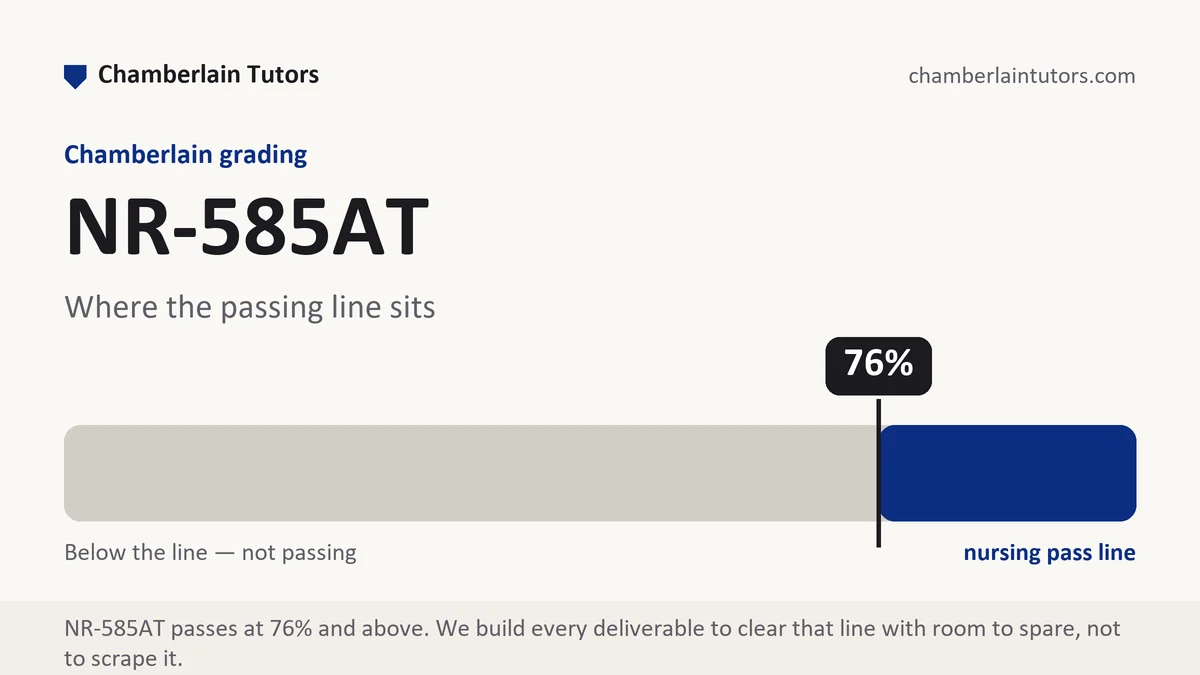
Pacing matters here too. Chamberlain's semesters run 16 weeks split into two eight-week sessions with up to six starts a year, and evidence work has a research phase that cannot be compressed as far as students hope. Core nursing courses pass at 76, and no amount of extra effort at the end reverses a weighted average that formed in weeks two and three.
How we help in this course
Send the prompt and rubric from Canvas with the practice question you want to settle, plus a line about the setting where it would be implemented. We build the evidence table, render the verdict in plain language, and write the adaptation and implementation sections so that a reader can see who does what differently and how anyone would know.
Where the evidence is genuinely thin, we say so in the draft rather than dressing it up, because a rubric row about strength of evidence is usually happier with an honest limitation than with an overstated recommendation.
Building the translation plan?
Send the rubric and your practice question. We will scope the evidence table and the verdict today.
Read the rubric before the prompt
Copy the criterion rows into a blank document and split them into three groups: rows about the evidence, rows about the judgment, and rows about the implementation. Most students overserve the first group because it is the group that feels like research. The second and third are where a leadership rubric puts its weight, and they are the ones a literature-review-shaped draft leaves empty.
Then convert weights into words. Take a 1,400-word cap with four rows weighted 30, 25, 25 and 20 percent: 420, 350, 350 and 280 words. Note what that means. If the evidence row is one of the 350s, then roughly a quarter of the document covers the studies, which is far less prose than most drafts give them, and the discipline that makes it possible is putting the study details in a table and reserving the prose for what the studies mean together.
Tables usually sit outside the word count, but check your guide. Where they do, an evidence table is the highest-leverage 30 minutes in the assignment.
The stages of an evidence translation plan
The dominant deliverable moves from a question to a change somebody has agreed to make. Each stage answers the question the next one depends on.
| Stage | What it has to produce | The stalled version |
|---|---|---|
| The practice question | A question tied to a decision somebody is waiting on, with the population and outcome named. | A subject the writer finds interesting, with no pending decision behind it. |
| The evidence, tabulated | Design, sample, setting, intervention, outcome and limitation for each source, in a table a reader can scan. | Study-by-study paragraphs that repeat the same sentence structure eight times. |
| The verdict | What the body of evidence supports overall, including how consistent it is and where it is weakest. | A summary that reports each study's conclusion and never adds them up. |
| Local fit | How your setting differs from the study settings on volume, staffing, population and resources. | An assumption that findings transfer intact. |
| Adaptation | What you would change about the intervention to fit, and which parts must stay intact for it to work. | A plan to implement the intervention as published, or silence about changes made. |
| Implementation | Who changes their behaviour, what supports that, and in what order it happens. | A statement that staff will be educated on the new practice. |
| Fidelity and outcome | One measure of whether it was done and one of whether it worked, with denominators and intervals. | A single outcome measure, so a failed rollout looks like a failed intervention. |
| Sponsor and cost | Who authorizes it, what it consumes, and what happens if it is not funded. | A recommendation with no owner and no price. |
Evidence craft when a decision is waiting
Reading for a decision is different from reading for a paper, and the rubric can tell which one you did.
Applicability is a separate judgment from quality. A well-conducted trial in a population unlike yours may be less useful than a smaller study in a setting like yours. Say which of the two problems you are weighing in each case, because collapsing them is what produces recommendations that fail on contact.
Guidelines are dated documents. Cite the issuing body and the version in force. A recommendation resting on superseded guidance is not a citation error, it is a wrong answer, and it is the easiest thing for a grader to check.
Design still decides the verb. Cohort and before-and-after evidence supports "was associated with" and "was followed by". Randomized evidence supports "reduced". In a translation plan the temptation to upgrade the verb is strongest in the recommendation paragraph, which is exactly where a careful reader is checking.
Effects need their base. "Complications fell from 46 to 29 per 1,000 procedures across two years" can be evaluated. "Complications fell significantly" cannot, and a relative change with no absolute numbers behind it is the most common way a translation paper overstates its case.
Passing and strong in a translation course
A passing plan reviews the literature accurately and recommends the intervention the literature favours. It reads as though the studies made the decision, which is comfortable but not what the course is testing. Nothing in it would help a manager decide whether the change is affordable, survivable or worth the disruption.
The tell is where the paper spends its confidence. Weak plans are confident about the science and vague about the rollout. Strong plans are careful about the science, explicit about the uncertainty that remains, and specific about the rollout, because that is the part the writer would have to survive if the plan were real.
A strong plan makes the call and shows its work. It states what the evidence supports and how confident that makes it. It names what it is adapting and what it refuses to adapt because the effect depends on it. It measures fidelity separately from outcome, so a disappointing result can be diagnosed rather than blamed on the evidence. And it names the sponsor and the cost, because a recommendation nobody owns is a paper, not a plan.
Six habits that cost marks in NR-585AT
- Writing a literature review. The evidence section is a means. If the paper ends where the review ends, the heaviest rows are empty.
- No verdict sentence. Somewhere the paper must say what the evidence supports overall. Study-by-study summaries never add up on their own.
- Ignoring local fit. Transferring a finding without examining the setting difference is the most common reason implementations fail in practice.
- Undated guidelines. Version and issuing body, every time. Guidance changes faster than the reading lists that mention it.
- Measuring only outcome. Without a fidelity measure you cannot tell a bad idea from an idea nobody carried out.
- Posting an unfinished discussion response. Posts do not reopen once submitted at Chamberlain, so paste only the finished version.
Questions NR-585AT students ask
How many studies belong in the evidence table?
The evidence on my question is thin or contradictory. Do I pick another topic?
If a national guideline already covers this, is that enough on its own?
Where NR-585AT sits in Chamberlain's programs
Open the exact program map for sequence, credit, and option context. The current student schedule and syllabus remain authoritative after transfer evaluation, electives, state rules, and approved plan changes.
The weeks, one by one
Week 1
If you run a department, you already have a shortlist. Read the full Week 1 manual.
Week 2
A telehealth service line director wants to know whether remote monitoring for patients with heart failure reduces readmissions enough to justify the nursing hours it consumes. Read the full Week 2 manual.
Week 3
Somebody brings a study to your desk showing that a deterioration alert built into the record reduced escalation delays by 31 percent. Read the full Week 3 manual.
Week 4
Every department has at least one metric that two people define differently and nobody has noticed. Read the full Week 4 manual.
Week 5
Nothing exposes a weak plan faster than a director asking, at the end of a presentation, how you will know whether it worked. Read the full Week 5 manual.
Week 6
The ethics questions that reach a department leader rarely arrive labelled as ethics. Read the full Week 6 manual.
Week 7
Practice changes fail in predictable places, and none of them are the evidence. Read the full Week 7 manual.
Week 8
The same finding needs four different documents. Read the full Week 8 manual.