The same finding needs four different documents. A committee that controls resources needs one page ending in a decision request. The nurses who would do the work differently need a short piece written as actions rather than as evidence. A professional audience at a conference needs methods and numbers compressed onto a board. A journal readership needs the full account so that others can judge and reuse it. The last stage of this session asks you to write about that fan-out, to set the evaluation that would tell anyone whether the change worked, and to make eight weeks of separately written sections read as one document.
Your section may print this as NR 585AT or NR585AT; it is the same course. Chamberlain publishes no syllabi outside Canvas. The placement here is our teaching judgment from the course's catalog arc; your section's rubric decides what your week actually asks.
What NR-585AT Week 8 asks for
Dissemination is an argument about audience rather than a list of formats, and for a leadership reader the internal audiences matter as much as the external ones. Start from who would have to do something differently if your question were answered, then work outward. Frontline staff need what changes on their shift. Charge nurses and educators need what they will be asked to reinforce. A director needs the resource line and the measure. A committee needs a recommendation phrased as a decision. External audiences come after that, and there is no shame in a plan whose strongest route is internal, because the change you are proposing lives in one department first.
Format literacy is graded. A one-page brief is the hardest of these to write well and the most useful: what was found, what is recommended, what it would take, what would be measured, and by when. A poster is a visual abstract with a small word count, one or two figures, and enough method to make the result interpretable. A podium presentation is a spoken argument on a strict clock, usually built around three points a listener could repeat afterwards. A manuscript follows a structured order and target journals publish author guidelines specifying length, structure and reference style, so naming a plausible outlet and describing its scope in one clause is a concrete, checkable sentence.
Evaluation is the other half of this stage and it is where leadership proposals distinguish themselves. Say what would be measured, against which baseline, at what intervals, by whom, and what result would trigger which decision. Process measures tell you whether the change is being done; outcome measures tell you whether it made a difference; and balancing measures tell you whether fixing one thing broke another, which is the category most plans omit and the one most likely to matter. Faster discharge that increases readmission is not an improvement, and only a balancing measure would have caught it.
Assembly is the mechanical half and it pays disproportionately. Terminology drift is the usual failure: a variable called follow-up contact in one section becomes patient outreach in another and monitoring adherence in a third. A reader cannot tell whether those are one thing or three. The same drift affects your population, your setting description and the phases of your change model, and one pass with a find command catches nearly all of it.
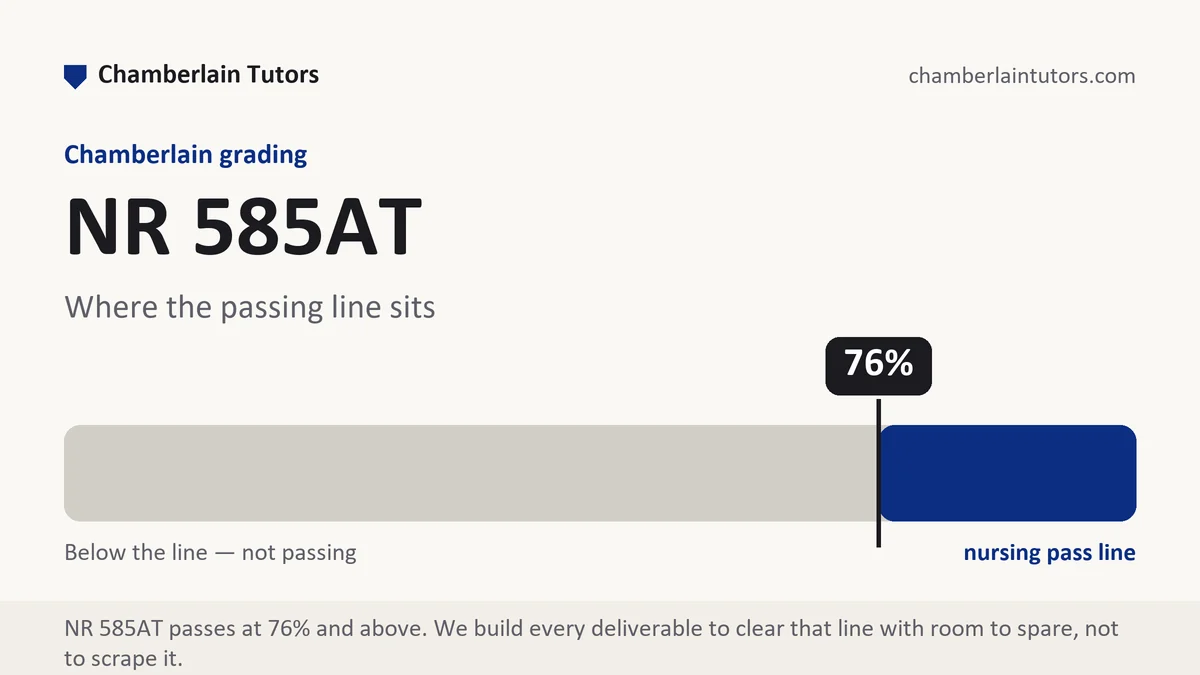
Expect a final deliverable of roughly 2,000 to 3,000 words if the whole document is assembled, or a shorter dissemination section if stages are submitted separately. In a course where core nursing passing sits at 76, this is the last chance to move an average that has been forming since week two.
The NR-585AT Week 8 method, step by step
Six moves for finishing the document and planning what happens to the findings.
-
List the audiences by what each would have to do differently
Write every group whose behaviour or decisions would change, then say for each what they need to know and what action follows. Format is derived from that list; choosing formats first is how a dissemination plan becomes three nouns with no reasoning behind them.
-
Match each audience to a route and justify the pairing
Say why that vehicle reaches that group. Staff who never open a journal do read a single laminated page at the workstation. A committee reads a brief with a resource line and a decision request. Write the reason, not just the pairing.
-
Draft the one-page brief inside your paper
Even where the assignment does not require it, writing the brief clarifies everything else, because a page that has to end in a decision forces you to know what you are asking for and what it costs.
-
Build the evaluation table with three kinds of measure
One process measure, one or two outcome measures, and at least one balancing measure. Each with a definition, a source, an interval and a named role responsible for producing it. The balancing measure is the one graders notice when it is present.
-
Write limitations as consequences with directions
Each limitation should say what it would do to your findings and which way. A single-department pilot with a self-selected first cohort would over-represent staff already interested in the change, which would likely inflate the observed adoption rate. That is analysis; the word limitations is not.
-
Run a consistency pass, then score against every rubric row
Force each variable, the population, the setting and the model phases into one form of words throughout. Check that the design named in the methods matches the analysis named later and that every number appears identically wherever it recurs. Then mark, for each rubric row, the paragraph that answers it.
A layout and word budget for a dissemination and evaluation section
Our frame for a closing section of roughly 1,300 words within an assembled document. It is our own outline rather than anything the university issues, and your week's rubric outranks it wherever they disagree.
| Section | What belongs in it | Word target |
|---|---|---|
| Anticipated findings | What the work would plausibly show, written conditionally, with the null result considered seriously. | 170 to 210 |
| Audiences and decisions | Each group with what they need to know and the decision or action that would follow for them. | 210 to 250 |
| Routes and formats | Audience paired with vehicle, an outlet named or described, and the reason that route reaches them. | 230 to 280 |
| Evaluation plan | Process, outcome and balancing measures, each with a definition, source, interval and responsible role. | 250 to 300 |
| Limitations | Three limitations specific to your design, each with the direction of the likely bias. | 190 to 230 |
| Contribution and close | What would be known afterwards that is not known now, in one paragraph introducing no new claims. | 140 to 180 |
Evidence craft for the closing stage
Cite the literature on dissemination and uptake. The gap between publication and practice change is a studied phenomenon with a substantial literature, and one or two citations convert a paragraph of common sense into a supported argument.
Keep every anticipated finding conditional. Would show, would suggest, may indicate. A proposal that slips into reporting results it never collected is the error graders remember, and it usually appears in the final paragraphs when the writing has been going on for weeks.
Verify the reference list line by line. Across eight stages sources get cited, dropped and renamed. Confirm that every in-text citation appears in the list, that every listed source appears in the text, and that authors and years match the papers you actually read.
Describe outlets accurately or generically. If you say a journal publishes work in your area, that claim can be checked against its published scope. Name it correctly or describe the type of outlet without inventing detail about it.
Write the limitation a critical reader would raise first. Anticipating the strongest objection and addressing it is a more credible position than listing three safe weaknesses, and it is the version an experienced reader is looking for.
Hold the register through the final paragraph. Closing sections attract inspirational language about the future of the profession. A graduate conclusion states what would be known, for whom, and what should happen next, and then stops.
Five mistakes that cost points in this week's territory
- One message for every audience. A plan that sends identical content to staff, to a director and to a journal has not thought about what any of them needs.
- An evaluation with no balancing measure. Without one, the plan cannot detect the cost of its own success, which is the failure mode experienced readers look for first.
- Results reported before they exist. Conditional language has to hold to the last line, and losing it here undermines the methodological care of every earlier stage.
- Terminology drift across sections. When one variable carries three names, the coherence row suffers even where each section is individually sound.
- Leaving assembly to the final night. The consistency pass is mechanical, takes longer than anyone expects, and is what turns a set of competent sections into one document.
Before you submit
- Three or four distinct audiences appear, each with the decision or action that follows
- Each audience is paired with a route and a reason that route reaches them
- The evaluation plan contains process, outcome and balancing measures with owners and intervals
- Every limitation carries the direction of its likely effect
- Each variable, the population and the model phases use one consistent form of words
- Design, sample and analysis are consistent everywhere they appear
- Every rubric row has a paragraph you can point to
Finishing the NR-585AT document?
Send the rubric out of Canvas with whatever stages you already have. A premium original draft comes back in 24 to 48 hours with dissemination built by audience, an evaluation plan carrying balancing measures and the whole document made consistent section to section, and revisions run until the grade lands.