NR-581 is a three-credit theory course covering professional standards and the historical, theoretical and ethical underpinnings of advanced nursing practice. Nothing in it is procedural, which is why students who are excellent at the bedside sometimes open with a low grade. What it grades is whether you can take an abstract framework and make it do visible work on a concrete practice problem.
What NR-581 actually grades
The subject matter of this course is other people's thinking: the theorists who shaped the discipline, the professional standards that define the advanced role, and the ethical principles a practitioner is expected to reason with. That makes the writing unusually easy to fake and unusually easy to grade. A reader can tell within two paragraphs whether a framework is being applied or merely named.
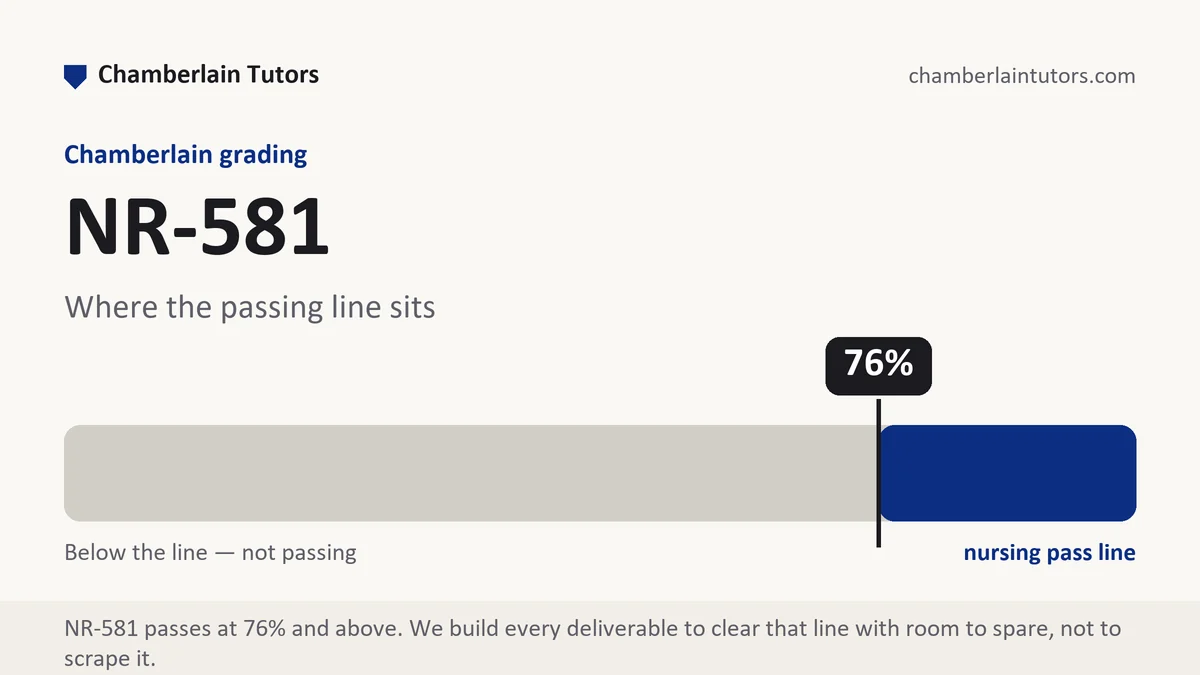
The rubric rows here almost always ask for a movement rather than a summary. You describe a concept, then you carry it into a situation and show what it changes. A paper that explains a theory accurately across three pages and then adds a paragraph saying it applies to nursing has completed half the instruction and will be graded that way. Chamberlain sets 76 as the passing floor in core nursing courses, and students in nurse practitioner specialty tracks work under a scale with no C at all, where 84 is the last passing number. Either way, a course this early sets the average that later courses have to defend.
The historical portion catches people off guard as well. Being asked to trace how the advanced role developed is not a request for a timeline. It is a request to explain why the role looks the way it does now, which is an argument with dates in it.
How we help in this course
Send the prompt and the rubric from Canvas and tell us which practice setting you work in. The setting matters more here than in almost any other course, because every application section in NR-581 is only as good as the concrete situation it lands on, and a generic hospital example scores like a generic hospital example. We build the draft around a real problem from your own practice and keep the framework doing work in every section.
This course also rewards tutoring, because the reading load is heavy and unevenly useful. A walkthrough that separates the sources you must read closely from the ones you need only for context saves more hours than any single draft.
Starting the graduate core?
Send this week's prompt and rubric. We will tell you what the rows are actually asking for before you write a line.
Read the rubric before the prompt
In a theory course the prompt reads like an invitation and the rubric reads like a contract. Start with the contract. Copy the criterion rows into an empty document, one per line, and underline the verb in each: describe, relate, apply, evaluate, justify. Those verbs are not decoration. A row that says relate is asking for two things joined, and a paragraph that describes both without joining them scores in the lower band no matter how accurate it is.
Then turn the weights into a word budget. Say your week's paper is capped at 1,000 words and the guide lists four rows weighted 30, 30, 25 and 15 percent. That gives 300 words to each of the first two rows, 250 to the third and 150 to the last. Now look at what those rows usually are in this course. One of the 300-word rows will be the application row, and application is exactly what students compress into a closing paragraph because it is harder to write than exposition. Seeing 300 words attached to it before you start is what prevents that.
Keep the numbers beside the headings while you draft. If your theory description reaches 500 words on a 1,000-word paper, you have spent half the assignment on the row worth less than a third of it, and no amount of polish recovers the difference.
The shape of a framework application paper
Most graded writing in NR-581 is a framework carried onto a practice problem. The parts below each do one job, and the paper fails at whichever one gets skipped.
| Part | The job it does | How the thin version reads |
|---|---|---|
| The problem, stated first | One concrete practice situation, named in two or three sentences before any theory appears. | A general statement that healthcare is complex, with the situation arriving on page two. |
| The framework, selected | Which theory or standard you chose and the reason it fits this problem rather than another. | A theory introduced with no explanation of why it is the right tool here. |
| Core elements, defined | Only the parts of the framework you are about to use, defined in your own words with the source attached. | Every element of the model summarized, most of which never returns. |
| Application, element by element | Each element mapped onto a specific feature of the problem, with what it reveals. | A single paragraph asserting that the theory applies well. |
| Professional standards | The standard that governs this situation, quoted sparingly and then used as a test. | Long block quotations from a standards document with no analysis around them. |
| Ethical dimension | The principle at stake, the tension between principles, and how you would resolve it. | An assurance that the practitioner should always act ethically. |
| What changes | The specific practice difference the analysis produces, stated as an action. | A conclusion restating the introduction in different words. |
Citation craft when the sources are ideas
Foundational courses invert the usual recency rule, which confuses students who learned to filter by date.
Historical sources are allowed, and they still need a reason. A theorist's original work is the right citation for that theorist's concept regardless of its age. What is not allowed is a decades-old source used for a claim about current practice. Say which job the old source is doing and the objection disappears.
Standards get cited by issuing body and edition. Professional standards are revised. Citing one without its year or edition leaves a grader unable to check whether you read the version currently in force, and that alone can cost a row.
Interpretation gets attributed too. When you explain what a theorist meant, you are usually relaying somebody's reading of the original. If that reading came from a textbook or a secondary article, cite it. Presenting a secondary interpretation as your own reading of the primary text is the most common integrity problem in this course.
Verbs that match the evidence. Theory papers still contain empirical claims, and those claims carry the same rules as anywhere else. Observational work supports "was associated with" and "occurred more often among". Only controlled evidence supports "improved" or "caused". Any rate you cite needs its denominator and its measurement window in the same sentence, or it is decoration.
Passing and strong in a foundations course
A passing NR-581 paper is correct and inert. It describes the framework properly, cites real sources, offends no one, and could have been written by any student in the section because nothing in it comes from a particular practice. That paper sits in the low bands and the comments usually say something about depth without explaining what depth means.
A strong paper differs in three ways. It picks one problem small enough to analyze rather than a topic large enough to survey. It uses fewer elements of the framework and uses them harder, so each one produces a finding rather than a mention. And it ends with something that would be visible in practice next week: a question you would now ask, a step you would now document, a conversation you would now have with a colleague. Supplementary work cannot rescue a weak weighted average later in the program, so the habit of specificity is worth building in the course where the stakes are still low.
Six things that quietly lose marks here
- Naming a theory and then leaving it. If the framework disappears after the second section, the application row has nothing to score.
- Quoting a standard instead of applying it. A quotation is not analysis. Use the standard as a test the situation either passes or fails.
- Treating ethics as sentiment. Ethical rows want named principles in tension and a defended resolution, not a statement that the patient comes first.
- Writing history as a chronology. Dates without an argument about why the role changed read as filler in a graduate course.
- Posting a board response before it is finished. A Chamberlain discussion post cannot be edited once it is up, so treat the box as a submission window rather than a drafting space.
- Choosing a problem too large to analyze. Nursing shortage, burnout and access are topics, not situations. One unit, one decision, one week is analyzable.
Questions NR-581 students ask
How do I choose between two theories that both seem to fit?
Am I allowed to write in first person about my own practice?
How many sources does an early graduate paper actually need?
Where NR-581 sits in Chamberlain's programs
Open the exact program map for sequence, credit, and option context. The current student schedule and syllabus remain authoritative after transfer evaluation, electives, state rules, and approved plan changes.
The weeks, one by one
Week 1
A charge nurse on a cardiac step-down unit can run a code, titrate three drips and negotiate a transfer without ever writing a sentence about where her authority came from. Read the full Week 1 manual.
Week 2
Competency documents read like furniture until you have to cite one. Read the full Week 2 manual.
Week 3
Two nurses finish the same program, sit the same certification, and go to work three hundred miles apart under materially different authority. Read the full Week 3 manual.
Week 4
Ask a nurse in a twelve-bed intensive care unit what theory she uses and you will usually get a polite silence. Read the full Week 4 manual.
Week 5
A rapid response call at three in the morning is not usually where anyone thinks about conceptual models, which is exactly why it makes a good subject for one. Read the full Week 5 manual.
Week 6
Real ethical difficulty in acute care rarely looks like a philosophy seminar. Read the full Week 6 manual.
Week 7
A sedation protocol gets rewritten in a forty minute committee meeting, and the one person in the room who knows how it fails at three in the morning says nothing. Read the full Week 7 manual.
Week 8
Eight weeks ago the course asked where the role came from. Read the full Week 8 manual.