Eight weeks ago the course asked where the role came from. The closing stage asks what you will do with it. NR-581 Week 8 is the synthesis stage of a foundations course, and it usually arrives as a philosophy of practice: a short, argued statement of the beliefs that will govern your clinical decisions, built from the history, standards, regulation, theory and ethics the session has already made you write about. It is the only paper in the course where the evidence is meant to converge rather than accumulate. Your section may print this as NR 581 or NR581; it is the same course. Chamberlain publishes no syllabi outside Canvas. The placement here is our teaching judgment from the course's catalog arc; your section's rubric decides what your week actually asks.
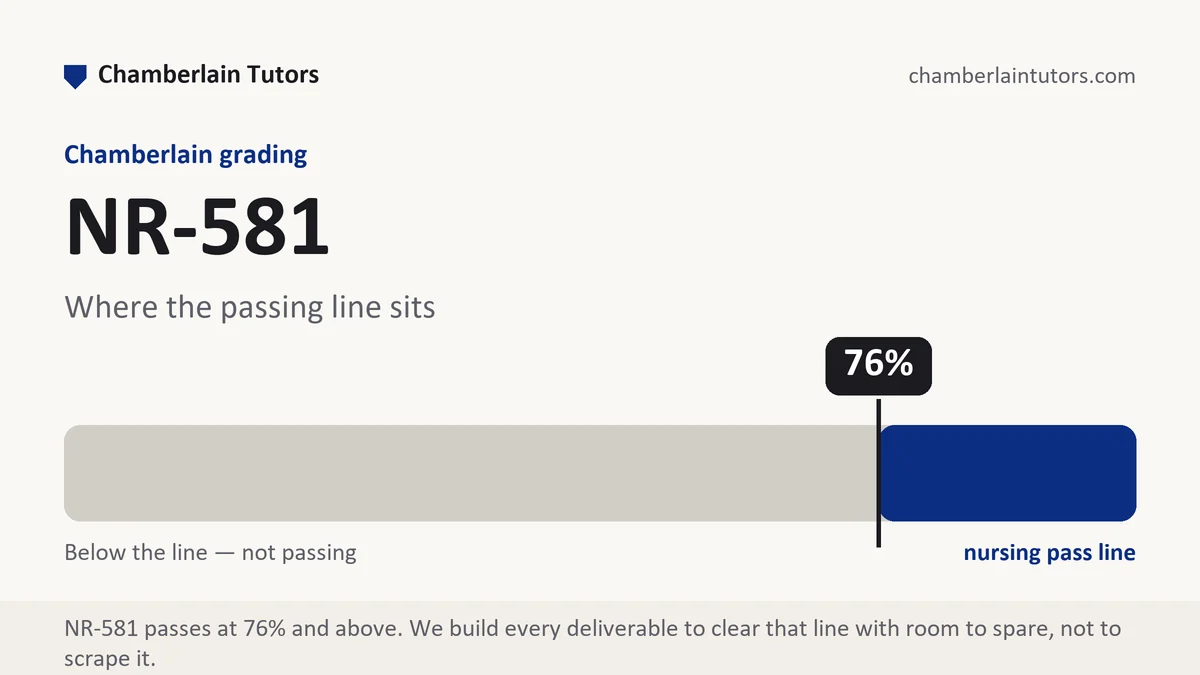
What NR-581 Week 8 asks for
A philosophy of practice is not an essay about values. It is a set of commitments precise enough that someone could watch you work and tell whether you were keeping them. That is the whole test, and it is the one most closing papers fail. A writer who states a belief in holistic, compassionate, patient-centered care has written something no reader can check and no colleague could disagree with. A writer who states that she treats a family's account of a patient's baseline as clinical data of equal standing to the chart, and then shows what that commitment costs her when the two conflict, has written a philosophy.
The synthesis obligation is the second thing graders look for. This stage is closing an eight-week arc, and the reader expects to see the session's materials working inside the argument rather than listed at the end of it. The historical account of why the role exists should be visible in what you say the role owes. The standards documents should supply the vocabulary for what competent practice means. The regulatory work should show up as a realistic account of the authority you will actually hold. The theoretical frame you defended should be doing explanatory work, not sitting in a paragraph of its own. The ethical method should govern how you say you will handle conflict. When those threads are genuinely woven, the paper reads as one argument; when they are stapled, it reads as five short essays with a shared title, and the organization row records the difference.
Length at this stage tends to be moderate rather than large. Closing pieces in short sessions are usually shorter than the mid-session analytic papers, because the work being tested is compression, not coverage. There may also be a reflective component, a posted response, or a portfolio-style element that carries some of the load. Whatever shape your section uses, treat compression as the skill on display: the ability to say in eleven hundred words what you would previously have needed two thousand to say is exactly the growth the stage is asking you to demonstrate.
Register deserves one warning. Philosophy statements invite elevated language, and elevated language is where graduate writing goes to die. The sentence that begins with a claim about the sacred trust of the nursing profession has already stopped being checkable. Keep the prose flat and the commitments sharp. A reader should finish knowing what you would do at four in the morning when a family disagrees with the plan, not how you feel about nursing.
The NR-581 Week 8 method, step by step
Six moves for building a philosophy statement that holds together.
-
Harvest the session before you draft
Open your six or seven earlier submissions and pull one sentence from each that you still believe. That page of sentences is your raw material, and it prevents the closing paper from being written as though the session had not happened.
-
Reduce to three commitments
Three is the working number. Each one must be a statement about what you will do, not about what you value, and each must be capable of being violated. If a commitment could not be broken, it is not a commitment.
-
Attach a source to each commitment
A standards document, a theoretical frame, a code provision, a piece of scholarship. The commitment is yours; the ground under it belongs to the literature. This is the single largest difference between a closing paper in the top band and one in the middle.
-
Show each commitment costing you something
Every real commitment collides with something else: time, throughput, a colleague's preference, your own convenience. Write the collision. A commitment that has never been inconvenient is a preference wearing better clothes.
-
Name the practice pattern you are changing
Closing papers gain enormously from one honest paragraph about a habit the session has made indefensible. Specific, small and real beats a grand declaration about future growth every time.
-
Cut every sentence that could appear in a classmate's paper
Run the draft looking for interchangeable prose and delete it. What remains should be recognizably yours because of the settings, the collisions and the sources you chose, not because your name is on it.
A layout and word budget for a philosophy of practice
Our frame for a closing philosophy statement of roughly 1,000 to 1,300 words. It is our own outline rather than anything the university issues, and your week's rubric outranks it wherever they disagree. If your section pairs the statement with a reflection, keep this order for the statement and give the reflection its own short section rather than mixing the two.
| Section | What belongs in it | Word target |
|---|---|---|
| The governing claim | One sentence naming what your practice is organized around, followed by the two sentences that make it specific. No preamble about the profession. | 90 to 120 |
| Commitment one | The statement, its ground in a named source, and the situation in which honouring it costs you something. | 210 to 250 |
| Commitment two | A commitment of a different kind from the first, ideally one drawn from the regulatory or ethical stages rather than another clinical value. | 210 to 250 |
| Commitment three | The one you are least confident of keeping, written with the doubt visible rather than smoothed away. | 190 to 230 |
| The habit you are retiring | One current practice pattern the session has made indefensible, named plainly, with what replaces it. | 150 to 190 |
| Close | What a colleague would observe in your practice if these commitments were real. Not a summary of the paragraphs above. | 100 to 130 |
Evidence craft for a synthesis paper
A philosophy statement still carries citations. The most common structural error at this stage is treating the closing paper as personal and therefore unsourced. Every claim about what advanced practice requires, what a standard expects or what an ethical principle demands belongs to a document, and the paper that grounds three commitments in three named sources outscores the eloquent one that grounds none.
Reuse the session's sources deliberately. Returning to the standards document from the second stage or the theoretical work from the fourth is not laziness; it is what synthesis means. Cite them again properly and show them doing new work in the new argument. Introducing five sources you have never mentioned before, in the closing paper, signals that the session's reading was disposable.
Do not quote your way through the ending. This is the paper where an accumulation of quotations reads worst, because the reader wants your position and keeps getting other people's sentences. Paraphrase with attribution as the default and reserve direct quotation for language that would lose its force if reworded, such as the operative clause of a code provision.
Keep every practice scene de-identified. The closing paper draws on real work, and real work carries detail. Alter incidental particulars, describe roles rather than people, name unit types rather than institutions, and say in a clause that identifying features have been changed where you use a real encounter.
Check the reference list against the arc. A foundations synthesis whose list contains no professional standards document, no theoretical source and nothing on ethics is telling the grader that the session did not land, whatever the prose says. The list is read first at this stage more often than at any other.
Five mistakes that cost points in this week's territory
- Uncheckable commitments. Compassionate, holistic and patient-centered are the three words that most reliably indicate a philosophy statement with nothing in it.
- Threads stapled, not woven. A section for history, a section for theory and a section for ethics is a table of contents, not a synthesis.
- Zero sources in the closing paper. Personal does not mean unsupported, and the support row does not disappear because the topic is you.
- Inspirational register. Elevated language about calling and sacred trust converts a graduate paper into a graduation speech in about two sentences.
- Reflection that is only gratitude. A closing reflection listing what you enjoyed has skipped the graded part, which is what specifically changed in how you practise or write.
Before you submit
- Each commitment is stated as something you will do, and could visibly fail to do
- Each commitment names a source that grounds it
- At least one commitment is shown colliding with a real constraint
- Material from earlier stages appears inside the argument rather than in a section of its own
- One specific practice habit is named as retired, with its replacement
- No sentence in the paper could be dropped unchanged into a classmate's version
Closing out NR-581 this week?
Send the instructions, the rubric and your earlier submissions out of Canvas. A premium original draft comes back in 24 to 48 hours with the session's threads woven into one argument and every commitment grounded, and revisions run until the grade lands.