NR-575 is the closing acute care practicum: precepted advanced practice carrying nearly a full theory credit, a capstone product, an on-ground intensive review session, and the turn toward AGACNP certification. It is the only course in the track where three different audiences read your work, a grader scoring a rubric, a room of peers and faculty at the intensive, and eventually a certification blueprint that does not care how well you write.
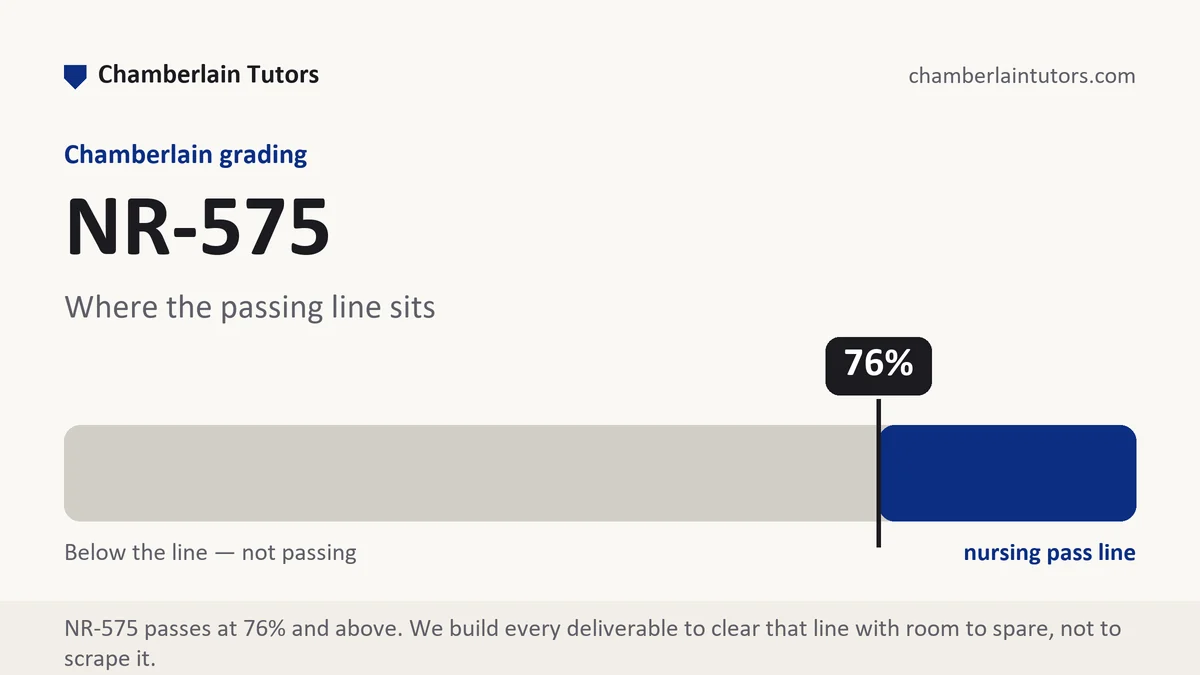
What NR-575 actually grades
A product, not a paper. The distinction is the whole course. A paper explains something to a grader and ends. A capstone product is meant to be used by somebody, which means it has a user, a setting, a format that suits both, and a plan for finding out whether it worked. Documents that describe a topic thoroughly and produce nothing usable score respectably and never reach the top band, because the row asking for application has nothing to hold.
The second graded thread is defensibility out loud. Where an intensive session asks you to present, your written argument has to survive a spoken version, and spoken versions expose vagueness immediately. A sentence you cannot say without adding a clarification is a sentence that will lose you a question in the room.
Certification preparation runs underneath all of it. The exam is yours to sit and nobody else can sit it, so the useful work here is structural: mapping what you know against the domains the credentialing body publishes, and turning the gaps into a study schedule with dates. On a specialty scale where 84 is the last passing number, the final course in a track is a poor place to be carrying a thin average, and supplementary work will not repair one.
How we help in this course
We draft the capstone document and the pieces around it: the practice question, the evidence synthesis, the product itself where it takes written form, the implementation and evaluation sections, the portfolio narrative, the presentation script or slide text, and the discussion posts and reflections that run alongside. We also build study frameworks for the certification stretch, organised by domain rather than by textbook chapter.
The limits are the same as every practicum course and they do not soften at the end of a program. We do not work clinical hours, contact preceptors, faculty or sites, complete or sign placement documents or hour logs, attend the on-ground intensive, or sit any assessment or certification examination in your name. Those are yours, and they are the part of the degree that means something precisely because they are.
In NR-575 right now?
Send the week and the rubric from Canvas. First premium sample free, floor-checked, back in 24 to 48 hours.
Split the guide before you write anything
A capstone course usually grades several distinct objects, and the first mistake is treating them as one long assignment. Separate the rubrics physically: one file per deliverable, rows copied in, verbs extracted, headings built. Where the same content appears in two deliverables, decide once what the spine argument is and let each format carry its own version of it rather than pasting between them.
Then budget the largest document. Take a 3,000 word capstone with five rows weighted 25, 25, 20, 20 and 10 percent: roughly 750 words for the practice problem and question, 750 for the evidence synthesis, 600 for the product and its implementation context, 600 for evaluation, and 300 for scholarly presentation. Read that list against the way capstones usually arrive, with 1,400 words of background, 900 of literature and a few hundred each for the product and its evaluation, and the reason the top band is rare becomes obvious. Two rows worth 1,200 words routinely get 500.
Write the budget into the outline and hold it. If evaluation will not fill 600 words, your product has no measurable claim attached to it, and that is worth discovering in week two rather than the night before submission.
The shape of a capstone product
Whatever your section calls the deliverable, these are the parts a grader checks for, and the middle column is where the marks live.
| Part | What it has to prove | The version that stops at competent |
|---|---|---|
| Practice question | A question from real practice, narrow enough to answer and worth answering. | A topic announced rather than a question asked. |
| Why it matters here | The local consequence: who is affected, how often, and what it costs in outcomes or time. | National importance statistics with no setting attached. |
| Evidence synthesis | What the body of work supports, where it disagrees, and what it does not cover. | A chronological tour of ten articles. |
| The product | The usable thing: a protocol, a teaching module, an algorithm, a documentation tool, in its final form. | A description of what such a tool might contain. |
| User and setting | Who picks it up, at what point in their day, and what it replaces. | Intended for staff, generally. |
| Evaluation plan | The measure, the source of the data, the interval, and the result that would count as success. | Feedback will be collected. |
| Dissemination | Who is told, in what format, and what you are asking them to do about it. | Findings will be shared with stakeholders. |
Evidence and citation craft in a closing synthesis
The evidence row in a final course is scored more strictly than in earlier ones, because you are being read as a nearly qualified practitioner.
Recent, with a stated reason for anything older. Where the guide sets no rule, hold clinical recommendations to five years and justify anything older inside the sentence. In a capstone the exception is usually a foundational study that defined a measure or a method, and naming why you are reaching back is itself a mark of a synthesis rather than a search.
Design and sample before the finding, every time. A synthesis is a set of claims about a body of evidence, and claims about a body of evidence are only checkable if the reader can see what each piece was. State design, size and setting in the sentence, then use the result. Where you have three studies pointing one way and one pointing another, the outlier's design usually explains the disagreement, and saying so is the single most impressive move available in these documents.
Verbs the design can pay for. Observational and implementation evidence supports was associated with and improved after; randomized evidence supports reduced. A capstone that keeps this straight throughout reads as trained, and one that borrows causal language for pre-post work reads as a student who summarised abstracts.
Denominator, window, and the difference between them. Any number in your problem statement or evaluation plan carries a base and a period. Of the 214 admissions to the unit in six months, 38 met the criterion is a measurement. An 18 percent rate is a claim with its evidence stripped off, and your evaluation plan will inherit the ambiguity.
What a strong capstone product does differently
A passing capstone reads as a competent long paper. The problem is real, the literature is current, the recommendation is sensible, and at the end nothing exists that did not exist before.
Strong capstones produce an object and defend it. They include the product in final form, formatted for the person who would use it rather than for the grader reading about it. They carry an evaluation with a threshold, so somebody could declare the project a failure on a specific date with specific data. And they say what the evidence does not support, which is the sentence that distinguishes a synthesis from an advertisement and the one most students omit because it feels like weakening their own case. Object, threshold, honest limit.
Mistakes that cost points here
- A capstone that is only a paper. If nothing usable comes out of it, the application row cannot score well however good the writing is.
- A product with no user. Name the role, the moment in the workflow and what the product replaces, or it will sit unused in the scenario as well as in reality.
- Evaluation without a threshold. Collecting feedback is not evaluation. State the measure, the interval and the number that would mean it worked.
- Presentation text written to be read silently. Long clauses collapse when spoken. Write the presentation version in short sentences you can say without a breath in the middle.
- Certification prep by rereading. Study by domain against the published blueprint, in timed blocks, with a date on each domain. Rereading a textbook front to back is the least efficient route to a passing score.
- Identifiers anywhere in the portfolio. Sites, preceptors, colleagues and patients stay out of the document, described only by setting type and clinical picture.
Questions NR-575 students ask
How do I choose a capstone topic that will not collapse halfway through?
How should I prepare for the certification exam alongside the capstone?
Can you write the presentation for the on-ground intensive?
Where NR-575 sits in Chamberlain's programs
Open the exact program map for sequence, credit, and option context. The current student schedule and syllabus remain authoritative after transfer evaluation, electives, state rules, and approved plan changes.
The weeks, one by one
Week 1
NR-575 opens with the one decision that governs the remaining seven stages: what practice problem your capstone is going to solve, and for whom. Read the full Week 1 manual.
Week 2
Early in a closing practicum the written work usually turns to the case: one encounter you managed under supervision, written up so that a reader can follow the reasoning rather than the chronology. Read the full Week 2 manual.
Week 3
By the third stage of a capstone practicum the written work usually turns to evidence: not a literature review that tours what has been published, but a synthesis that establishes what the body of work supports, where it disagrees, and what it never tested. Read the full Week 3 manual.
Week 4
Around the midpoint of a capstone practicum the writing turns from argument to artifact. Read the full Week 4 manual.
Week 5
Past the midpoint, a capstone stops being about whether the idea is right and starts being about whether it would survive contact with a real unit. Read the full Week 5 manual.
Week 6
The evaluation section is the row most capstones lose, and they lose it the same way: several hundred words about the importance of evaluation and one vague sentence about monitoring outcomes. Read the full Week 6 manual.
Week 7
Late in this course the written work has to become sayable. Read the full Week 7 manual.
Week 8
The closing stage of a final practicum usually carries two written objects with opposite orientations. Read the full Week 8 manual.