The closing stage of a final practicum usually carries two written objects with opposite orientations. One looks backward: a portfolio narrative and a summative reflection that argue, with evidence drawn from your own work across the program, that you have reached the competencies the role requires. The other looks forward: a written certification readiness plan that maps what you know against the domains the credentialing body publishes and turns the gaps into study blocks with dates. Your section may print this as NR 575 or NR575; it is the same course. Chamberlain publishes no syllabi outside Canvas. The placement here is our teaching judgment from the course's catalog arc; your section's rubric decides what your week actually asks. Your clinical hours, hour logs, site paperwork and preceptor evaluations are your own record and are never drafted, reconstructed or estimated with help, and the certification examination is yours alone to sit.
What the closing submissions have to demonstrate
Open a portfolio at the end of a program and audit it the way an evaluator would: for each competency claimed, is there an artifact attached, and does the narrative say what specifically in that artifact demonstrates the competency? Most portfolios fail the second half. They contain good work and a paragraph of general reflection, and the reader is left to construct the link. The scoring rows exist precisely for that link, so a portfolio narrative that never makes it explicit forfeits the marks its own contents had already earned.
A competency claim at this level has three parts. The competency named in the published language of the framework your program maps to. The evidence, meaning a specific artifact and the specific part of it that shows the ability, not the whole document waved at generally. And the reasoning connecting them, which is where the analysis is scored: what the artifact demonstrates, at what level, and what it does not yet demonstrate. Three tightly argued claims outperform nine gestures every time.
The summative reflection is a different genre and students routinely write the wrong one. It is not a narration of the term and it is not gratitude. It is an argument about change: what your clinical reasoning did at the start of this practicum, what it does now, and what specifically produced the difference. The evidence for that argument is your own earlier written work, which is why comparing an early case write-up against a later one is the most effective single move available in this piece.
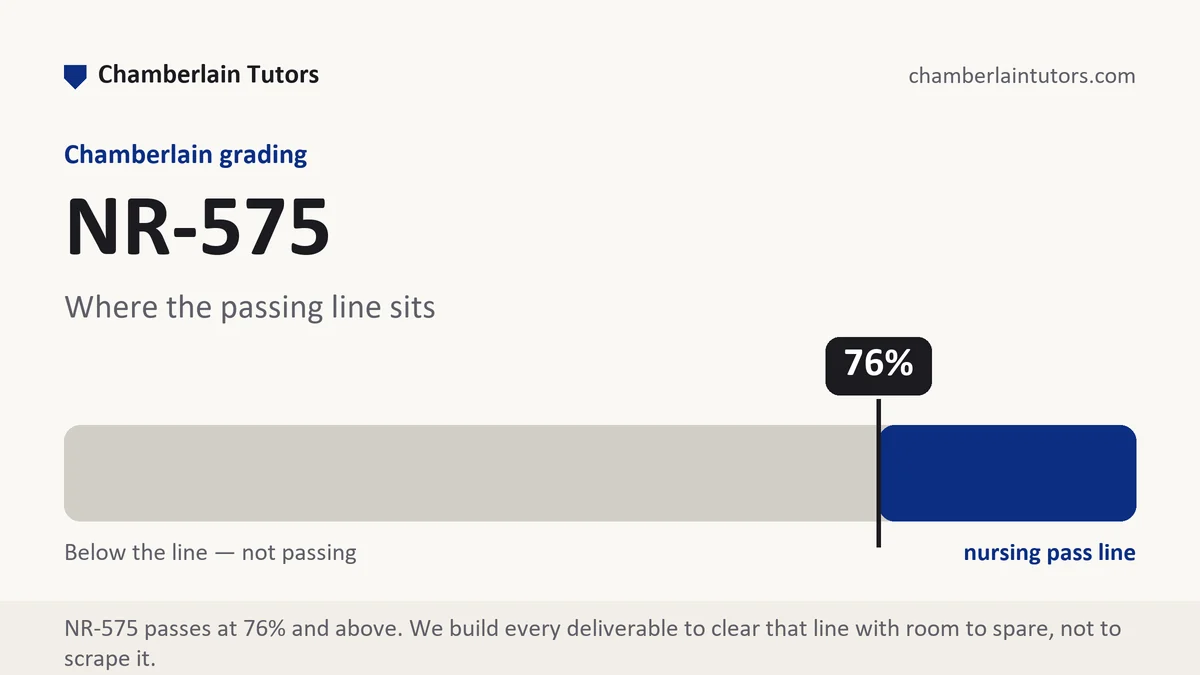
The certification plan is written work about a solitary act. Nobody sits the examination for you and nobody can shorten the study. What can be written is the structure: the published domains listed, an honest self-rating against each, the two weakest converted into study blocks with dates and resources, and a schedule that survives contact with a working life. On a specialty grading scale where the last passing number is 84, the closing stage of a track is a poor place to be carrying a thin average, and supplementary work does not repair one, so the plan should also be honest about what this course still owes you.
Deliverables at this stage commonly include a portfolio with a narrative, a summative reflection and sometimes a written transition or readiness plan. Any accompanying post is final copy; posts do not reopen after submission in Canvas.
The NR-575 Week 8 method, step by step
Six moves for the closing written work of a practicum track.
-
Inventory your artifacts before you write any narrative
List every substantial piece of written work from the program with one line on what it demonstrates. The inventory takes an hour and it turns the portfolio narrative from a memory exercise into a selection problem, which is a far easier problem.
-
Map artifacts to competencies in the framework's own words
Take the published competency language your program maps to, name the document and its edition, and place artifacts against statements. Where a statement has no artifact, that gap is content for the forward-looking section rather than something to disguise.
-
Write each competency claim as claim, evidence, reasoning
Name the competency, cite the artifact and the specific element inside it, then argue what that element shows and at what level. One paragraph each, and resist the urge to summarize the artifact.
-
Build the reflection on a before and after comparison
Put an early piece of your own writing beside a recent one and describe the difference in reasoning, not in polish. Name the experience that produced the shift. That is analysis; anything else in a reflection is narration.
-
Rate yourself against the published certification domains
List the domains from the credentialing body's own blueprint, rate each honestly, and be specific about what the weak ratings mean: not weak in cardiology but unsure about interpreting a particular class of findings under time pressure.
-
Convert the two weakest domains into a dated study plan
Blocks with dates, resources named, and a checkpoint where you re-rate. A plan with no dates is a wish, and the closing weeks of a program are exactly when good intentions decay fastest.
A layout and word budget for the closing submissions
Our frame for the portfolio narrative, reflection and readiness plan together, sized for roughly 1,600 to 2,000 words across the set. It is our own outline rather than anything the university issues, and your week's rubric outranks it wherever the two disagree.
| Section | What belongs in it | Word target |
|---|---|---|
| Portfolio framing | The competency framework named and dated, and how the artifacts were selected against it. | 120 to 160 |
| Competency claims | Three to five claims, each with the named competency, the specific artifact element, and the reasoning between them. | 500 to 650 |
| Growth argued from your own work | An early piece against a later one, with the difference described in reasoning terms and the cause named. | 300 to 380 |
| What is still developing | Two abilities not yet at the level the role requires, stated without apology and with what would develop them. | 180 to 230 |
| Certification domain map | The published domains, an honest self-rating for each, and the specific content behind the low ratings. | 230 to 300 |
| Dated study plan | Blocks with dates and resources, a weekly volume you would actually sustain, and a re-rating checkpoint. | 200 to 260 |
Evidence craft for portfolio and reflective writing
Cite your own artifacts precisely. The case analysis submitted in the second stage of this practicum, in the paragraph where the differential was discriminated, is a reference a reader can locate. My coursework is not. Portfolio rows are scored on the linkage, and vague self-reference is the most common reason a strong body of work scores as an average portfolio.
Name and date the competency framework and the certification blueprint. Both are published, both are revised, and both should appear with issuing body and edition inside the sentence. Rating yourself against a blueprint whose version you never specified makes the whole plan unauditable.
Keep reflection evidenced even when it is personal. Where first person is permitted, keep it working: I concluded, I revised, I now check. A reflective piece still needs specifics attached to every claim of growth, and the specifics come from your own documents rather than from feeling.
State what is not yet demonstrated without hedging it away. Naming two genuine developmental edges, with what would close them, reads as professional self-assessment. A portfolio claiming full competence everywhere reads as a document written to a rubric rather than about a practice, and evaluators mark that difference.
De-identify anything that came from clinical work. Portfolio artifacts drawn from encounters carry the same obligation as any other written work: no names, no dates, no facility, no unit, no combination of details that could point at a person. Check the appendices as carefully as the narrative, since that is where identifiers survive.
Five mistakes that cost points at this stage
- A portfolio that lists rather than argues. Attachments plus a general paragraph leaves the grader to build the link that the scoring row asked you to build.
- Reflection as chronology. A term-by-term account of what happened is narration. The graded content is the difference between then and now, with a cause attached.
- Competencies claimed in your own paraphrase. Using the framework's published language is what makes the claim checkable; rewording it makes it an assertion.
- A study plan with no dates. Review pharmacology and do practice questions are not a plan. Blocks, dates, resources and a checkpoint are.
- Nothing left developing. A closing self-assessment showing uniform strength is the least credible thing you can submit at the end of a practicum.
Before you submit
- The competency framework is named with its issuing body and edition
- Every claim points to a specific artifact and the specific element inside it
- Growth is argued from a comparison of two pieces of your own writing
- Two developmental edges are named with what would close them
- The certification domains come from the published blueprint, not from a textbook contents page
- The study plan carries dates, resources and a re-rating checkpoint
- No appendix or artifact identifies a patient, colleague, preceptor or facility
Closing out NR-575?
Send the rubric and your artifact list out of Canvas. A premium original draft of the portfolio narrative, reflection and readiness plan comes back in 24 to 48 hours with every competency claim tied to specific evidence, and revisions run until the grade lands.