NR-573 opens with the written work that sits in front of a skills lab rather than inside it. The hands, the check-off and the faculty-supervised performance are yours and stay yours; what an opening stage typically asks on paper is that you arrive prepared in a way somebody else can read, which usually means a preparation note built around indication, anatomy, equipment, complications and the safety pause. Your section may print this as NR 573 or NR573; it is the same course. Chamberlain publishes no syllabi outside Canvas. The placement here is our teaching judgment from the course's catalog arc; your section's rubric decides what your week actually asks.
What NR-573 Week 1 asks for
A nurse who has spent nine years in a pediatric emergency department walks into an adult acute care lab already knowing how to move fast in a room. What changes is not the speed, it is the paperwork of preparation: adult critical care procedures carry a different consent culture, different anticoagulation questions and a different set of anatomical landmarks, and an opening lab stage tends to test whether you have converted that difference into written preparation before the first session rather than after it. That is the real object of an opening week. The lab teaches hands. The written layer teaches the reasoning that has to be in place before the hands move.
Expect the opening written deliverable in a half-credit lab to be short and unforgiving. Skills courses distribute their points across performance and a small number of written pieces, so a two-page preparation note carries more weight per word than a term paper in a didactic course. Graders read these for precision, not for warmth: whether you can state an indication and the two or three conditions that would make the same procedure a bad idea, whether your equipment list is complete enough that somebody could set a tray from it, and whether you named the complications you would be watching for and what you would do about each one.
The boundary around this course is absolute and worth stating in plain language before anything else. Lab attendance, faculty-supervised performance, check-offs, simulation participation, recorded demonstrations and any signature or completion record attached to them are your own work and your own record. Nobody drafts, reconstructs or estimates them on your behalf, and no written manual substitutes for the hours you spend in the lab. What a manual can do is teach you to write the preparation and the documentation that surround those hours, so that the reasoning you bring into the room is already organized. Where your writing later draws on anything you observed, every patient detail is de-identified before it reaches a page.
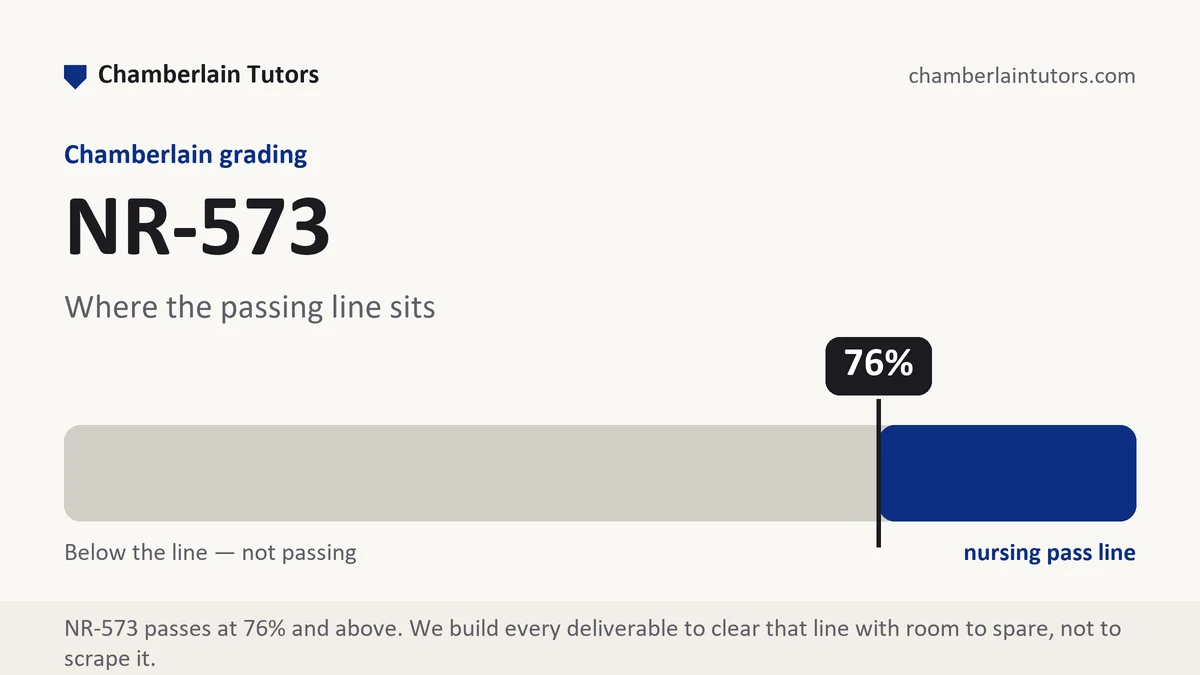
One more feature of an opening stage deserves attention. Because this sits inside an NP specialty track, the passing floor is higher than the undergraduate one and there is no C on the scale, so a half-credit lab that looks like a rounding error on a transcript behaves like everything else inside a weighted average. Students routinely leave the opening preparation note until the night before because it is small. Small and cheap are different things.
The NR-573 Week 1 method, step by step
Six moves that turn a skills checklist into a written preparation note.
-
Rewrite the checklist as a scoring guide
Copy every line of the lab checklist into a blank document, then group the lines into the four or five things they are actually testing: preparation, technique, safety, complication recognition, documentation. Those groups become your section headings, and the grouping alone tells you where the weight sits.
-
State the indication in one clinical sentence
Write why this procedure, on this kind of patient, at this point in a presentation, and what the alternative would have been. A procedure named without a reason attached reads as a task rather than a decision, and that distinction is the first thing a faculty reader looks for.
-
List contraindications you would actually check
Name the specific ones rather than writing that contraindications were considered: coagulation status, site condition, anatomy, prior instrumentation, patient factors that change the approach. A blank line here reads as none looked for rather than none present.
-
Build the equipment list as a working tray
Write it in the order you would lay it out, including the sterile field, the backup for the item most likely to fail and the monitoring you want running before you start. A list that would let a colleague set your tray is a list that shows you rehearsed.
-
Pair each complication with its response
Two columns of thinking in prose form: what can go wrong, how you would recognize it early, and the first two actions you would take. Recognition without a response is half the point, and the response is where a grader sees whether you understand the procedure or only its steps.
-
Close with the one thing you expect to find hardest
Name a specific step, not a general nervousness, and say what you will do to prepare for it before the session. That sentence converts a preparation note into a document with a plan in it, and it is the sentence most students leave out.
Budget a pre-lab preparation note
Below is the frame our tutors keep beside an opening preparation note, sized for a piece of roughly 700 to 900 words. It is our own outline rather than anything the university issues, and your week's scoring guide outranks it wherever the two disagree. Scale the targets proportionally if your assigned length differs.
| Section | What belongs in it | Word target |
|---|---|---|
| Procedure and indication | The procedure named precisely, the clinical situation that calls for it, and the alternative you would have considered first. | 110 to 140 |
| Anatomy and landmarks | The structures that matter, the landmarks you would identify, and what changes when the usual landmark is unavailable. | 120 to 150 |
| Contraindications and cautions | Named conditions that would stop you or change your approach, each with the reason it matters. | 110 to 140 |
| Equipment and setup | The tray in order, the monitoring running beforehand, and the backup for the component most likely to fail. | 100 to 130 |
| Complications and responses | Three or four complications, each with an early recognition sign and the first two actions. | 150 to 190 |
| Personal preparation goal | The single step you expect to find hardest and what you will do before the session about it. | 60 to 80 |
Source a preparation note the way a graduate reader expects
Anchor technique claims to published procedural guidance. A statement about how a procedure should be performed belongs to a professional society document, a critical care text or a peer-reviewed procedural review, not to what your unit happens to do. Name the source and its year inside the sentence so a faculty reader can see the standard you are working to.
Distinguish evidence-based practice from local habit. If your hospital uses a particular kit or sequence, say so and label it as local practice. Graders in a lab course reward a student who can tell the difference between a step required by evidence and a step required by the supply cabinet, because that distinction is what makes a clinician portable.
Use adult critical care sources for an adult critical care lab. A nurse arriving from pediatrics or from a family practice clinic often reaches for the references she already trusts, and dosing, equipment sizing and landmark descriptions do not transfer cleanly. Where your background source is pediatric, say so and cite the adult equivalent alongside it.
Give every number a unit and a context. Depths, gauges, volumes, pressures and timings are the currency of procedural writing, and a figure without its unit or its patient context is unusable. Write the range and the condition that moves you within it rather than a single number stated as if it were universal.
Five mistakes that cost points in this week's territory
- Copying the checklist back as prose. Restating the steps in sentences proves you can read. Grouping them and explaining the reasoning behind each group proves you prepared.
- Writing contraindications as a category. The phrase contraindications were assessed carries no information. Named conditions with reasons attached carry all of it.
- Skipping the safety pause. Identification, site verification and the shared pause before starting are graded elements in almost every procedural rubric and the easiest line to forget on paper.
- Complications listed without responses. A list of what can go wrong is a hazard inventory. What a faculty reader wants is the first two things you would do about each one.
- Treating a half-credit lab as background noise. On a specialty scale with no C, the smallest course on your schedule moves the average exactly as far as its weight allows, and no supplemental work exists to repair it.
Before you submit
- Every checklist line has been sorted into one of your written sections
- The indication appears as a clinical decision, not as a procedure name
- At least three contraindications are named specifically with reasons
- The equipment list would let a colleague set your tray without asking questions
- Each complication carries an early sign and a first response
- Adult critical care sources are cited with their year inside the sentence
Starting NR-573 this week?
Send the lab instructions and the scoring guide out of Canvas. A premium original preparation note comes back in 24 to 48 hours, written to the checklist groups rather than around them, and revisions run until the grade lands.