NR-571 is the acute care practicum for complex health problems in critically ill adults, 125 precepted clinical hours with a small theory component that produces the graded writing. Complexity is the whole subject: the patient has several active problems, treating one of them makes another worse, and the written work is scored on whether you can hold that tension on the page instead of writing three tidy plans that ignore each other.
What NR-571 actually grades
Interaction. A complex case write-up that handles each problem in its own section, with no sentence connecting them, is the most common middle-band submission in this course, and it is invisible to the student writing it because every individual section is correct. The rubric rows want the connections: which problem is driving the others, which two treatments pull in opposite directions, and what you did about the conflict.
Priority is the second thread. In a patient with six active problems, saying what you address first and defending the order is the graded act. It is also where evidence gets hardest, because trials tend to study one condition in patients who were excluded if they had the others, and your patient is the person the trial excluded. Writing that extrapolation honestly, rather than quoting the trial as though it enrolled your patient, is what a top-band evidence row looks like.
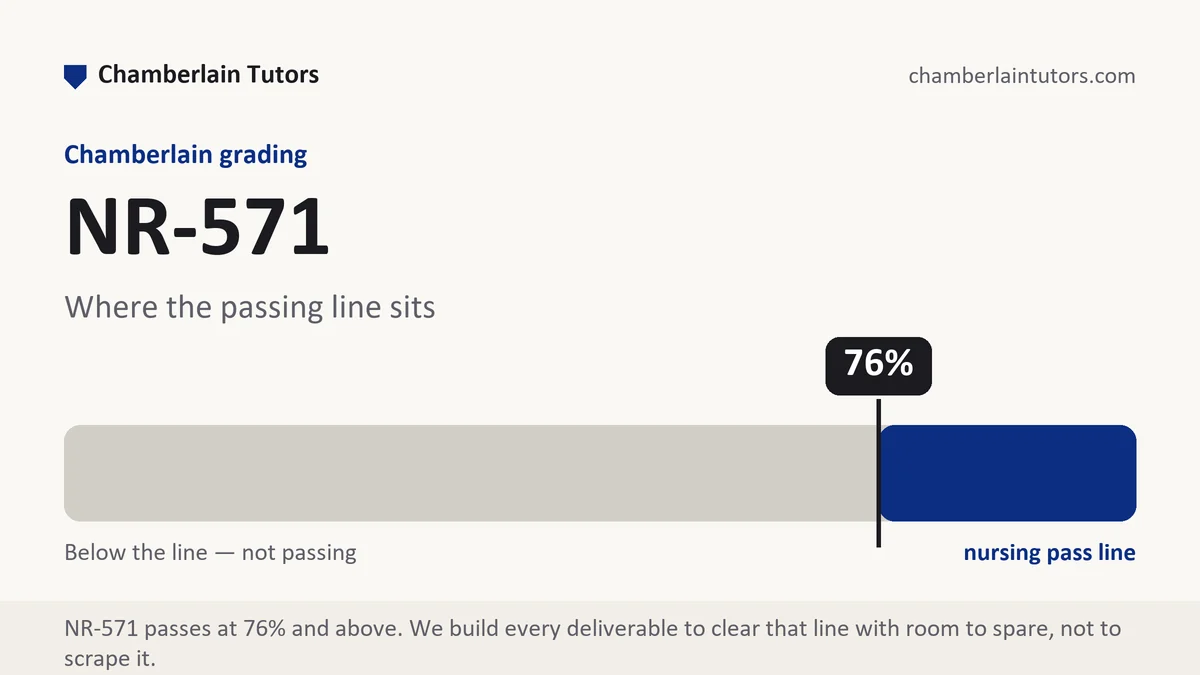
The NP specialty scale has no C, so 84 is the line, and supplementary work will not lift a weighted average that has already slipped. Complex case writing takes longer than students plan for, which is the practical reason this course's grades slide: the analysis is doable, the hours are exhausting, and the document gets written last.
How we help in this course
We draft the complex case analyses, multi-problem management papers, note-format write-ups, discussion posts and the reflective pieces built on your clinical experience. The specific value in this course is structural: our drafts carry a problem list ordered by priority with the reasoning attached, an explicit section on the conflicts between treatments, and a contingency plan, which are the three things graders find missing when a paper is accurate but scores in the low eighties.
What we never do is stand between you and your placement. No hours worked on your behalf, no contact with your preceptor or site, no signatures or forms, no hour logs, no assessments sat in your name. The 125 hours here count toward the 625 clinical hours the MSN NP tracks carry, and they are yours alone. Our work is the writing.
In NR-571 right now?
Send the week and the rubric from Canvas. First premium sample free, floor-checked, back in 24 to 48 hours.
Price the rubric rows before you write
Complex case assignments are long, and length is where structure gets lost. The scoring guide is the map. Copy the rows out, cut each to its verb, analyze, prioritize, integrate, justify, evaluate, and turn them into headings in the guide's order. Where a row uses the word integrate or synthesize, treat it as an instruction to write about relationships between problems, not to write more about each problem separately.
Then attach a word count to each row. A 2,000 word complex case with rows at 35, 25, 25 and 15 percent gives roughly 700 words to the analysis of the problems and their interactions, 500 to the management plan, 500 to the evidence and rationale, and 300 to evaluation and reassessment. Most students spend those 700 words describing the problems one at a time, which fills the space without earning the row, because the row was priced for the interaction rather than the inventory. If you have four problems and no paragraph explaining how any two of them affect each other, the heaviest section of the paper is still empty.
Hold the budget in brackets while drafting. The evaluation section is the one that gets squeezed, and 300 words of what you would watch, when, and what would change the plan is a good use of the last hour before submission.
The shape of a complex case analysis
The graded document in this course usually assembles from these parts, whatever the assignment is titled.
| Part | What it has to make visible | The version that scores as adequate |
|---|---|---|
| Problem list, active | Every live problem, stated at the level of the physiology rather than the diagnosis label. | A list of admission diagnoses copied forward. |
| Drivers and dependencies | Which problem is producing which, and what would improve if the driver were controlled. | Six problems described in parallel with no relationship between them. |
| Priority order | What is addressed first and the reasoning that puts it there, including what can wait safely. | Everything treated as equally urgent. |
| The conflict, named | The place where treating one problem worsens another, and how you resolve or balance it. | Two competing therapies both recommended in different sections. |
| Evidence and its limits | The trial or guideline used, plus an honest statement of how your patient differs from the studied population. | A recommendation quoted as though the patient had been enrolled. |
| Escalation and consultation | Who is asked, the specific question asked of them, and what you do while waiting. | Consult critical care, with no question and no interim plan. |
| Goals of care and contingency | What the patient or surrogate has decided, and the plan if the current approach fails. | A plan that assumes everything works and nobody objects. |
Evidence and citation craft when the patient is the exception
Complexity breaks the usual relationship between evidence and patient, so the craft rules shift with it.
Current, and current for whom. Where your guide sets no limit, treat therapeutic evidence past five years as needing a stated reason. Then add the second question this course requires: whether the recommendation was ever tested in patients with your patient's other problems. A recent guideline is still weak evidence for a patient its trials excluded, and saying so earns points rather than losing them.
Design, sample and exclusions before the finding. In complex cases the exclusion criteria matter as much as the enrolment. Writing that a trial of 900 adults excluded those with advanced kidney disease, which your patient has, is not a hedge; it is the analysis. The strongest papers follow it with the pharmacological or physiological reason they are extrapolating anyway, and with what they will monitor because of the gap.
Verbs the design can pay for, and subgroups treated as hypotheses. Observational work supports was associated with; trials support reduced. A subgroup result is a suggestion, not a finding, and a paper that builds its plan on one is making a claim the data cannot carry. Say that the subgroup signal exists and treat it as a reason to watch rather than a reason to act.
Denominator and window on every number. Mortality, ventilator days and complication figures are meaningless unbased. Of the 640 patients treated within six hours, 71 required escalation during the first 48 hours is an argument. An 11 percent escalation rate is a decoration, and in a complex case the period is often the thing that decides whether the number applies at all.
Where a complex case wins its extra points
A passing complex case covers everything. Each problem gets a paragraph, each paragraph is defensible, the sources are real. It reads as thorough and scores in the middle, because thoroughness is not the skill this course is teaching.
Strong analyses do three things the thorough version does not. They name a driver, arguing that one problem is producing several others and that controlling it changes the rest, which converts a list into a diagnosis of the situation. They write the tradeoff in the open, stating which treatment they are accepting a cost from and what that cost is worth. And they carry a contingency with a trigger attached: if this parameter has not moved by this hour, the plan becomes that. Driver, tradeoff, trigger. Three paragraphs most submissions never write, and the difference between them and everything else is visible from the first page.
Mistakes that cost points here
- Parallel plans that never meet. If no sentence connects two problems, the integration row scores at the bottom no matter how correct each section is.
- Consultation without a question. Naming a service is not a plan. Write the question you are asking and what you will do in the meantime.
- Treating numbers instead of the patient. Correcting a value that carries no consequence, while a driver goes unaddressed, is the classic complex-case error and graders name it directly.
- Goals of care left out. In a critically ill patient, a plan that never mentions what the patient or surrogate wants is incomplete as a clinical document, not just as an assignment.
- Evidence quoted past its population. Using a trial result for a patient the trial excluded, without saying so, is the fastest way to lose an evidence row that was otherwise well sourced.
- Composing in the discussion box. Chamberlain posts do not reopen after submission, so write the argument elsewhere, check the interactions, then paste it once.
Questions NR-571 students ask
How do I show integration instead of just describing several problems?
What if the guideline for one problem contradicts the guideline for another?
My case is very long. Do I use headings from the note format or from the rubric?
Where NR-571 sits in Chamberlain's programs
Open the exact program map for sequence, credit, and option context. The current student schedule and syllabus remain authoritative after transfer evaluation, electives, state rules, and approved plan changes.
The weeks, one by one
Week 1
The opening written work in an acute care practicum is rarely about a patient at all. Read the full Week 1 manual.
Week 2
Once a rotation is under way, the written work turns into case construction: taking an encounter you personally lived, stripping it of every identifier, and rebuilding it on the page so a reader who was not there can follow the clinical logic from presentation to plan. Read the full Week 2 manual.
Week 3
It is a trail: a written record of which explanations were live, what raised or lowered each one, and where the evidence closed a door. Read the full Week 3 manual.
Week 4
Justification is the paragraph where you stop describing and start defending. Read the full Week 4 manual.
Week 5
Prioritization is where complexity stops being a word in the catalog line and becomes a writing problem. Read the full Week 5 manual.
Week 6
Patients leave acute care faster than the reasoning about them travels, and the written work in the back half of a practicum often turns to that gap. Read the full Week 6 manual.
Week 7
Reflection is the most misunderstood genre in graduate nursing, because it looks like permission to write about feelings and is actually a demand for causal analysis of your own decisions. Read the full Week 7 manual.
Week 8
The closing written work in a practicum is an argument, and the claim is about you: that a specific set of competencies moved during this rotation, that the evidence for the movement exists, and that you know precisely where you are still short. Read the full Week 8 manual.