Justification is the paragraph where you stop describing and start defending. A working diagnosis in a complex acute care patient has to be argued against its nearest rival, tied to the evidence that supports it, and connected to the plan that follows from it, all in prose a grader can score line by line. By the midpoint of a practicum this is usually where the analytic marks live. Your section may print this as NR 571 or NR571; it is the same course. Chamberlain publishes no syllabi outside Canvas. The placement here is our teaching judgment from the course's catalog arc; your section's rubric decides what your week actually asks.
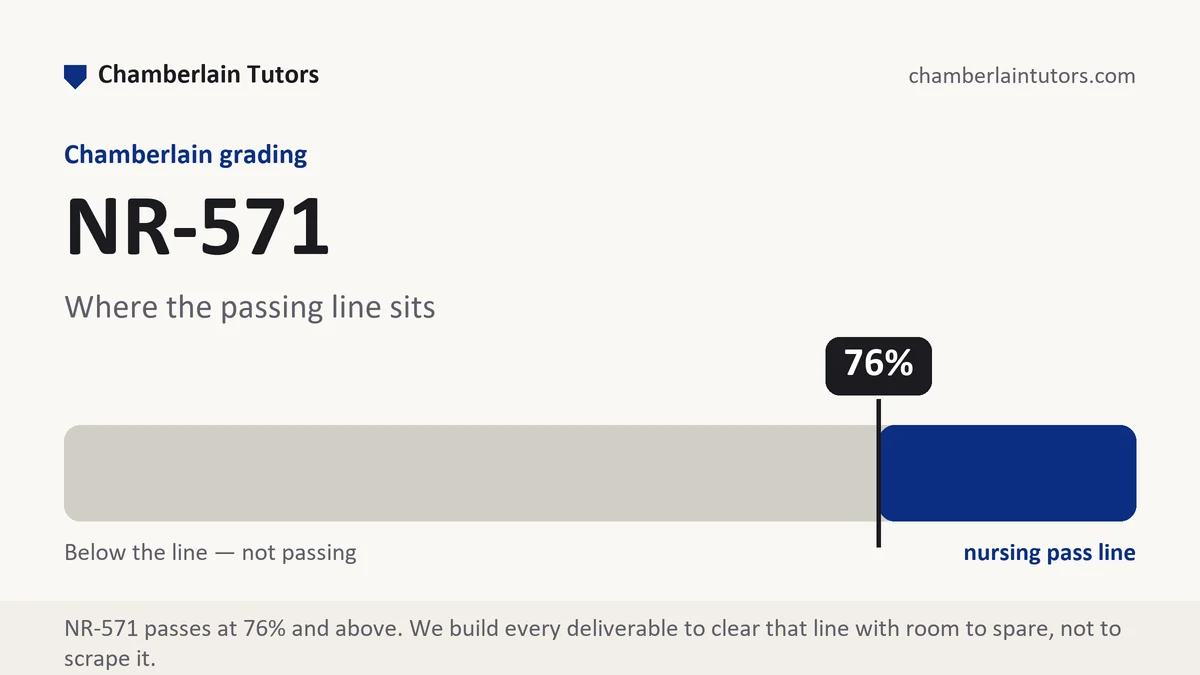
What NR-571 Week 4 asks for
Halfway through a precepted rotation the written work usually tightens from breadth to defence. Generating a field of possibilities, which the previous stage rewarded, is a beginner's virtue in the sense that it can be done systematically. Committing to one explanation and defending it against the second-best one is harder, because it requires you to be wrong in public if the evidence goes the other way. The written justification is where that commitment happens, and rubrics at this depth almost always weight it above description.
The shape of a justification paragraph is stable across specialties. It names the diagnosis, states the case for it using the specific findings from this patient, states the strongest case against it, names the closest competing explanation and says why it lost, and then declares what the plan does about the residual uncertainty. Students who learn that five-part shape write these sections in a third of the time, because the sequence tells them what sentence comes next.
Complexity is what makes it difficult here. In an adult carrying five chronic conditions, the winning diagnosis rarely explains everything, and the honest justification has to say which findings it accounts for and which it does not. A woman readmitted from a long-term-care facility with worsening breathlessness may have an infection, a volume problem and progressive deconditioning simultaneously, and asserting a single cause for the whole picture is less defensible than arguing that one process is driving the acute change while the others set the floor. Writing that distinction clearly is a graduate-level move and it is scored as one.
The practicum boundary continues to apply without exception. Your 125 supervised hours, the log that records them, encounter counts, site paperwork, preceptor evaluations and signatures are your own record and are never drafted, reconstructed or estimated with help. Justification writing works only on encounters you personally lived, fully de-identified before drafting, and it changes nothing about the clinical experience itself. What it changes is whether a reader can see the reasoning you already did.
The NR-571 Week 4 method, step by step
Six moves that build a defensible diagnostic argument on paper.
-
Declaration of the diagnosis in one unhedged sentence
State the working diagnosis plainly before any argument. Hedged openings such as it appears possible that leave the grader unsure what is being defended, and every later sentence loses its target.
-
Assembly of the positive case from this patient's findings
Use the actual features of the encounter, not textbook features of the condition. Three specific findings from the patient in front of you outrank a paragraph of general presentation description, because only the former shows you applied knowledge to a case.
-
Concession of what the diagnosis does not explain
Name the findings your diagnosis leaves unaccounted for. This single move separates confident writing from defensible writing, and it pre-empts the objection a grader would otherwise write in the margin.
-
Comparison against the nearest rival
Take the second-place candidate seriously enough to state its best evidence, then say what defeated it. A rival dismissed in half a sentence signals that the comparison was never really made.
-
Separation of the driver from the substrate
In multimorbid patients, distinguish the process causing the acute change from the chronic conditions that set the baseline and shaped the presentation. Say which is which and what evidence supports the split.
-
Connection of uncertainty to the plan
Finish by saying what the plan does about the parts you are unsure of: what is being monitored, what result would trigger reconsideration, and at what point the working diagnosis should be abandoned. Uncertainty tied to an action is judgment; uncertainty left hanging is hedging.
A layout and word budget for a diagnostic justification
Our frame for a justification section inside a larger case document, sized for roughly 900 to 1,200 words. It is our own outline rather than anything the university issues, and your week's rubric outranks it wherever the two disagree.
| Section | What belongs in it | Word target |
|---|---|---|
| Declaration | The working diagnosis stated without hedging, with the degree of certainty named honestly in the same breath. | 60 to 90 |
| The positive case | Three to five findings from this encounter that support the diagnosis, each tied to why it supports rather than merely listed. | 230 to 290 |
| What is unexplained | The findings the diagnosis does not account for, and whether they are noise, a second process, or a reason to doubt. | 140 to 180 |
| The nearest rival | The strongest competing explanation stated at its best, then the specific evidence that displaced it. | 200 to 260 |
| Driver and substrate | Which process is producing the acute change and which chronic conditions are setting the baseline, with the evidence for the split. | 150 to 200 |
| Uncertainty and the plan | What is being watched, what result would reopen the question, and the point at which the working diagnosis fails. | 140 to 190 |
Evidence craft for defended diagnosis
Attach the source to the inference, not to the paragraph. A citation parked at the end of a block of reasoning tells the reader nothing about which claim it supports. Put it on the sentence that needed it, which is usually the sentence asserting that a finding argues for or against a condition.
Use current clinical guidance where it exists and say so. Where a professional society publishes diagnostic criteria or a definition, name the body and the year in the text. Where you are reasoning outside published criteria because the patient does not fit them, say that too, because a mismatch acknowledged is far stronger than a criterion quietly stretched.
Prefer specific over dramatic evidence. A finding that few other conditions produce carries more argumentative weight than a finding that is common across the whole differential, regardless of how striking it looked at the bedside. Order your positive case by discriminating power rather than by memorability.
Report trends, not snapshots. In a patient with chronic disease the direction and rate of change usually argue better than any single value. A slow drift across three measurements documented over the preceding weeks says something a single reading cannot, and where the earlier values come from a sending facility's record, attribute them.
Keep certainty language calibrated. Probable, possible and consistent with are not interchangeable, and using the strongest available word for a modest case is the fastest way to lose credibility with a clinical reader. Say what the evidence supports and no more.
Let the timeline do argumentative work. Sequence is evidence in acute care, because a process that began before an intervention cannot have been caused by it and a change that appeared within hours of a transfer narrows the field on its own. Write the tempo explicitly in hospital-day or hour terms rather than calendar dates, and place the events that matter in order inside a single sentence where you can. A justification that shows the reader the shape of the deterioration has already done half the work of excluding the slower explanations, and it costs perhaps forty words to include.
Five mistakes that cost points in this week's territory
- Textbook features instead of patient features. A paragraph describing how the condition usually presents proves reading, not reasoning about this case.
- The straw rival. Naming a competing diagnosis nobody would seriously entertain makes the comparison look performed rather than done.
- One cause for everything. In a multimorbid acute presentation, insisting a single process explains every finding is usually less defensible than an honest split.
- Uncertainty without consequences. Further assessment is warranted, with no threshold and no trigger, is a sentence that scores nothing.
- Certainty language beyond the evidence. Writing consistent with when the findings are merely compatible is an accuracy error clinical graders catch quickly.
Before you submit
- The diagnosis is declared in one clear sentence before the argument begins
- Every supporting finding comes from this encounter, not from a textbook description
- Findings the diagnosis does not explain are named openly
- The nearest rival is stated at its strongest before it is displaced
- Driver and chronic substrate are distinguished with evidence
- Residual uncertainty is tied to a monitoring plan and a reconsideration trigger
Defending a diagnosis in NR-571?
Send the rubric and your de-identified case notes out of Canvas. A premium original draft of the written component comes back in 24 to 48 hours with the argument built and the rival taken seriously, and revisions run until the grade lands.