NR-570 is the AGACNP practicum for the problems you will actually meet most days: common acute conditions in adults and older adults, worked in a precepted setting across 125 clinical hours with a small theory component carrying the written work. Where the differential course asks what this is, this course asks what you do about it, in what order, and how you decide where the patient goes next.
What NR-570 actually grades
Management as a sequence rather than a set. A common presentation has a known playbook, which makes this course harder to score well in than it looks, because everybody can name the right interventions. The rubric rows separate students on ordering and timing: what happens in the first hour, what waits until a result returns, what gets reassessed and when, and what specific finding tells you the plan is not working.
Disposition is the second graded thread and the one most written work underweights. Deciding that a patient needs admission is not an answer; the answer names the level of care and gives the criteria behind it, then says what would allow a step down and what would force a step up. The third thread is the handover. Common conditions are managed by teams across shifts, so a write-up that cannot be picked up by the next clinician is incomplete however good the clinical reasoning was.
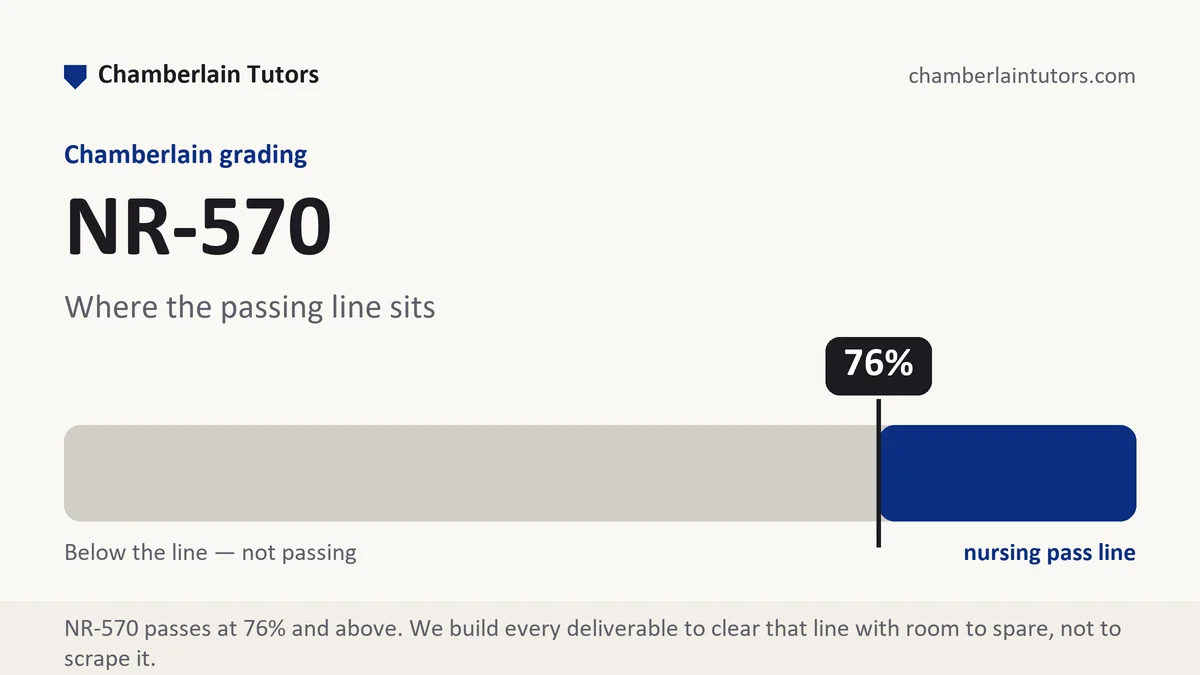
The specialty scale gives no C, which puts 84 at the boundary, and supplementary work does not repair a weighted average that has drifted. Practicum writing tends to be produced in the gaps between clinical days, and that is exactly where the middle band comes from.
How we help in this course
We draft the management case write-ups, note-format documents, condition-focused papers, discussion posts and the reflective work attached to them. Our drafts are built around the elements graders look for and students skip: a severity statement with criteria behind it, interventions in time order with rationale, named reassessment points, and a disposition decision that reads like a decision rather than a default.
The clinical component is not something we touch. We never work your hours, contact a preceptor or facility, sign or fill placement documentation, complete an hour log, or take an assessment in your place. Those 125 hours count toward the 625 clinical hours your MSN NP track requires and they have to be yours. The written work that surrounds them is where a model draft is legitimate and useful.
In NR-570 right now?
Send the week and the rubric from Canvas. First premium sample free, floor-checked, back in 24 to 48 hours.
Turn the criterion rows into a section plan
Management prompts describe a patient and ask for a plan, which sounds like one task and is scored as five. The guide is the document that tells you how many. Lift the rows into a blank file, strip each to its verb, assess, prioritize, manage, justify, evaluate, and make those your headings in the guide's sequence, so the grader meets each row where they expect it.
Then translate the percentages into words. Take a 1,400 word case with rows weighted 30, 30, 25 and 15 percent: roughly 420 words for the assessment and severity stratification, 420 for the management plan, 350 for the evidence and rationale behind it, and 210 for evaluation and disposition. In practice most drafts spend 700 words restating the presentation, because the details are in front of them, and then compress management, rationale and disposition into the remaining space. The budget is what stops that, and it is worth writing down before the first paragraph rather than discovering afterwards.
Keep the targets bracketed beside each heading and clear them as sections land. When the rationale section will not reach its share, the usual cause is that the plan was copied from practice rather than argued, and the repair is to attach one source and one reason to each intervention.
The shape of an acute management write-up
Whatever your assignment is called, the graded document usually contains these parts, and each is separately visible to a grader.
| Part | What it must demonstrate | The version that stalls in the middle |
|---|---|---|
| Presentation, compressed | The patient in three or four lines, with the findings that set urgency. | A full narrative history with the urgent findings buried inside it. |
| Severity stratification | How sick, judged against stated criteria or a validated tool, with the score's meaning explained. | The patient appears unwell, offered as an assessment. |
| Immediate actions | What happens first and why that order, including what is done before any result returns. | An undifferentiated list of orders with no sequence. |
| Therapeutic rationale | Each intervention tied to a mechanism or a guideline, sourced, with the alternative considered. | Standard treatment for this condition, cited to nothing. |
| Level of care decision | Where the patient goes, on what criteria, and what would change that placement. | Admit, with no unit named and no threshold given. |
| Reassessment triggers | The parameter, the interval, and the value that means the plan is failing. | Reassess frequently. |
| Handover and discharge criteria | What the next clinician needs, and the conditions under which this patient could go home. | Continue current management, addressed to nobody. |
Evidence and citation craft in management writing
Common conditions have the largest evidence base and the most outdated folklore attached to them, so this is where careful sourcing earns visible points.
Treat recommendations as perishable. Where your guide sets no rule, five years is the working horizon for management recommendations and anything older carries its justification in the sentence. Pathophysiology from an older source is fine. An antibiotic duration, a fluid strategy or an oxygen target from an older cycle is a claim that may have been reversed, and reversals in acute care are common enough that graders look for them.
Name the design and the population before the result. A trial in adults admitted through an emergency department is a different evidence base from a registry of patients already in intensive care. Nine words of provenance, in a randomized trial of 1,120 adults admitted with the condition, turn an instruction into an argument and let the grader see that you know which patients the number belongs to.
Verbs matched to the design. Quality registries and before-and-after implementation studies support was associated with and fell after. Reserve reduced mortality for randomized evidence. In management writing the temptation to use the strong verb is highest, because the sentence is defending a decision you have already made.
Every rate with its denominator and window. Readmission, complication and length-of-stay figures are comparisons in disguise. Twenty-nine of the 380 patients discharged returned within 30 days is usable. An 8 percent readmission rate is not, because the period is the entire argument and it has been left out.
What lifts a management plan out of the middle
A passing management write-up in NR-570 contains everything that should be done. It is correct and it is undated. Nothing in it says when, nothing says who, and nothing says what would change it, which is why it reads as a summary of the condition rather than a plan for the patient.
Strong write-ups add three elements. They put a clock on the plan, so each action has a time and each reassessment has an interval. They name the failure signal, the value or observation that would send the team in a different direction, which is the sentence that shows the writer expects reality to argue back. And they close the loop on disposition with criteria in both directions, saying what would justify a step up in care and what would allow discharge. Time, failure signal, criteria in both directions.
Mistakes that cost points here
- Order sets without reasoning. Listing what is usually ordered scores as recall. Each item needs a reason and, where it exists, a source.
- Severity asserted, not measured. If the write-up never states criteria or a score with its interpretation, the row scoring assessment has nothing to grade.
- Disposition without criteria. Naming a unit is half the answer. The other half is the threshold that put the patient there and the one that would move them.
- Reassessment with no number. Frequently is not an interval. Give the parameter, the time and the value that triggers a change.
- Ignoring the handover. A plan the next shift cannot execute is an essay. Say what to watch, what to expect and what to call about.
- Posting straight into Canvas. Discussion posts at Chamberlain cannot be edited after submission, so build the case in a document, check the timings, then paste.
Questions NR-570 students ask
How detailed should the management plan be for a common condition?
Do I need a validated severity tool in every write-up?
Can you turn my clinical encounter into the assignment write-up?
Where NR-570 sits in Chamberlain's programs
Open the exact program map for sequence, credit, and option context. The current student schedule and syllabus remain authoritative after transfer evaluation, electives, state rules, and approved plan changes.
The weeks, one by one
Week 1
NR-570 opens with a written plan for 125 precepted hours whose subject is management rather than diagnosis: what you intend to be able to decide, order and monitor by the end of the session, and what written work will show that you can. Read the full Week 1 manual.
Week 2
Early in NR-570 the written work becomes the plan itself: a problem-by-problem management document for a de-identified acute encounter, in which every intervention carries a rationale, a monitoring parameter and a stopping or escalation rule. Read the full Week 2 manual.
Week 3
Around this stage NR-570 narrows onto drug therapy: why this agent rather than the alternative, at what dose for this patient's clearance, monitored by what, and stopped or changed on what signal. Read the full Week 3 manual.
Week 4
Midway through NR-570 the writing has to hold more than one disease at once. Read the full Week 4 manual.
Week 5
Around this stage NR-570 turns to written communication between clinicians: the consult question, the escalation message, the concise clinical summary that has to move a decision. Read the full Week 5 manual.
Week 6
Late in NR-570 the written work follows the patient out of the unit. Read the full Week 6 manual.
Week 7
The scholarly stage of NR-570 asks you to argue a management plan against published guidance rather than alongside it: which recommendations you followed, which you modified, which did not apply to your patient, and what evidence sits behind each choice. Read the full Week 7 manual.
Week 8
NR-570 closes by asking what you can now manage, evidenced by the written work you produced across the practicum and mapped onto the competencies the role expects. Read the full Week 8 manual.