NR-570 opens with a written plan for 125 precepted hours whose subject is management rather than diagnosis: what you intend to be able to decide, order and monitor by the end of the session, and what written work will show that you can. Your section may print this as NR 570 or NR570; it is the same course. Chamberlain publishes no syllabi outside Canvas. The placement here is our teaching judgment from the course's catalog arc; your section's rubric decides what your week actually asks.
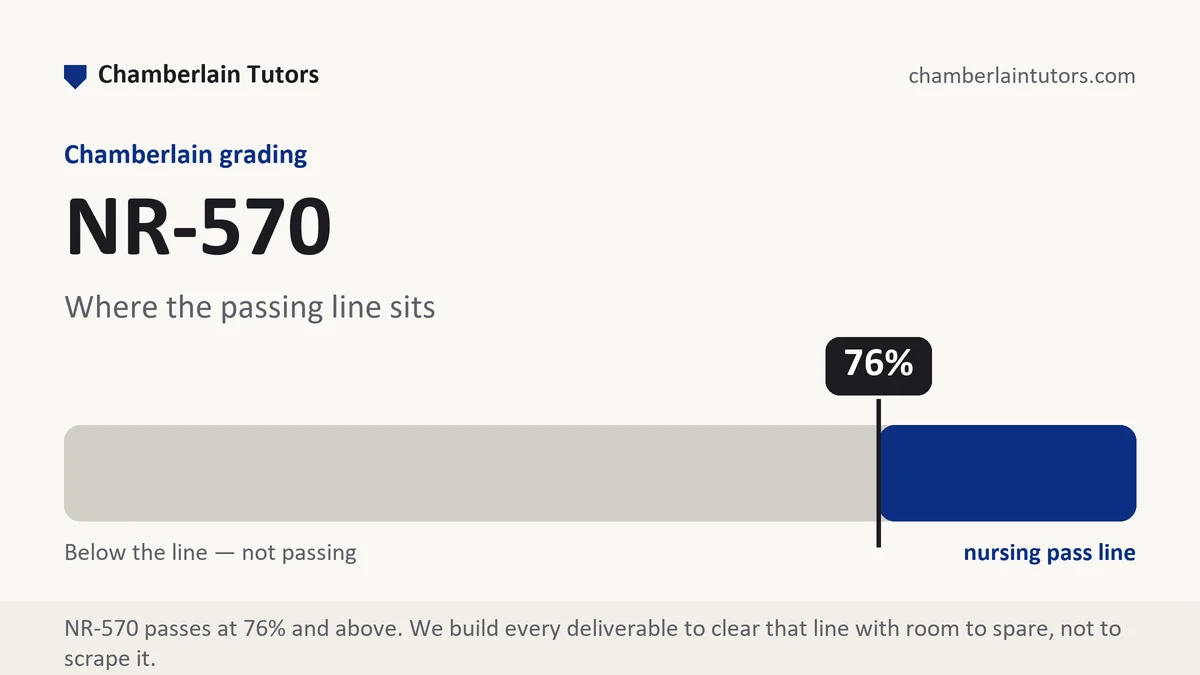
What NR-570 Week 1 asks for
Ventilator rounds move quickly. A respiratory therapist reads out the settings, the attending asks what should change today, and the trainee who has been following the patient for three days answers with a diagnosis. Nobody asked for a diagnosis. The question was what to do next, at what dose, monitored by what, with what stopping rule. Management is a different cognitive act from diagnosis, and this practicum exists because the second does not automatically follow from the first. The opening written stage is where you say, on paper, how you intend to build it.
What the deliverable looks like on the surface is a plan document: setting, preceptor structure, patient population, the shape of the hours. Where the scoring actually happens is in whether your objectives are about decisions rather than exposure. Learn more about heart failure management is a topic. Construct and defend management plans for adults admitted with decompensated heart failure, including titration parameters and monitoring, evidenced by five written plans, is an objective with a finish line a reader can inspect in Week 8.
There is a second thing this stage is checking, and it is specific to a management course. Management decisions carry authority, and in a precepted practicum your authority is bounded and shared. Your plan needs a paragraph that says plainly which decisions you draft for preceptor review, which you propose on rounds, and which you never make independently. On a graduate rubric that paragraph is scored as professional accountability, and its absence is one of the most reliable ways to lose a row that costs nothing to earn.
The boundary that governs every stage of this course belongs here, stated without softening. We support the written and preparatory layer that surrounds real clinical work. Your precepted hours, encounter logs, patient counts, site documentation, preceptor evaluations and every signature attached to them are your own record, never drafted, reconstructed or estimated with help. What can be taught is how to write clearly about management reasoning you genuinely performed, with every patient detail de-identified before it reaches the page.
The NR-570 Week 1 method, step by step
Six moves for a plan that the closing weeks can be measured against.
-
Turn each rubric row into a question you must answer
Copy the criterion rows into a blank file and rewrite each as an interrogative. What decisions will you be able to make. Where. Under what supervision. Proven by what. Those questions become your section headings, in the guide's own order.
-
Profile the caseload by problem, not by ward
Name the recurring acute problems your setting admits, the proportion of older adults, the typical length of stay and where patients go afterwards. A management plan built without knowing the discharge destination is missing half the decisions.
-
Write objectives around decisions and their monitoring
A management objective needs the decision, the population, the depth and the proof. Titrate and document rationale for vasoactive or diuretic therapy in older adults, with monitoring parameters stated, evidenced by written plans, does all four in one sentence.
-
Declare your supervision boundaries as a list of decision types
Drafted for review, proposed on rounds, never independent. Sorting decisions into those three categories in Week 1 gives every later paper a stable way to describe your own role without overstating it.
-
Plan the written artifacts, not just the shifts
Say how many management write-ups you intend to produce and roughly when. Written work scheduled early gets written; written work left to the availability of an interesting patient arrives in Week 7 in a heap.
-
Name your own knowledge gaps by drug class and problem
Vague deficits produce vague plans. Anticoagulation in renal impairment, or antibiotic de-escalation, are gaps precise enough to build reading and writing around before the hours start.
A layout and word budget for a management practicum plan
The drafting frame our tutors keep beside an opening plan for a management practicum, sized for roughly 1,000 to 1,300 words. It is our own outline rather than anything the university issues, and your week's rubric outranks it wherever the two disagree.
| Section | What belongs in it | Word target |
|---|---|---|
| Aim of the practicum | What these hours are meant to change about your management decision-making, in one paragraph with no preamble. | 80 to 100 |
| Caseload profile | The recurring acute problems, the older adult share, length of stay, and where patients go on discharge. | 180 to 220 |
| Decision inventory | The management decisions you expect to participate in, sorted into drafted, proposed and never independent. | 200 to 240 |
| Objectives with proof | Three or four objectives, each naming a decision, a population, a depth and the written artifact that evidences it. | 260 to 320 |
| Knowledge gaps and reading | Named gaps by drug class or problem, with the preparatory reading and writing attached to each. | 150 to 190 |
| Schedule of written work | When each write-up lands, the midpoint review, and the closing evaluation dated first. | 110 to 150 |
Evidence craft for a management practicum plan
Frame objectives against published role competencies. Adult gerontology acute care practice is described in competency documents issued by named professional organizations, and writing your objectives in their language turns a personal list into a plan measured against an external standard. Name the body and the edition year in the sentence.
Describe the caseload with proportions. A service where roughly two-thirds of admissions are adults over seventy-five, and where a third are transferred from long-term care, tells a reader what management problems will actually reach you. Descriptors like high acuity carry no information a plan can be judged against.
Cite something on the safety of the decisions you are learning. Medication-related harm, transitions of care and monitoring failures all have substantial published literature, and grounding your plan in one of them signals that you understand management as a risk-bearing activity rather than a set of orders.
Keep site-specific pathways in their place. Internal order sets and unit protocols are not citable evidence. Where they shape what you can do, name them as local practice and support the underlying reasoning from published sources instead.
De-identify any past encounter used as illustration. If a previous case explains a gap you are naming, strip identifiers before the sentence exists: no exact ages, no dates, no unit or facility names, no combination of details that would let a colleague place the patient.
Five mistakes that cost points in this week's territory
- Diagnostic objectives in a management course. Getting better at recognizing conditions is a different competency, and a plan full of recognition goals has answered the previous practicum's question.
- A caseload description made of adjectives. Busy, diverse and high acuity are impressions, and none of them lets a reader judge whether your objectives are achievable there.
- Authority left unstated. A plan that never says which decisions are yours to propose rather than to make reads as a misunderstanding of a precepted role.
- Objectives with no monitoring in them. In management, the decision and its monitoring are one thought, and an objective that stops at the order has stopped halfway.
- Written work left unscheduled. Artifacts that were never given a date are the ones missing from the closing portfolio, and Week 8 has nothing to point at.
Before you submit
- The caseload is described by recurring problems and proportions
- Every objective names a decision, a population, a depth and a written proof
- Monitoring parameters appear inside the objectives, not after them
- Decisions are sorted into drafted, proposed and never independent
- A published competency document is cited with its year in the sentence
- The plan states plainly that hours, logs and evaluations are your own record
- Each written artifact has a date and the closing evaluation was scheduled first
Opening NR-570 this week?
Send the instructions and the rubric out of Canvas. A premium original draft of the written layer comes back in 24 to 48 hours with objectives built around decisions and their monitoring, and revisions run until the grade lands. Hours, logs and evaluations stay yours.