NR-560 Professional Nursing Capstone carries three theory credits and no practicum credit, and it asks you to apply the whole degree in a real-world setting through a quality improvement initiative built with an interdisciplinary team. Nothing about that is graded at the bedside. It is graded as a project document: a problem defined with numbers, an aim somebody could hold you to, an intervention defended from evidence, and a measurement plan that would expose the project if it failed.
What NR-560 actually grades
A capstone rubric scores synthesis, which is a specific thing rather than a compliment. It means the reader should be able to see the statistics course, the evidence course and the systems course all working inside one document without any of them being named. The graded question underneath is narrow: can you take a problem that exists in a real unit, size it with data, choose a change that the literature supports for that problem, and describe how the team would know within a defined period whether it worked.
Most submissions lose their points at the front. Students write about a topic instead of a problem. A topic is nurse burnout. A problem is that on one 32-bed medical unit, a defined share of night-shift nurses left within twelve months, measured against a comparison the reader can check. Everything downstream inherits the difference: an aim built on a topic cannot carry a number, and a project with no number has nothing to measure at the end.
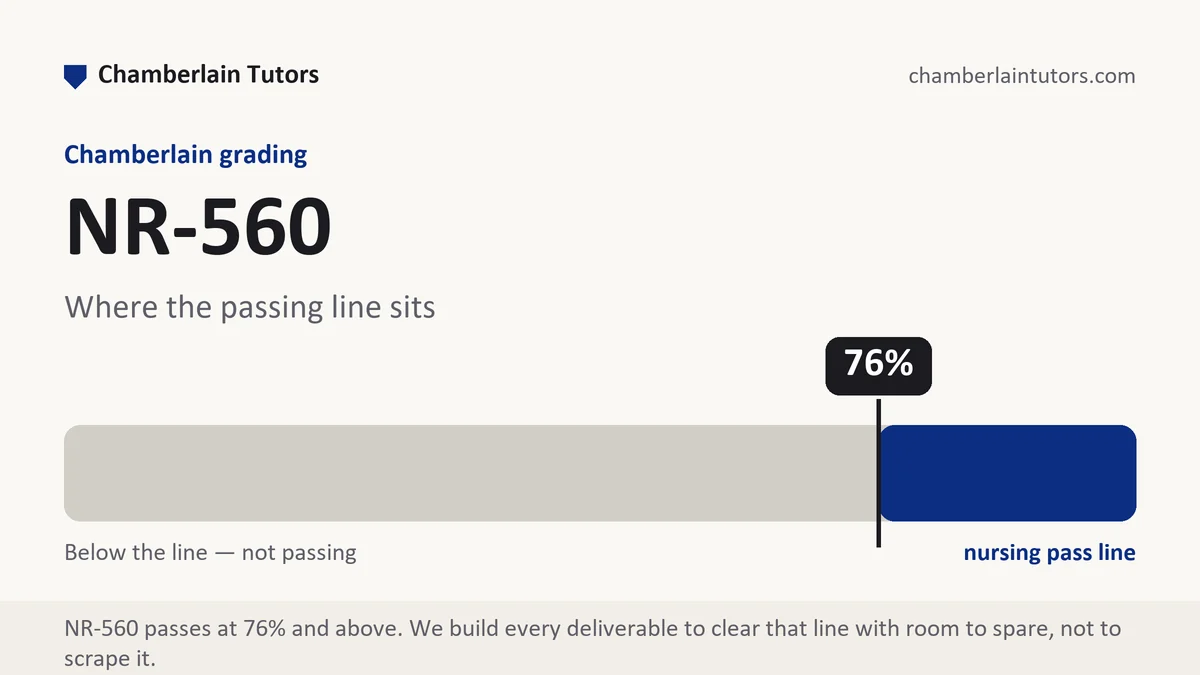
The 76 percent floor for core nursing courses sits under this course, and a capstone is a poor place to discover a weighted average is short. Where your course builds the project in parts across the session, later parts inherit the flaws of earlier ones, because the aim you wrote in the opening section is the aim the measurement section has to serve.
How we help in this course
We build the written project: the problem statement with its baseline framing, the evidence synthesis, the intervention design, the measurement plan, the stakeholder and team sections, the dissemination piece, plus the discussion posts and the reflective writing that runs alongside. Where a course asks for an executive summary or a poster narrative drawn from the paper, that gets drafted from the same spine so the two documents agree.
What we do not do is invent your site. We never contact a facility, a manager or an interdisciplinary team member, and we never fabricate baseline data for a unit we have not seen. Where the setting details are yours to supply, our draft is built with the placeholders visible so you fill them from what you actually observed rather than around a number somebody made up.
In NR-560 right now?
Send the week and the rubric from Canvas. First premium sample free, floor-checked, back in 24 to 48 hours.
Read the rubric before the prompt
Capstone prompts are written in program language and scoring guides are written in gradeable language, so read the guide first and let the prompt fill in the theme. Paste the criterion rows into an empty document, one per line, and reduce each to the verb it is really asking for: identify, justify, synthesize, design, measure, disseminate. Those verbs are your headings, kept in the order the guide lists them, because a reader scoring down a column should never have to hunt.
Then convert the weights into words, because a percentage is a depth instruction. Say your project document is capped at 2,500 words with four rows weighted 30, 25, 25 and 20 percent. Multiplying through gives roughly 750 words to the problem and its data, 625 to the evidence synthesis, 625 to the intervention design and 500 to measurement and evaluation. Students almost never write it that way. The evidence section swells past 900 words because summarizing articles feels productive, and the measurement section, the one row where a capstone proves it is a project rather than an essay, arrives at 200 words the night before it is due. Title page, references and appendices sit outside the count unless the guide says otherwise.
Keep the target beside each heading while you draft and delete it when the section reaches its share. Any section running well under budget is telling you something true about the thinking behind it, usually that the intervention was chosen before the evidence was read.
The shape of a quality improvement project document
Whatever your course calls the deliverable, a capstone project paper assembles from these parts, and a grader can either find each one or cannot.
| Part | What it has to establish | The version that scores in the middle |
|---|---|---|
| Problem, localized | What is going wrong, where, to whom, and how far it sits from an expected value. | A national statistic with no local anchor, so no reader knows what would improve. |
| Aim statement | One sentence carrying a direction, a number, a population and a date. | To improve communication among staff, which cannot be met or missed. |
| Evidence synthesis | What has been tried for this problem, what worked, in settings close enough to yours to transfer. | Article summaries in sequence, each ending where it started. |
| Team and stakeholders | Who has to act, who can block it, and what each needs before they agree. | A list of departments with no statement of what any of them do. |
| Intervention design | The change itself, described so another nurse could run it next Monday. | Education and awareness, with no content, audience, dose or owner. |
| Measurement plan | Outcome, process and balancing measures, each with a source, a denominator and a review interval. | Pre and post surveys, unnamed, ungathered, unscheduled. |
| Sustainability and spread | What keeps this running after the project ends and who owns it then. | A closing paragraph about the importance of ongoing commitment. |
Evidence and citation craft at capstone level
A capstone is judged partly on how carefully it handles other people's results, because the whole argument is that a change worked somewhere else and can be expected to work here. Four habits carry most of that weight.
Recent enough to act on. Where your guide sets no rule, treat anything past five years as needing its justification written into the sentence. A model of change published decades ago is fair to cite as a model. A staffing ratio, a readmission benchmark or a technology cost from that era is not, and reviewers notice the difference immediately.
Design and setting before the result. Name what produced a finding before you use it. In a quality improvement literature this matters more than usual, because much of it is single-site pre-post work. Writing that a project reduced falls at one 24-bed rehabilitation unit over six months tells your reader exactly how much confidence to lend it, and it protects you when a grader asks whether the evidence transfers.
Verbs the design can pay for. Pre-post improvement work rarely supports a causal verb. Say the rate fell after implementation, or the intervention was associated with fewer events, and reserve caused and reduced for controlled comparisons. This single substitution separates graduate writing from undergraduate writing more reliably than vocabulary does.
No rate without its denominator and its window. Every number in a capstone needs a base and a period attached. Thirty-one falls per 1,000 patient days across the second quarter is a measure. A 31 percent fall rate is a sentence with a hole in it, and it will be the sentence a reviewer circles, because the entire measurement plan rests on knowing what you divided by.
What separates a passing capstone from a strong one
A passing capstone is complete and unfalsifiable. It has all the sections, cites real sources, proposes something reasonable, and would read the same if the setting changed. It sits in the high seventies or low eighties because nothing in it could turn out to be wrong.
Strong capstones do three things the middle band avoids. They commit to a number, so the aim can fail publicly. They name what would make them abandon the intervention, which is the clearest evidence a student is thinking like a project lead rather than an essayist. And they carry a balancing measure, some second thing that could get worse while the target gets better, because every real change in a hospital moves work from one place to another and graders in a systems course know it. A project that says what it might break is a project somebody has thought about.
Mistakes that cost points here
- An aim with no number in it. If the aim cannot be met or missed by a date, every downstream section is describing a plan for nothing in particular.
- Education as the whole intervention. Teaching is a component, not a change. Name the workflow, the trigger, the owner and the point in the day it happens.
- Evidence summarized rather than synthesized. Group sources by what they claim and where they disagree. A paragraph per article reads as a reading log.
- A team section with no conflict in it. Interdisciplinary work is graded on how you handle competing priorities, so name the department whose workload increases and what you offered it.
- Identifiable facility or patient details. Describe the unit by size, population and setting type. No facility names, manager names, room numbers or dates of specific events.
- Writing the discussion post as a rough draft. Posts do not reopen for editing once submitted at Chamberlain, so build the post outside Canvas, read it once, then paste it.
Questions NR-560 students ask
I do not have real baseline data from my site. What do I write instead?
How do I keep the evidence section from turning into a list of article summaries?
My aim statement keeps getting marked down. What does a strong one look like?
Where NR-560 sits in Chamberlain's programs
Open the exact program map for sequence, credit, and option context. The current student schedule and syllabus remain authoritative after transfer evaluation, electives, state rules, and approved plan changes.
The weeks, one by one
Week 1
Medication reconciliation is a good illustration of what a capstone problem statement has to do, because everyone agrees it matters and almost nobody can say how often it fails where they work. Read the full Week 1 manual.
Week 2
Restraint documentation audits are a useful teaching case for this stage because the numbers almost always tell two stories at once: a compliance rate that looks like a training problem, and a workflow underneath it where the required entry lives three screens away from where the nurse is standing. Read the full Week 2 manual.
Week 3
Bedside shift report is the classic example of an intervention whose published record is far more interesting than its reputation: the results vary widely, and most of the variation comes from how faithfully it was implemented rather than from whether it works. Read the full Week 3 manual.
Week 4
An aim statement is the sentence a project can be held to, and the fastest way to test yours is to imagine a compliance report six months from now: could somebody open it and say yes or no. Read the full Week 4 manual.
Week 5
Look at the sign-in sheet of any improvement team that stalled and you will usually find the same thing: every discipline attended the first meeting, and by the third only nursing was still in the room. Read the full Week 5 manual.
Week 6
Every unit has a laminated protocol on a wall that nobody follows, and the reason is almost always in the implementation rather than the protocol. Read the full Week 6 manual.
Week 7
An alarm-reduction project that hits its target while quietly increasing the time nurses spend at the central station has not succeeded; it has moved the problem somewhere nobody was auditing. Read the full Week 7 manual.
Week 8
Audit trails of abandoned initiatives all end the same way: compliance holds for six weeks, the person who cared about it moves to another unit, and by the next quarterly report the number is back where it started. Read the full Week 8 manual.