NR-555 Health Policy: Advancing Health Equity and Outcomes carries three theory credits and covers social determinants of health together with the policy interventions that reduce disparity and improve quality. The deliverable it keeps returning to is the policy brief, which is a different genre from the academic paper you have been writing all program: it is addressed to somebody, it presents choices, and it ends in a decision rather than a conclusion.
What NR-555 actually grades
Whether the writing is aimed at a reader who can act. A brief has an audience with authority and limited time, which changes everything about the structure: the recommendation appears early, the background is rationed to what the decision requires, and every paragraph is answering the unspoken question of what the reader is being asked to do. Students submit five-paragraph essays with a policy topic and lose the format rows before the content is read.
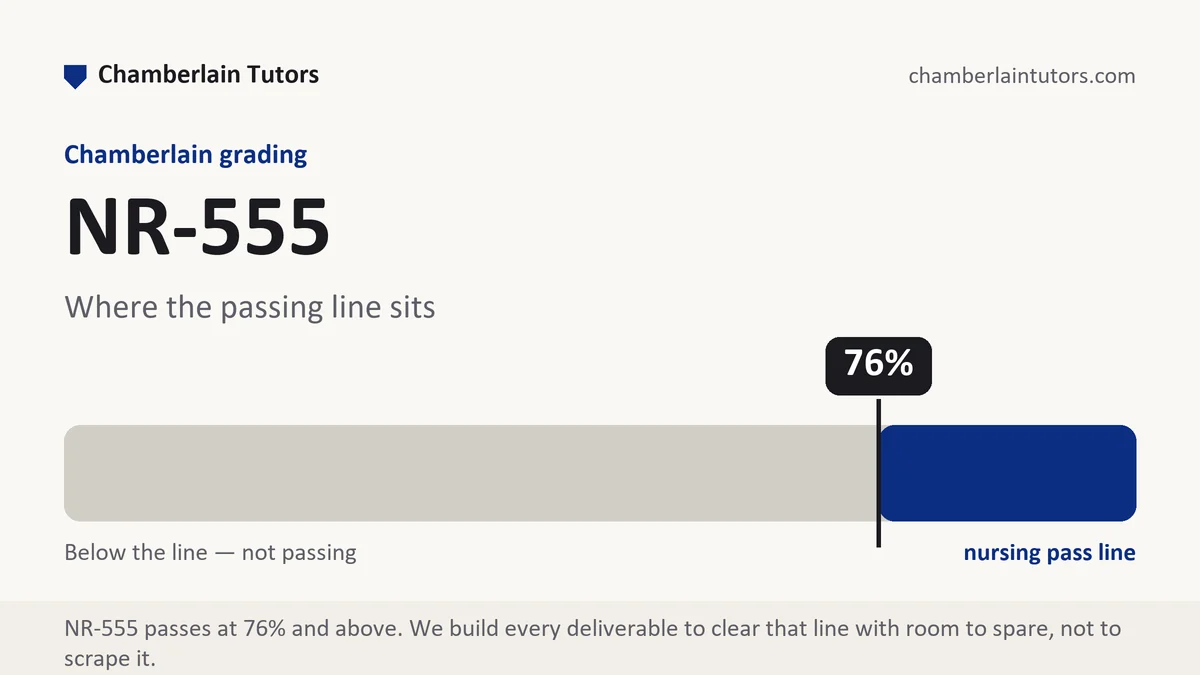
The second axis is the pathway. Naming a social determinant is worth almost nothing on its own; what earns marks is the chain from the condition to the health outcome to the policy lever that interrupts it. Chamberlain's 76 percent floor for core nursing courses applies here, and inside an eight-week session with weekly deliverables the early weeks carry disproportionate weight. Supplementary work will not rescue an average that has already been set by three vague submissions.
How we help in this course
We draft policy briefs, determinant analyses, option papers, stakeholder and opposition assessments, equity impact write-ups, discussion responses and the session project. Our drafts open with the decision being requested and keep the background subordinate to it, which is the structural habit this course rewards most consistently.
We write from published sources and from the scenario your prompt sets. We do not contact legislators or their staff, submit testimony, sign petitions, or communicate with any agency on your behalf. Where an assignment asks you to send something to a real official, that action stays with you.
In NR-555 right now?
Send the policy issue, the audience if you have one, and the rubric from Canvas. First premium sample free, floor-checked, back in 24 to 48 hours.
Read the rubric before the prompt
Brief assignments carry format rows that essay writers never look for, so the guide is where the genre is defined. Copy the criterion rows into an empty file and reduce each to its verb: identify, analyze, evaluate, recommend, communicate. That last verb is the one that catches people. A row about clarity or audience is grading whether the document behaves like a brief, and it is scored even when your analysis is excellent.
Then convert weights into words. Take an 1,100 word brief with four rows at 40, 30, 15 and 15 percent. That is 440 words for the first row, 330 for the second and 165 for each of the last two. Briefs are short by design, so the arithmetic bites immediately: 165 words is one tight paragraph, and if that row is your evaluation plan then the plan has to be specific rather than elaborate. Meanwhile a 440 word row leaves no space for a general introduction about the importance of equity, which is what most first drafts spend it on. Title page and references sit outside the count unless your guide says otherwise.
Write the four numbers beside the headings and check them after the first draft of the options section. If options and recommendation together are shorter than the background, the document is still an essay.
The shape of a policy brief
Whatever your section titles it, the dominant deliverable here asks somebody to choose something. These are the parts a grader looks for.
| Part | What it must do | What a weak version does |
|---|---|---|
| Audience and the decision | Names who is reading and what they are being asked to approve, fund or change. | Addresses policymakers in general. |
| Issue statement | One sentence containing the problem, the affected group and the size of the gap. | A paragraph of context with the problem implied. |
| Background, rationed | Only the history the decision requires, with the current legal or regulatory status confirmed. | A chronology of every related law since the 1960s. |
| Determinant and pathway | The specific condition and the steps by which it produces the health outcome. | Names housing or transportation and moves on. |
| Options, at least two | Real alternatives, each with its cost, its reach and what it fails to solve. | One preferred idea and two obviously weak foils. |
| Recommendation and instrument | The chosen option and the actual mechanism: statute, rule, payment change, accreditation standard, organizational policy. | Recommends that more should be done. |
| Implementation | Who acts, what they need, and what the first ninety days look like. | Assumes adoption follows agreement. |
| Evaluation | One measure, its denominator, and the date the decision maker reviews it. | Promises ongoing monitoring of effectiveness. |
Evidence and citation craft at this level
Policy evidence goes stale faster than clinical evidence and is quoted more loosely, so four habits matter.
Currency, and the current status of the law. Where your guide sets no rule, five years is the working line for evidence, and for legal or regulatory facts the requirement is stronger: verify the present status before you write about it. Bills that were introduced are not law, rules that were proposed may never have been finalized, and provisions get delayed or repealed quietly. Cite the enacted text or the agency rule itself, and name the date you checked it if your guide allows.
Say what kind of study produced the finding. Policy effects are usually estimated from natural experiments, comparisons between states that adopted and states that did not, or before and after series with controls. Ten words of setup, such as comparing states that expanded a program with those that did not, tells the reader how much confidence the number carries. Advocacy organizations publish real analysis alongside real spin; cite them for positions and prefer peer-reviewed or nonpartisan analytic sources for effects.
Verbs the design can pay for. A well-constructed policy evaluation can support caused or increased, but most of what you will cite supports was associated with, rose following implementation and remained higher after adjustment. The riskiest sentence in a brief is the one predicting what your recommendation will achieve, so write it as an expectation with its basis attached rather than as a result already banked.
Denominator and window on every figure. Write 61 percent of the 12,400 eligible residents were enrolled in the first program year rather than enrollment was low. Coverage and screening claims need the eligible population in view, and program figures need the year stated, since first-year numbers and steady-state numbers are different animals and briefs routinely present one as the other.
What separates a passing brief from a strong one
A passing brief identifies a real determinant, cites current sources, and recommends expanded funding and improved coordination. It scores in the high seventies to low eighties because the reader is never told who decides, what the alternatives were, or how anyone would know if it worked.
Strong briefs do three things. They name the decision maker in the first two sentences and stay inside that person's authority, which quietly solves the level-of-government problem that muddles most student policy writing. They present a genuine rival option and concede something to it, because a brief that dismisses every alternative reads as advocacy and a brief that weighs one honestly reads as counsel. And they name the instrument: not that access should improve, but that a specific payment rule, licensure provision, screening requirement or budget line should change, which is the difference between a paper about policy and a piece of policy work. Close with a review date and a measure, and the reader knows exactly what they are committing to.
Mistakes that cost points here
- No audience. A brief addressed to nobody cannot be judged for fit, and the communication row has nothing to score.
- A determinant with no pathway. Naming transportation is not analysis. Show the missed appointments, the delayed diagnosis, the outcome, in that order.
- Only one option. Without an alternative there is no decision, and the evaluation row collapses into agreement with yourself.
- Level confusion. Asking a hospital board to change federal law, or a legislator to change a unit protocol, loses the application row regardless of the idea.
- Citing a bill as though it were law. Introduced, passed one chamber, enacted and in force are four different states. Say which one applies.
- Treating the discussion board as a first draft. Posts do not reopen once submitted at Chamberlain, so a misstated legal status stays visible all week. Confirm before you paste.
Questions NR-555 students ask
How much background belongs in a brief?
My prompt does not name an audience. What do I do?
Should I write at the organizational, state or federal level?
Where NR-555 sits in Chamberlain's programs
Open the exact program map for sequence, credit, and option context. The current student schedule and syllabus remain authoritative after transfer evaluation, electives, state rules, and approved plan changes.
The weeks, one by one
Week 1
An opening stage in a health policy course is where a clinical irritation gets converted into a policy problem, and the conversion is the graded skill. Read the full Week 1 manual.
Week 2
Naming a social determinant is easy and worth almost nothing on a graduate scoring guide. Read the full Week 2 manual.
Week 3
Almost nothing you want to change is unregulated. Read the full Week 3 manual.
Week 4
Interests are not opinions, and the middle of a policy course is where that distinction starts carrying grades. Read the full Week 4 manual.
Week 5
Three options, one set of criteria, and a verdict that could have gone another way. Read the full Week 5 manual.
Week 6
Every policy argument eventually meets someone holding a budget, and the sentence that decides the meeting is the one naming who pays and who saves. Read the full Week 6 manual.
Week 7
It is a different genre with a different reader, and the reader is a staffer with eleven minutes who will decide whether the person they work for hears about your issue at all. Read the full Week 7 manual.
Week 8
A policy that improves an average and leaves a gap untouched has failed the standard this course sets, and the only way anyone finds out is if the measurement plan was built to notice. Read the full Week 8 manual.