Three options, one set of criteria, and a verdict that could have gone another way. That is the whole architecture of an appraisal stage, and papers fail it in a predictable manner: the writer decides in advance, then builds two weak alternatives so the preferred one wins. A grader can see that from a page away. Consider a proposal to reduce night-time transfers out of a skilled nursing facility. On-site advanced practice coverage, an after-hours telehealth contract, and standing order protocols with a pharmacy consultation requirement are three genuinely different instruments, with different costs, different equity consequences and different odds of surviving a legislative session. NR-555 Week 5 asks you to judge between them on stated criteria. Your section may print this as NR 555 or NR555; it is the same course. Chamberlain publishes no syllabi outside Canvas. The placement here is our teaching judgment from the course's catalog arc; your section's rubric decides what your week actually asks.
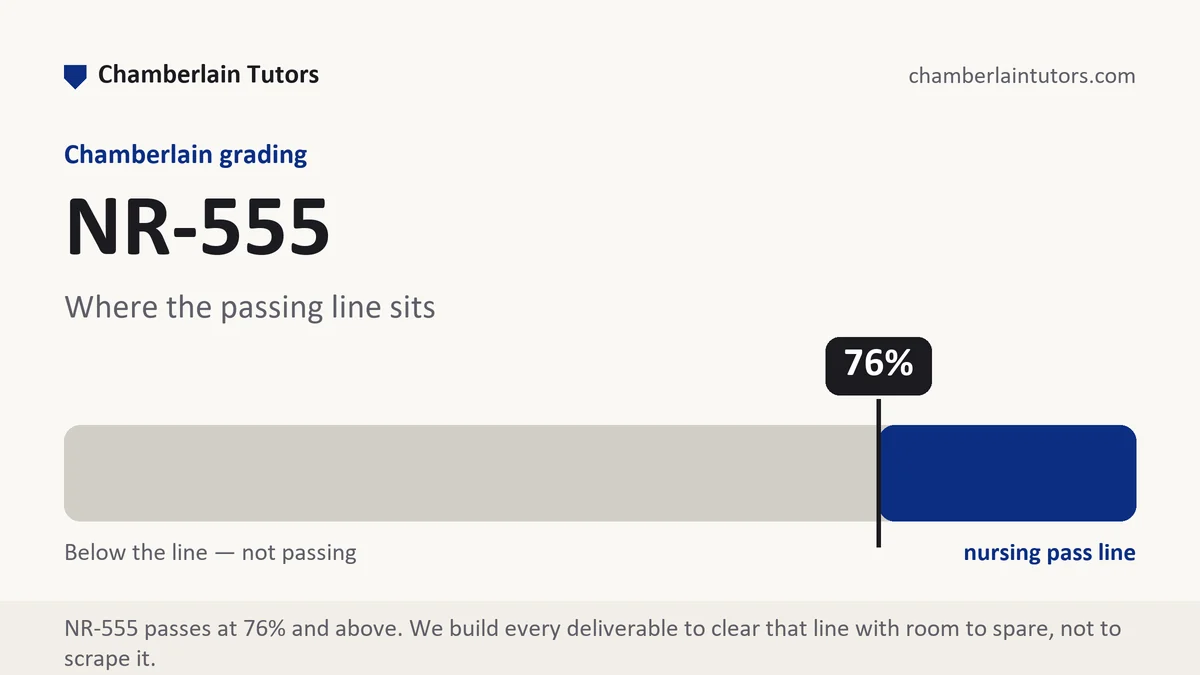
What NR-555 Week 5 asks for
An option stage is a comparison exercise with an explicit method. The method has two parts and both are graded. First, the criteria: the dimensions on which alternatives will be judged, chosen and defined before any option is discussed. Second, the application: each option assessed on every criterion, in the same order, with evidence rather than adjectives.
Criteria in health policy usually include effectiveness, cost and affordability, feasibility given the political configuration you mapped earlier, administrative burden on the people who have to operate the change, and equity. That last one deserves its own definition sentence in a course built on disparity, because equity is not a synonym for effectiveness. An option can improve average outcomes while widening a gap, which happens routinely when a change depends on resources that are unevenly distributed. Facilities with the thinnest staffing are the ones least able to implement a new documentation requirement, and a policy that assumes capacity will find capacity is exactly where it already is.
Weighting is the second thing students skip. If all criteria count equally, say so and defend it. If effectiveness matters more than administrative burden in your judgment, say that too, and say why. A verdict that emerges from an unstated weighting looks arbitrary even when it is right.
The status quo belongs in the comparison. Doing nothing is a real option with real consequences, and including it forces you to quantify what the problem costs if untouched. Papers that omit it implicitly assume change is free, which no policy reader believes.
The NR-555 Week 5 method, step by step
Six moves for an appraisal that reads as judgment rather than as preference.
-
Write and define the criteria before naming any option
Four to six, each with a sentence saying what would count as scoring well on it. Effectiveness measured how, over what horizon, for whom. Criteria defined after the options are on the page always end up shaped to fit the winner.
-
Build three options that a reasonable person could prefer
One incremental, one structural, one that shifts who pays or who is accountable. If you cannot write a fair paragraph arguing for each, the set is not a comparison and the appraisal collapses into advocacy.
-
Describe each option as an instrument with an operator
Say what legal or contractual form it takes, who issues it, who must comply, and what happens if they do not. Options described as goals rather than instruments cannot be appraised on feasibility or burden.
-
Run every option through every criterion in the same order
Consistency of order is what makes a comparison readable. Where evidence is missing for one cell, say that the evidence is missing rather than filling it with an inference the reader cannot separate from a finding.
-
Test each option for distributional effect specifically
Ask who is least able to comply, and whether the option's benefits require a resource the worst-served settings do not have. This paragraph is where equity analysis actually happens, and it is the one graders in this course read most closely.
-
Deliver a verdict with its own defeat condition
Name the option you recommend, then name the fact that would change your recommendation if it turned out otherwise. A verdict carrying its own condition of defeat is the strongest form a policy judgment takes on paper.
A layout and word budget for an option appraisal
Our frame for this stage, sized for roughly 1,300 to 1,600 words with a comparison table. It is our own outline rather than anything the university issues, and your week's rubric outranks it wherever the two disagree.
| Section | What belongs in it | Word target |
|---|---|---|
| Decision framing | The problem in two sentences and the question the appraisal answers, phrased as a choice between named alternatives. | 90 to 120 |
| Criteria and definitions | Four to six criteria, each defined by what good performance would look like, plus your weighting and its justification. | 240 to 300 |
| Option one, incremental | The instrument, its operator, and its performance across every criterion in the fixed order. | 230 to 280 |
| Option two, structural | The same treatment for a change that alters authority, staffing standards or payment conditions. | 230 to 280 |
| Option three and the status quo | A third alternative plus the cost of leaving the arrangement as it is, judged on the same criteria. | 240 to 300 |
| Verdict and defeat condition | The recommendation, the trade it accepts, and the finding that would overturn it. | 170 to 220 |
Evidence craft for comparative appraisal
Borrow evidence from places that already tried it. Most options you can imagine exist somewhere. States, systems and pilot programs generate evaluations, and a comparison grounded in what happened in a jurisdiction that adopted a similar instrument is far stronger than reasoning from first principles.
Report transferability honestly. When you use an evaluation from another setting, say what differs: the payer mix, the facility size, the workforce supply, the density of the geography. One clause of transfer analysis prevents the common criticism that a promising result was imported without inspection.
Keep cost language separate from cost evidence. Cheaper and expensive are comparisons that need a base. Where published costing exists, cite it with its year and its unit. Where it does not, describe the cost drivers qualitatively and say plainly that you are not costing the option, which is more credible than a manufactured figure.
Do not let feasibility swallow the analysis. Political difficulty is one criterion among several. Papers that reject every structural option as unrealistic end up recommending whatever is easiest, and graders read that as an absence of analysis rather than as pragmatism.
Five mistakes that cost points in this week's territory
- Straw alternatives. Two options constructed to lose make the appraisal decorative, and the pattern is obvious to anyone who reads these papers regularly.
- Criteria invented after the fact. Dimensions that appear for the first time in the verdict paragraph tell the reader the conclusion came first.
- Equity folded into effectiveness. An option that raises the average while widening the gap scores well on a paper that never separated the two, and that is precisely the error this course exists to correct.
- No status quo column. Leaving out the cost of inaction makes every alternative look burdensome by comparison with nothing.
- A verdict with no trade named. Recommending an option without saying what it gives up reads as enthusiasm rather than as judgment.
Before you submit
- Criteria are defined before any option appears
- Weighting is stated, even if the weighting is equal
- Each option is described as an instrument with an issuer and a complier
- Every option is assessed on every criterion in the same order
- A distributional paragraph asks who is least able to comply
- The status quo is appraised alongside the alternatives
- The verdict names both a trade and a condition that would reverse it
Comparing options for NR-555?
Send the rubric and the instructions out of Canvas. A premium original draft comes back in 24 to 48 hours with criteria defined up front, three genuine alternatives, and a verdict that carries its own defeat condition, and revisions run until the grade lands.