NR-543 Information Workflow in Healthcare carries three theory credits and applies information system life cycle concepts to improving the way information moves through healthcare work. The graded writing asks for something narrower than students expect: not an opinion about a system, but a described sequence of steps with real actors, a defect located inside that sequence, and a redesign that says what breaks next. Most lost points sit in the description, not the recommendation.
What NR-543 actually grades
Fidelity first. A workflow section is scored on whether a reader who has never seen your unit could reconstruct the current process: who does what, in what order, using which screen or paper, and what has to arrive before the next step can start. Students write the process they believe exists, which is the policy, rather than the one people actually perform, which is where the defect lives. Rubric rows about analysis have nothing to grade when the sequence is idealized.
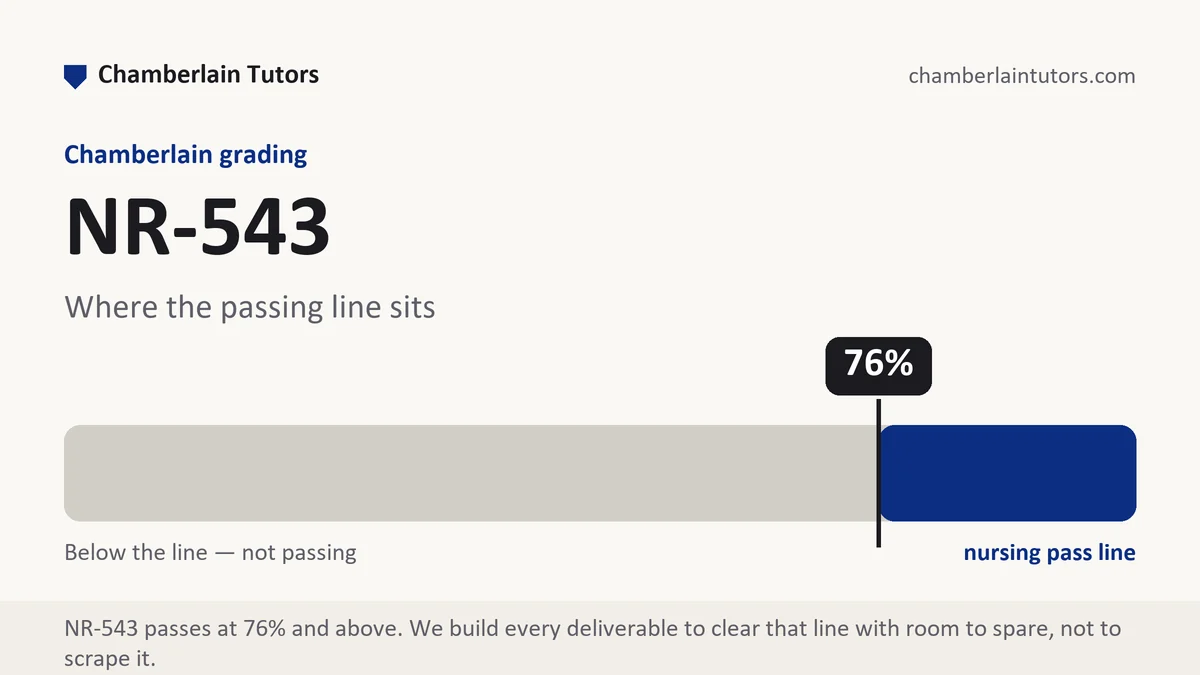
Second, life cycle discipline. The course expects you to place your work in a phase, and the phase controls what you are allowed to recommend. A problem discovered in evaluation is handled differently from one caught in design, and a paper that proposes a build change while writing about a post-implementation review has mixed its phases. The 76 percent floor for core nursing courses sits under all of this, and the eight-week session leaves no slack: an unfocused week is on your weighted average within days, and no supplementary submission repairs an average that has already settled.
How we help in this course
We draft workflow analyses, current and future state write-ups, life cycle phase papers, gap analyses, implementation and downtime plans, discussion responses and the session project. Our drafts keep the sequence in the foreground, with actors named at every step, so the analysis rows have something concrete to attach to.
We write from what you observed and from the scenario your prompt sets. We do not enter your facility, observe staff, request system access, or gather timings for you. If your section asks you to shadow a process, you do the watching and we turn your notes into the graded document.
In NR-543 right now?
Send the process you are analyzing and the rubric from Canvas. First premium sample free, floor-checked, back in 24 to 48 hours.
Read the rubric before the prompt
The guide in a workflow course usually contains a row that the prompt never mentions, and it is normally the one about consequences. Copy the criterion rows into a blank file and strip each to its verb: describe, map, analyze, propose, anticipate, evaluate. Keep them in the printed order and let them become your headings, because a grader working down the guide should meet each section as the row comes up.
Then convert weights into words. Take a 1,400 word paper with four rows at 40, 20, 20 and 20 percent. That gives 560 words to the first row and 280 words to each of the other three. When the 40 percent row is the current state description, 560 words is roughly two full pages of sequence, which is more than most students think a description deserves and exactly why their analysis has nothing to bite on. Three equal rows at 280 words each also means three balanced sections, not one long recommendation and two token paragraphs. Title page and references sit outside the count unless your guide says otherwise.
Put the four numbers next to the headings and check them once the current state is finished. If the description came in at 200 words, you have not watched the process closely enough to write the rest.
The shape of a workflow analysis and redesign
Section names vary, but the dominant deliverable here is a written analysis of one process before and after a change. These are the parts that carry marks.
| Part | What it must establish | What a weak version does |
|---|---|---|
| Scope boundary | The event that starts the workflow and the event that ends it, stated before anything else. | Begins in the middle and drifts into adjacent processes. |
| Current state, step by step | Each step with its actor, its input, its system or paper artifact, and its output. | A summary of how the department generally operates. |
| Volume and timing | How often the workflow runs, how long steps take, where the queue forms. | An assertion that the process is time consuming. |
| Defect located in a step | The specific step where information is lost, duplicated, delayed or re-entered. | A general complaint about the electronic record. |
| Life cycle placement | Which phase this work belongs to and what that phase permits you to change. | Names the phases in a paragraph and never uses them. |
| Future state | The same sequence rewritten, with the changed steps marked and the actors updated. | A wish that the system would talk to itself. |
| Downstream consequences | What the change pushes onto another role, shift or department, named honestly. | Assumes the redesign has no cost to anyone. |
| Evaluation trigger | The measure and the date at which you would decide the change failed. | Promises continuous monitoring with no threshold. |
Evidence and citation craft at this level
Workflow claims are easy to assert and hard to support, which makes four habits load bearing.
Currency, and the version behind the study. Where your guide sets no rule, treat five years as the line for implementation literature, because findings about adoption are tied to system versions and regulatory conditions that move quickly. When you cite something older for a life cycle framework, say in the sentence that you are using it as a framework rather than as current evidence.
Name the observation method before the finding. A workflow number can come from direct observation, from staff self-report or from system audit logs, and these three disagree with each other in predictable directions. Seven words of setup, such as timed across 22 observed medication passes, tells the reader how much weight the figure carries. Self-reported time is consistently longer than observed time, and saying which one you used protects the rest of the analysis.
Verbs your evidence can pay for. Before and after comparisons in one unit are observational. They support fell alongside and was faster in the period after; they do not support the redesign reduced unless a controlled evaluation stands behind it. This is the single most common overreach in workflow papers, and it usually appears in the sentence the student is proudest of.
Denominator and window on every timing claim. Write four minutes per admission across 60 admissions observed over two weeks rather than saves four minutes. State the unit the time is per, the number of instances measured and the period, and say whether the measurement covered nights and weekends, since a workflow observed only on day shift is a different workflow.
What separates a passing analysis from a strong one
A passing analysis identifies a real annoyance, describes it broadly, and proposes a fix that any reader would call reasonable. It scores in the high seventies to low eighties because the redesign is plausible and unfalsifiable: nothing in it could be shown to have failed.
Strong analyses do three things. They fix the boundary in the first paragraph, naming the triggering event and the closing event, which stops the paper from sprawling and gives every later claim a place to sit. They locate the defect at a numbered step rather than in a system, so the reader can see exactly where information is re-entered or where a nurse holds a fact in her head across a gap. And they write the consequence honestly: the redesign that removes a call from the unit adds a task to pharmacy, and saying so is the mark of someone who has watched a change land rather than proposed one on paper. Close with a threshold that would make you reverse the change, and the evaluation row writes itself.
Mistakes that cost points here
- Describing the policy instead of the practice. The workaround is the finding. A current state with no workarounds in it has documented the manual, not the work.
- No start and end event. Without a boundary, the analysis expands until every section is shallow and the grader cannot tell what was in scope.
- Steps without actors. Passive sequences hide the handoffs, and handoffs are where information is lost. Name the role at every step.
- Life cycle phases listed and abandoned. If the phases appear only in a definition paragraph, the row that asked you to apply them scores nothing.
- A redesign with no loser. Every workflow change moves work somewhere. A proposal that costs no one anything has not been thought through.
- Posting a half-formed board response. Discussion posts do not reopen once submitted at Chamberlain, so an unfinished sequence stays unfinished. Draft it in a document and paste the final version.
Questions NR-543 students ask
How do I describe a workflow in prose when I cannot draw a diagram?
Which life cycle phase should I write from?
The real workflow at my site is a mess. Do I clean it up for the paper?
Where NR-543 sits in Chamberlain's programs
Open the exact program map for sequence, credit, and option context. The current student schedule and syllabus remain authoritative after transfer evaluation, electives, state rules, and approved plan changes.
The weeks, one by one
Week 1
A med-surg charge nurse who has to open four screens to answer one question about a patient's fluid balance is standing inside the subject of this course. Read the full Week 1 manual.
Week 2
The second stage of an information workflow course is where you stop describing and start drawing. Read the full Week 2 manual.
Week 3
Two systems can be connected and still fail to understand each other, and NR-543 Week 3 is where that distinction gets its vocabulary. Read the full Week 3 manual.
Week 4
Halfway through the session the course turns from describing what exists to specifying what is needed. Read the full Week 4 manual.
Week 5
Design is where requirements become a future state that someone could actually build, and NR-543 Week 5 asks you to specify one and defend it. Read the full Week 5 manual.
Week 6
Good designs fail at go-live for reasons that have nothing to do with the design. Read the full Week 6 manual.
Week 7
Systems that go live successfully can still make care worse, and NR-543 Week 7 is where you learn to look for that in writing. Read the full Week 7 manual.
Week 8
The closing stage of an information workflow course usually asks for the whole argument in one document, written for someone who will decide rather than someone who is grading your learning. Read the full Week 8 manual.