The closing stage of an information workflow course usually asks for the whole argument in one document, written for someone who will decide rather than someone who is grading your learning. NR-543 Week 8 pulls the problem, the current state, the requirements, the design, the implementation approach and the evaluation into a single recommendation, and adds the two things a decision-maker needs that a student paper often omits: what it costs to sustain, and who owns it once the project is over. Your section may print this as NR 543 or NR543; it is the same course. Chamberlain publishes no syllabi outside Canvas. The placement here is our teaching judgment from the course's catalog arc; your section's rubric decides what your week actually asks.
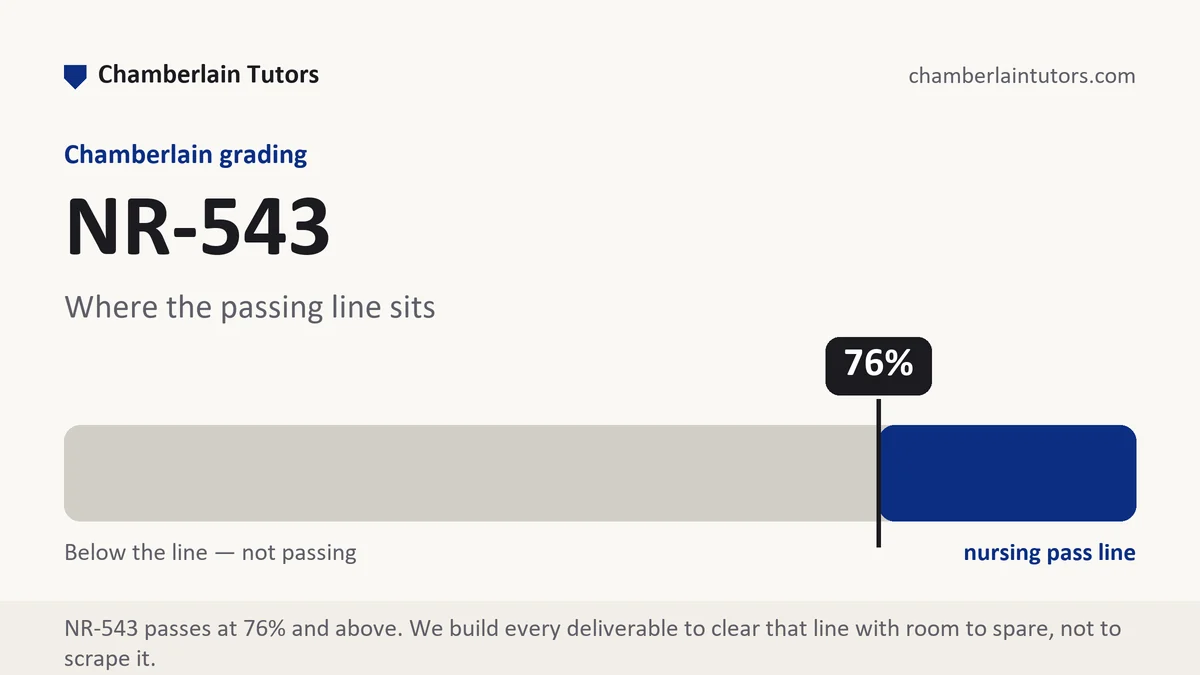
What NR-543 Week 8 asks for
The audience changes in the final stage and most students miss it. Seven weeks of writing have been addressed to a faculty reader who wants to see reasoning. The closing document is addressed to a nurse executive, an informatics council or a director who reads the first page, decides whether to keep reading, and wants to know what they are being asked to approve. That reader does not want your literature review reconstructed. They want the recommendation early, the reasoning available, and the risks acknowledged before someone else raises them.
Synthesis is the technical demand. A synthesis is not a set of summaries laid end to end; it is a single argument in which each earlier stage supplies a load-bearing piece. The current-state map supplies the evidence that a problem exists. The requirements supply the definition of success. The design supplies the mechanism. The implementation plan supplies feasibility. The evaluation supplies accountability. When those five are compressed into one document, each should appear because the argument needs it, not because it was a week of the course.
Two elements are commonly required and commonly thin. The first is sustainment: what keeps the redesigned workflow working after attention moves on, including who monitors the measures, who maintains any configuration, what happens when staff turn over, and how the change survives the next system upgrade. The second is governance: which existing committee or role owns this workflow, who approves changes to it, and where the decision you are requesting actually gets made in your organization. A recommendation that does not say where it goes for approval reads as an academic exercise even when the analysis behind it is strong.
Deliverables in a closing stage are typically a synthesis paper, sometimes with an executive summary, occasionally with a presentation artifact or a final reflective post. Where the course asks for reflection, keep it analytic: what your thinking changed about, and what evidence changed it.
The NR-543 Week 8 method, step by step
Six moves for assembling a recommendation a decision-maker could act on.
-
1. Write the ask in one sentence and put it first
What you want approved, for which workflow, at what scale, and what it requires. Everything else in the document exists to support that sentence, and burying it on page four costs you the reader you are writing for.
-
2. Compress each earlier stage to its load-bearing claim
One paragraph per stage, and each paragraph must carry a claim rather than a summary. If a paragraph could be deleted without weakening the recommendation, it is a summary and it should go.
-
3. Rebuild the evidence chain end to end and check every link
Problem, evidence for the problem, requirement, design element, implementation step, measure. Read the chain backwards: every measure should trace to a requirement, and every requirement to a documented failure.
-
4. State the resource position honestly
Staff time to build, staff time to train, ongoing monitoring effort, and anything requiring purchase. Precision is not required; visibility is. A recommendation with no stated cost invites the question that stops it.
-
5. Specify sustainment and ownership by role
Who watches the measures after the project closes, who maintains the configuration, what the onboarding change is for new staff, and which committee holds the workflow. Roles, not names.
-
6. Surface the strongest objection before the reader does
Name the best argument against your recommendation, in its strongest form, and answer it. Doing this yourself is the single most reliable way to make a closing document read as senior work rather than as advocacy.
A layout and word budget for a closing recommendation
Our frame for a synthesis document, sized for roughly 1,600 to 2,000 words. It is our outline rather than anything the university issues, and your week's rubric outranks it wherever they disagree. Scale proportionally if your assigned length differs.
| Section | What belongs in it | Word target |
|---|---|---|
| Executive summary | The recommendation, the problem it solves, what it requires and what it would deliver, written to stand alone. | 170 to 220 |
| Problem and evidence | The workflow failure with the current-state evidence that establishes it, compressed to the facts that carry the argument. | 280 to 340 |
| What success requires | The requirements that define success, reduced to the essential set with the rest referenced rather than restated. | 230 to 280 |
| The recommended change | The design and why it was chosen over the alternatives, with the deciding criterion named explicitly. | 320 to 380 |
| Feasibility and risk | Implementation approach in brief, resources required, the strongest objection, and your answer to it. | 300 to 360 |
| Accountability and sustainment | The measures that will be watched, by which role, at what cadence, and who owns the workflow after the project ends. | 240 to 300 |
Evidence craft for a closing synthesis
Cite the earlier work as evidence, not as autobiography. Write that observation across three shifts documented four handoffs, rather than that in Week 2 you completed a workflow map. The reader wants the finding; the course structure is not part of the argument.
Keep the reference list current and consistent with the whole document. A synthesis assembled from six earlier papers accumulates citation drift, duplicated entries and sources that no longer appear in the text. Reconcile the list against the final draft as a distinct task.
Do not introduce new evidence in the closing paragraph. Anything important enough to affect the recommendation belongs in the body where it can be examined. A late arrival reads as an afterthought and weakens the position it was meant to strengthen.
Quantify the ask in the units the reader controls. Executives allocate hours, headcount and dollars. Translating your requirement into those units, even approximately and labelled as an estimate, is what turns an analysis into a proposal.
Hold the professional boundary in view. Where the work touched a real setting, the clinical activity, the hours and any documentation in a live system remain yours as the licensed professional. The written recommendation is the academic artifact, and it should be clearly identified as a proposal rather than as an approved organizational plan.
Five mistakes that cost points in this week's territory
- A stapled sequence of earlier papers. Seven summaries in order is a portfolio. One argument that uses seven stages as evidence is a synthesis, and only the second is being graded.
- The recommendation arriving last. Decision-makers read from the front. A document that withholds its ask until the conclusion has been designed for the wrong reader.
- No cost and no owner. Two questions stop real proposals: what does it take, and who holds it afterwards. A closing paper silent on both is incomplete regardless of its analysis.
- New claims in the conclusion. Evidence that appears for the first time in the final paragraphs cannot be assessed, and its arrival signals a draft that was not reconciled.
- Reflection that turns into a diary. A closing reflection is graded on what changed in your reasoning and what caused the change, not on how demanding the session felt.
Before you submit
- The recommendation appears in the opening paragraph in one sentence
- Every earlier stage appears as a claim rather than as a summary of a week
- The evidence chain traces from documented failure through requirement to measure without a break
- Resources are stated in hours, roles or dollars, labelled as estimates where they are estimates
- Sustainment names the role that watches the measures and the body that owns the workflow
- The strongest counterargument is stated and answered inside the document
- The reference list matches the final text exactly, with no orphaned or missing entries
Assembling the final NR-543 recommendation?
Send the rubric and your earlier stages out of Canvas. A premium original draft comes back in 24 to 48 hours built as one argument with the ask on the first page and sustainment named by role, and revisions run until the grade lands.