NR-541 Practice of Nursing Informatics carries three theory credits and covers the role, functions, scope and standards of practice of the informatics nurse as a specialization. That word specialization is the whole assignment. The graded writing asks you to draw a boundary around a job, defend where the line sits, and show that the work on your side of it is nursing practice rather than technical support.
What NR-541 actually grades
Role definition, mostly. A strong submission in this course can say what an informatics nurse does that a systems analyst cannot, and can say it without the word passion. Rubric rows generally ask you to describe functional areas of the specialty, situate them against the published scope and standards, and apply them to a setting. Each of those rows is scored on specificity: the function named, the decision it changes, the clinical knowledge that makes a nurse the right person to hold it.
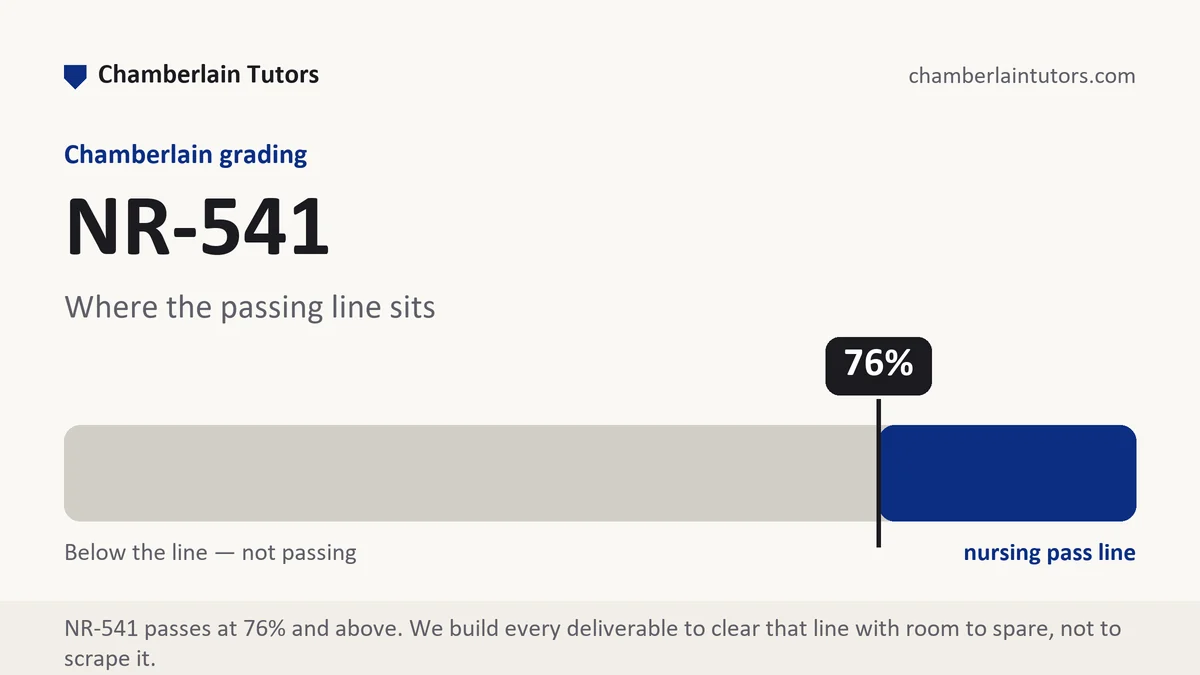
The second axis is standards fluency. Graduate informatics writing is expected to reference the specialty scope and standards the way a clinician references a policy, briefly and accurately, rather than by transcribing it. Chamberlain's 76 percent floor sits under every core nursing course, and in an eight-week session with weekly deliverables the arithmetic gets unforgiving early. Two or three vague role papers in a row set an average that later work has to fight, and supplementary submissions cannot rescue a weighted average that has already drifted.
How we help in this course
We draft role analyses, scope and standards applications, functional area papers, position descriptions written as academic work, technology adoption discussions, board responses and the session project. Every draft is written so the reader can tell which sentences describe the specialty and which describe the software, because that separation is where the points sit.
We work from the published sources you are permitted to cite and from the setting your prompt describes. We do not contact employers, interview practitioners on your behalf, or collect responses for you. Where your section asks for an interview, you hold the conversation and we build the analysis around your notes.
In NR-541 right now?
Send the prompt, the setting and the rubric from Canvas. First premium sample free, floor-checked, back in 24 to 48 hours.
Read the rubric before the prompt
Role papers reward planning more than research, and the guide is where the plan comes from. Paste the criterion rows into a blank file and strip each to its verb: describe, differentiate, apply, evaluate, support. In this course the differentiate row is usually the one students skip, because it is the only row that requires them to say what the role is not, and saying what something is not feels like padding until you see the score.
Then price the rows. Suppose the week caps the paper at 1,200 words with four rows weighted 30, 30, 25 and 15 percent. That is 360 words for the first row, 360 for the second, 300 for the third and 180 for the last. Two rows at 360 words means two substantial sections, not one long section and one paragraph, which is what most drafts deliver when the second row is the boundary work. Reference list and title page sit outside the count unless your guide says otherwise.
Keep the four targets visible while you write and check them at the halfway point rather than at the end. A 1,200 word cap punishes a slow start harder than a 2,000 word cap does, and an introduction that runs to 200 words has spent a whole row on throat clearing.
The shape of a role analysis paper
Under any of its section names, the dominant deliverable here is an analysis of what the informatics nurse does. These are the parts that get read.
| Part | What it must deliver | What a weak version does |
|---|---|---|
| Role statement | One or two sentences defining the specialty in terms of decisions it supports, not tools it uses. | Opens with a history of computing in healthcare. |
| Functional areas | Named areas of practice, each with a concrete example of work produced. | A list of area names copied without illustration. |
| Boundary with adjacent roles | What the analyst, the educator and the clinical lead each own, and where the handoffs occur. | Treats every technology job as informatics. |
| Standards applied | A specific standard of practice tied to a decision in your setting. | Long block quotations from the standards document. |
| Clinical judgment as the qualifier | The point at which nursing knowledge changes the technical answer. | An assertion that nurses understand workflow. |
| Setting application | One organization or unit, with the role described in its actual reporting structure. | A generic hospital with no reporting line. |
| Development path | Certification, experience and preparation routes, stated as they currently exist. | A closing paragraph about lifelong learning. |
Evidence and citation craft at this level
Role and scope writing has its own evidence problems, and four habits solve most of them.
Currency matters more here than in clinical courses. Informatics literature ages quickly, and a role description from a decade ago describes work that has since moved. Where your guide sets no rule, treat five years as the line, and when you cite an older source do it deliberately, for a definition or a founding framework, saying in the sentence why the older account still holds.
Say what produced the claim before you use it. Role evidence comes from surveys of practitioners, position statements and case reports, and these support different sentences. Nine words of setup, such as in a national survey of 1,900 informatics practitioners, tells the reader whether your claim about typical duties is measured or asserted. Position statements describe what a body recommends, not what most employers do, and a paper that blurs the two loses the support row.
Verbs the evidence can pay for. Adoption studies are overwhelmingly observational, so improved documentation time is associated with is honest where reduced documentation time by is not, unless a controlled evaluation is behind it. Vendor material is the sharpest trap in this course: it is written in causal verbs and cannot support them.
Denominator and window on every number. Write 63 of the 210 nurses surveyed at one system in the six months after go-live rather than most nurses reported. Informatics claims about satisfaction and adoption are meaningless without the population surveyed and the point in the implementation at which they were asked, because the same question yields different answers at week two and month six.
What separates a passing role paper from a strong one
A passing paper describes the specialty accurately. It names functional areas, mentions the standards, and closes with a sentence about the growing importance of technology. It is correct and interchangeable, which is why it settles in the high seventies and low eighties rather than the A band.
Strong papers do three things. They commit to one setting and keep the role inside it, so every function named has a place in an actual reporting structure and an actual weekly workload. They spend real words on the boundary, naming what the analyst owns and what the informatics nurse owns and describing one handoff in detail, because that paragraph is the only proof a reader gets that you understand the specialty rather than the software. And they show clinical judgment changing a technical outcome: an alert threshold questioned, a build decision reversed, a documentation field rejected because of what it would do to a handoff. One concrete instance of nursing knowledge overriding a technically correct answer is worth more than a page of role description.
Mistakes that cost points here
- Writing about systems instead of the role. Three paragraphs describing an electronic record is a product review. The rubric asked what the practitioner does with it.
- Block quoting the standards. Long quotations from a scope document eat your word budget and score nothing. Paraphrase the standard, cite it, then apply it.
- Treating a job posting as evidence of scope. Postings tell you what one employer wants this quarter. Say so explicitly if you use one, and pair it with a published source.
- Career narrative in an academic paper. Your route into informatics belongs in a reflection when the prompt asks for one, not in the analysis rows.
- No handoff described. Without one worked example of where the informatics nurse stops and someone else starts, the differentiation row has nothing to score.
- Rushing the board post. Discussion responses do not reopen once submitted at Chamberlain. Compose in a document, check that your role claims carry citations, and paste once.
Questions NR-541 students ask
I have never held an informatics job. Can I still write these papers well?
How much of the paper should be about the scope and standards document?
The prompt asks me to interview someone in the specialty. What do I do if I cannot find one?
Where NR-541 sits in Chamberlain's programs
Open the exact program map for sequence, credit, and option context. The current student schedule and syllabus remain authoritative after transfer evaluation, electives, state rules, and approved plan changes.
The weeks, one by one
Week 1
NR-541 Week 1 opens a specialty course by making you say in writing what an informatics nurse actually is. Read the full Week 1 manual.
Week 2
NR-541 Week 2 moves from what the specialty is to what it does. Read the full Week 2 manual.
Week 3
NR-541 Week 3 puts the specialty's published scope and standards of practice to work. Read the full Week 3 manual.
Week 4
NR-541 Week 4 turns the specialty map inward. Read the full Week 4 manual.
Week 5
NR-541 Week 5 is where the specialty stops describing itself and starts producing something. Read the full Week 5 manual.
Week 6
NR-541 Week 6 places the informatics nurse inside the life of a system: how a need becomes a selection, a selection becomes a build, a build becomes a go-live, and a go-live becomes years of optimization that nobody budgeted for. Read the full Week 6 manual.
Week 7
NR-541 Week 7 asks what the informatics nurse is accountable for when the system does something the organization did not intend. Read the full Week 7 manual.
Week 8
NR-541 Week 8 closes the session by making you argue the specialty rather than describe it. Read the full Week 8 manual.