NR-541 Week 1 opens a specialty course by making you say in writing what an informatics nurse actually is. The territory is definitional: a role statement, the functions that live inside it, and the line between that role and the analysts, educators and vendor consultants working beside it. Graduate readers want the definition argued from published specialty language rather than assembled from a job posting, and they want your own practice used as illustration rather than as authority. Your section may print this as NR 541 or NR541; it is the same course. Chamberlain publishes no syllabi outside Canvas. The placement here is our teaching judgment from the course's catalog arc; your section's rubric decides what your week actually asks.
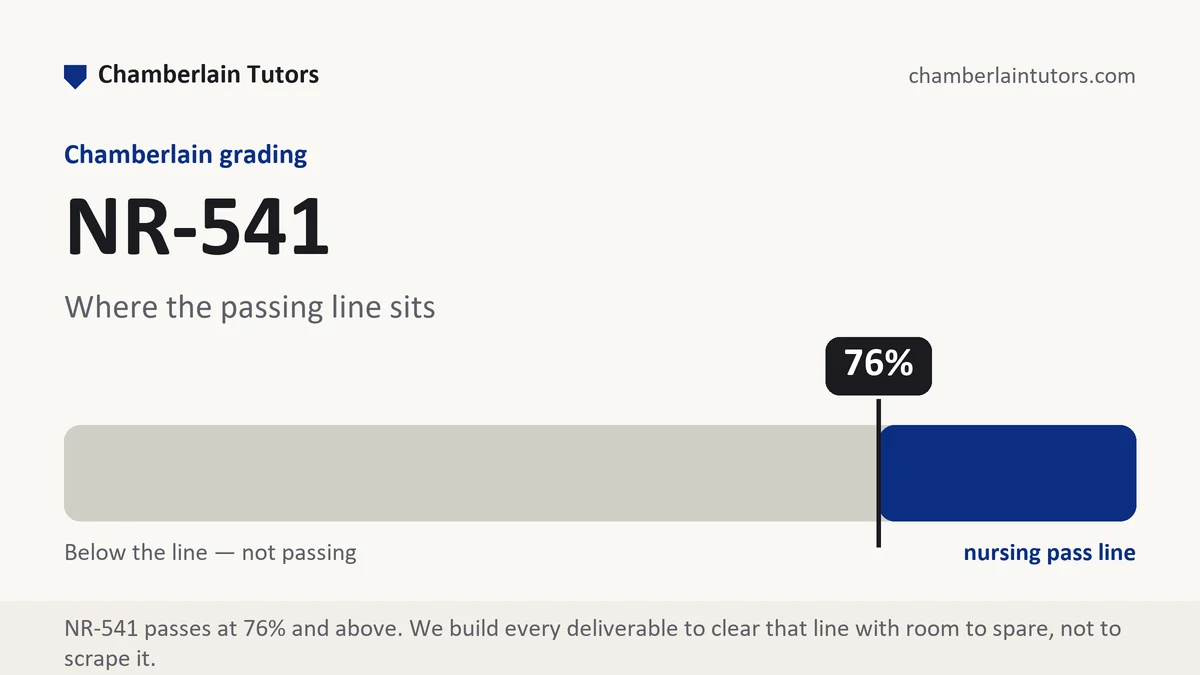
What NR-541 Week 1 asks for
Sit through one quarterly documentation audit and the specialty defines itself. An auditor pulls sixty charts to check whether a fall risk score was recorded within the window the policy sets, and the report comes back showing the score present in 37 of them. Then somebody opens the other twenty-three. In most of them the score was taken, and the nurse typed it into a narrative note because the flowsheet row had been moved during a build change and nobody told the night shift. The practice was compliant. The capture was not. The person who can tell those two failures apart, and who can then rebuild the form so the score lands where the report looks for it, is doing nursing informatics. Everyone else in the room is either auditing or fixing software.
That distinction is the whole opening stage. An early definitional deliverable in this course typically asks you to describe the specialty, situate it against adjacent roles, and show why nursing knowledge is the qualifying credential rather than a nice addition. The trap is that the question feels easy. Every nurse who has ever built a smart phrase believes they can define informatics, and the resulting drafts read as enthusiasm about technology with a citation stapled on. Enthusiasm is not a definition, and a definition that would also describe a systems analyst has not defined anything.
Early stages in an eight-week session often carry a short written piece, a posted introduction to the specialty, or both, because faculty want to see how you write before the applied stages arrive. If your section runs a discussion here, treat the post as final copy. Posts do not reopen once submitted in Canvas, and an opening post that describes informatics as the use of technology to improve patient care has spent its first sentence saying nothing that a hospital marketing page does not already say.
The habit to install this week is definition by decision. Do not define the role by the tools it touches. Define it by the decisions it changes: which alert fires, which field is required, which report a nurse manager trusts, which workflow a build supports. Tools are replaced every few years. Decisions are what the specialty owns, and a definition built on them survives the next platform migration and scores better on paper.
The NR-541 Week 1 method, step by step
Six moves that turn an enthusiastic description into a defensible definition.
-
Convert your week's guide into sections that each end in a claim
Copy each scoring line from your own rubric into a blank file and reduce it to its verb. Describe, differentiate, apply and support ask for different depths, and a line carrying differentiate is telling you that a section defining what the role is not has to exist as its own block of prose.
-
Write the role statement before you write any history
Two sentences, present tense, naming the decisions the specialty supports and the population affected. Drafts that open with the arrival of the electronic record in the 1990s have spent a section of the word budget on background the reader did not ask for and cannot score as analysis.
-
Attach every named function to an artifact somebody keeps
If you claim the role includes workflow analysis, name what workflow analysis produces: a current state map, a gap list, a build request with acceptance criteria. Functions described without their outputs read as job titles. Functions described with their outputs read as practice.
-
Draw the boundary against the three roles standing nearest to yours
Usually the application analyst, the clinical educator and the quality or performance improvement specialist. For each, say what they own, what you own, and where the handoff happens. The handoff sentence is the one graders read most carefully because it is the only place the boundary becomes concrete.
-
Anchor the definition in published specialty language, with a year in the sentence
Professional bodies publish scope and standards documents for this specialty and revise them on schedules of their own. Name the issuing organization and the edition inside your prose so the reader is not reconstructing your source from a reference list.
-
Close on the judgment only a nurse brings
End with a situation where clinical knowledge changed the technical answer: a required field that would have stalled a rapid response, an alert threshold that was defensible in a policy and unworkable at three in the morning. That paragraph is the argument for the specialty, and it belongs at the end where it lands.
A layout and word budget that keeps the boundary visible
The frame our tutors keep beside a definitional role paper, sized for roughly 1,000 to 1,300 words. It is our own outline rather than anything the university issues, and your week's guide outranks it wherever the two disagree. Scale each target proportionally if your assigned length differs.
| Section | What belongs in it | Word target |
|---|---|---|
| Role statement | The specialty defined by the decisions it supports, stated in the first two sentences with no history attached. | 80 to 110 |
| Functions, with outputs | Three or four areas of practice, each followed by the artifact that area produces and who receives it. | 240 to 280 |
| Boundary with adjacent roles | Analyst, educator and quality specialist compared, each with the handoff point named in a full sentence. | 230 to 270 |
| Specialty language applied | One published scope or standards element quoted briefly and then used to judge a real situation. | 180 to 210 |
| Clinical judgment as qualifier | A single documented case where nursing knowledge changed a build decision, told with its outcome. | 170 to 200 |
| Close | What the reader should now be able to say about the specialty that a job posting would not tell them. | 60 to 80 |
Evidence craft for a specialty definition
Cite the specialty's own documents, not general technology writing. Articles about digital transformation in healthcare will support almost nothing you need here. The claims in a definitional paper are claims about a nursing specialty, and the sources that carry them are the published scope and standards of practice, specialty competency frameworks and peer-reviewed informatics literature.
Quote the standards briefly and then do something with the quotation. A long block quote from a standards document is the most common filler in this course, and it converts your word budget into someone else's prose. Take one clause, name where it came from, then apply it to a decision in a setting you can describe. Application is what the reader is scoring; transcription is what they are subtracting for.
Keep your own experience in the illustration position. The sequence that scores is claim, published support, then your example showing the claim operating. A paper that runs the other way reads as a work anecdote with a reference list, and in a specialty course the difference is visible in the first paragraph of every section.
Any audit number arrives with its denominator and its window. Write that the score was documented in the flowsheet in 37 of 60 charts reviewed across one quarter, rather than reporting a compliance rate alone. Rates without bases cannot be weighed, and in informatics writing the base is frequently the finding, because a small denominator is often the reason a report looked alarming.
Five mistakes that cost points in this week's territory
- A definition that also fits an analyst. If every sentence would survive with the word nurse deleted, the differentiation work has not been done and the boundary section is doing nothing.
- Opening with the history of health computing. Background is cheap to write and hard to score. The reader wants a present-tense claim about a present-tense role.
- Functions listed without outputs. Naming project management, education and analysis in a series proves familiarity with vocabulary and nothing about practice.
- Standards quoted at length. Four hundred borrowed words in a paper capped near a thousand leaves you defending a definition in the space of a paragraph.
- Software brand names doing the work of argument. Naming the vendor your hospital runs tells the reader where you work, not what the specialty is.
Before you submit
- The role statement appears before any background and names decisions rather than tools
- Every function you claim is followed by the artifact it produces
- Three adjacent roles are compared, each with an explicit handoff sentence
- A published scope or standards source is named with its year inside the prose
- At least one case shows nursing knowledge changing a technical decision
- Every in-text citation appears in the list and every listed source appears in the text
Starting NR-541 this week?
Send the prompt and the rubric out of Canvas. A premium original draft comes back in 24 to 48 hours with the role defined by decisions and the boundary drawn against named adjacent roles, and revisions run until the grade lands.