NR-537 is the three theory hour course on evidence based assessment and evaluation of learning, the interpretation of performance data, and accountability to accreditors. It is the most technical course in the educator track. The graded question is rarely whether an assessment feels fair. It is whether the instrument measures what it claims to measure and whether the data supports the decision being made with it.
What NR-537 actually grades
The first scored idea is validity as an argument rather than a property. An examination is not valid in the abstract; it is valid for a particular inference about a particular group. Writing that a test is valid earns nothing. Writing that the blueprint samples the objectives in proportion to their teaching time, so a score can reasonably support an inference about mastery of the unit, is the argument the rubric rows want.
The second is reading performance data without over reading it. A cohort's pass rate, an item's difficulty, a discrimination index and a rubric's inter rater agreement all say something narrow, and the graded skill is saying exactly that much. Students either treat every number as decisive or treat none of them as meaningful, and both extremes sit in the middle band.
The third is accountability. Assessment data in nursing education is reported to accreditors and used to justify program decisions, so an evaluation plan is expected to say what evidence is produced, who reviews it, and what action follows a result.
How we help in this course
NR-537 has no clinical hours, so nothing on our side touches placement, preceptors, site paperwork or logs.
Send the prompt and the scoring guide from Canvas and a premium original draft comes back in 24 to 48 hours, planned against the criterion rows, with every claim about an instrument stated as an inference it supports rather than as a property it possesses. Both quality reviews and the floor check run before delivery, and revising continues free until it lands.
Writing this course's deliverables from the rubric
Rubric, inference, instrument, data, decision. Naming the inference first is the habit that makes the rest of an assessment paper straightforward, and skipping it is why so many drafts describe instruments without ever evaluating one.
In NR-537 right now?
Send the week and the rubric from Canvas. First premium sample free, floor-checked, back in 24 to 48 hours.
The floor in a technical course
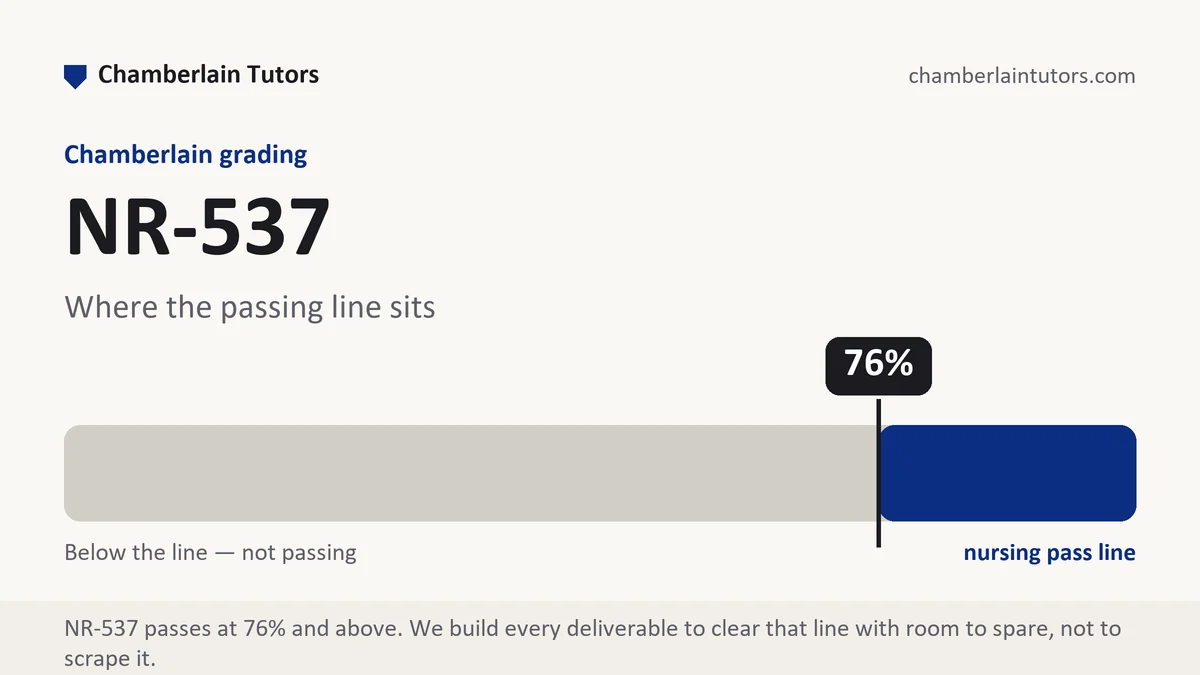
Core nursing courses pass at 76 percent, and where a track uses the nurse practitioner specialty scale, which has no C band, the last passing number is 84. A course about measurement is one of the few in this degree where an answer can be simply wrong, and a misunderstanding of a statistic propagates through every deliverable that uses it.
Sixteen week semesters running as two eight week sessions, up to six starts a year, weekly deliverables, and no supplementary route back from a weak weighted average. Get the vocabulary of reliability, validity and item statistics settled in the first fortnight, because every later assignment assumes it.
Turn the criterion rows into a section plan
Copy the rows into a blank file in printed order and reduce each to its verb: construct, analyze, interpret, evaluate, recommend. Headings follow the verbs in the guide's sequence, which stops an assessment paper from becoming a general discussion of testing.
Then price the rows. Suppose the assignment caps you at 1,350 words across four rows weighted 30, 30, 25 and 15 percent, giving roughly 405 words, 405, 337 and 202. Two equal rows near the top usually means construction and interpretation carry the same weight, and students almost always build the instrument carefully and then interpret it in three sentences. Four hundred words of interpretation is a real analysis of what the data does and does not support. The 202 word row is one paragraph, frequently the accreditation or reporting section, and it is the one most often omitted entirely.
Keep the target beside each heading while drafting. Title page and references sit outside the count unless your guide says otherwise, and blueprints, item tables and rubric grids usually do too, which is where the technical detail belongs.
The shape of an assessment analysis
Most graded writing here is the construction or the critique of an assessment, with data interpretation attached. Each part below carries one piece of the argument that a score means something.
| Part | What it has to establish | How the thin version reads |
|---|---|---|
| The inference | What the score is supposed to tell you, about whom, for what decision. | A statement that the assessment measures student learning. |
| The blueprint | How items or tasks are distributed across objectives and levels of thinking, with the proportions justified. | A set of questions with no map to objectives. |
| The instrument itself | Items or criteria written precisely, at the level the objective claims, free of cueing and ambiguity. | Recall items assessing an objective about judgement. |
| Reliability considerations | What threatens consistency here: too few items, vague rubric language, single rater scoring. | Reliability asserted rather than examined. |
| Data interpretation | What the difficulty, discrimination or agreement figures indicate, and what they cannot indicate. | Every low scoring item declared a bad item. |
| Decision and reporting | What changes as a result, who reviews the evidence, and where it goes for accreditation purposes. | An analysis ending with the numbers. |
Evidence and citation craft in measurement writing
Measurement claims are the easiest in this degree to state loosely and the easiest for a grader to check.
- Cite the current testing standards and name the edition. The professional standards governing educational measurement are revised periodically, and quoting a superseded edition misstates the guidance you are relying on.
- Attribute an instrument claim to its validation study. Where you say a published rubric or examination performs adequately, that comes from a study with a sample and a context. Name it rather than referring to the instrument's reputation.
- Design and sample before any figure. Write that a study examined item performance across 412 examinees in one program over two administrations, then the statistic. Item statistics are sample dependent, so the sample is part of the meaning rather than background.
- Verbs the design can pay for. Students scoring higher on the simulation rubric also passed the course examination at a higher rate is defensible. The rubric predicts safe performance in practice is a much larger claim, requiring evidence that most program level studies do not have.
- Denominator and window on every rate. Write that 31 of the 96 examinees answered the item correctly on that administration, rather than reporting a difficulty index alone. A difficulty value from a cohort of 20 and one from a cohort of 400 are not the same evidence, and the base is what tells the reader which they are looking at.
The gap between a passing paper and a strong one
A passing NR-537 paper defines reliability and validity correctly, produces a reasonable instrument, and concludes that assessment should be fair and aligned with objectives. It is accurate and it never argues anything, which is the middle band in a course whose whole subject is the strength of an argument from data.
Strong papers state the inference before the instrument, so every later choice has something to serve. They read data conservatively, noting what a small cohort can and cannot support and resisting the urge to redesign a test on the basis of twenty examinees. They examine their own instrument for the specific threats that apply, such as a single rater scoring a subjective rubric. And they carry the analysis into a decision, naming what changes, who approves it, and what evidence exists afterwards.
Six mistakes that cost points here
- Calling an instrument valid. Validity belongs to an inference, not to a test. Say what the score supports and for whom.
- Blueprint missing. Without a map from items to objectives there is no argument that the assessment covers what it claims.
- Level mismatch. Recall items cannot assess an objective about applying or analyzing, and this is the most visible alignment error in the course.
- Over reading small samples. An item statistic from a handful of examinees is a hint, not a verdict. Say so.
- Rubrics with unmeasurable language. Excellent and thorough are not criteria. Describe the observable performance at each level.
- Posting to the board from the text box. Chamberlain posts do not reopen once submitted. Draft elsewhere, check the citation, then paste.
Questions NR-537 students ask
How much statistics do I actually need for this course?
How do I write a rubric that is not vague?
What does accreditation accountability mean in a paper?
Where NR-537 sits in Chamberlain's programs
Open the exact program map for sequence, credit, and option context. The current student schedule and syllabus remain authoritative after transfer evaluation, electives, state rules, and approved plan changes.
The weeks, one by one
Week 1
NR-537 opens by separating three words most nurses use interchangeably: measurement, assessment and evaluation. Read the full Week 1 manual.
Week 2
The second stage of NR-537 turns objectives into a sampling plan. Read the full Week 2 manual.
Week 3
Item construction is where measurement theory meets sentence craft, and this stage is graded on both. Read the full Week 3 manual.
Week 4
The midpoint of NR-537 is where the vocabulary becomes an argument. Read the full Week 4 manual.
Week 5
Performance and written work cannot be scored by a key, so this stage moves to instruments that turn judgment into a defensible score: rubrics, rating scales and observation tools. Read the full Week 5 manual.
Week 6
Once a cohort has answered, the assessment starts producing evidence about itself. Read the full Week 6 manual.
Week 7
The seventh stage moves from measuring to deciding. Read the full Week 7 manual.
Week 8
The closing stage lifts the unit of analysis from the learner to the program. Read the full Week 8 manual.