NR-537 opens by separating three words most nurses use interchangeably: measurement, assessment and evaluation. Measurement assigns a number, assessment gathers evidence about learning, and evaluation makes a judgment and acts on it. The graduate move in the first stage is to stop describing tests as good or bad and start naming the inference each one is supposed to support, because every later stage in this course is an argument about whether a particular score licenses a particular conclusion. Your section may print this as NR 537 or NR537; it is the same course. Chamberlain publishes no syllabi outside Canvas. The placement here is our teaching judgment from the course's catalog arc; your section's rubric decides what your week actually asks.
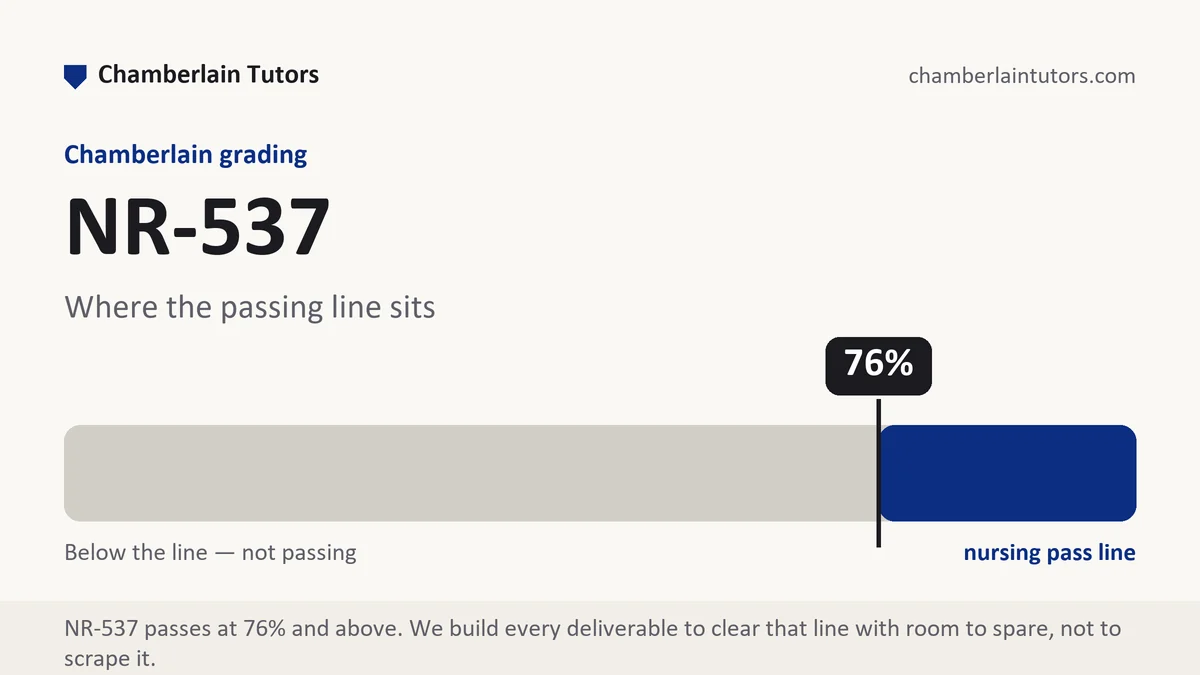
What NR-537 Week 1 asks for
Consider a staff development coordinator in a 118-bed skilled nursing facility who gives every new hire a twenty item quiz on the second day of orientation. She calls it a competency test. It is not, and the reason is the whole content of this opening stage. The quiz produces a number. Nobody has said what the number is supposed to license: whether this nurse may run a medication pass alone on the long-term hall, whether the orientation content was taught adequately, or whether the facility can show a surveyor that education happened. Those are three different inferences, and only one of them can be supported by a written quiz on day two. The first written work in this course usually asks you to make that kind of distinction explicit for a case, a setting or an instrument of your choosing.
Opening stages in an eight-week graduate course tend to be short and diagnostic. Faculty want to see whether you can hold a technical vocabulary steady across a page before the heavier construction work arrives, so the deliverable is often a compact written response, a posted introduction that includes an educator context, or both. If your section runs a discussion here, treat it as final copy from the first keystroke; posts do not reopen once submitted in Canvas, and an opening post that uses valid as a compliment sets a habit the grader will keep noticing.
The habit to install in this stage is the inference sentence. Before describing any instrument, write one sentence in this form: this assessment is intended to support the inference that a learner can do X, in a setting like Y, well enough for purpose Z. Once that sentence exists, everything else in the course has a reference point. Reliability becomes a question about how much the score would wobble if the same learner were assessed again. Validity becomes a question about whether the evidence gathered actually bears on X. Without the inference sentence, students end up writing general essays about the value of testing, and general essays sit in the middle band no matter how fluent they are.
Notice also what this course is not. It is not a course about teaching strategies, and it is not a course about curriculum design. Assessment writing that drifts into how to make a lecture more engaging has left the graded territory. Keep the pen on the evidence side of the equation: what was gathered, from whom, under what conditions, and what decision it will be used to justify.
The NR-537 Week 1 method, step by step
Six moves that turn an opening vocabulary stage into a piece of measurement writing.
-
Reduce your week's scoring rows to their verbs before drafting
Copy each row into a blank file as a heading and strip it to the verb it demands. Define, differentiate, apply and evaluate sit at four different depths, and a row asking you to differentiate wants a contrast held across a paragraph, not two definitions parked side by side.
-
Fix one educator context and keep it for the whole page
A prelicensure clinical course, a facility orientation program, a certification review, a preceptor development series. The context determines what the assessment is for, and a paper that drifts between three of them cannot argue anything about purpose.
-
Write the inference sentence before the instrument description
Name the claim the score is meant to support, the population it applies to, and the decision that follows. Everything you say afterwards about the instrument is then judged against that claim rather than against a general sense of quality.
-
Sort your example into formative or summative by consequence, not by format
The distinction is not quiz versus exam. It is whether the result feeds back into learning while there is still time to act, or whether it closes a decision. The same ten questions can be either, depending on what happens to the result.
-
Attach every technical term to its definition in a source, not to memory
Reliability, validity, criterion referenced and norm referenced all have settled meanings in the measurement literature. Use the published definition, cite it, and then apply it. Paraphrasing loosely from memory is how the vocabulary rows are lost.
-
Close by naming what your example cannot support
An opening piece that only praises an assessment has skipped the analytic half. State one inference the instrument you chose is regularly asked to carry and genuinely cannot, and say why the evidence does not stretch that far.
Layout and word budget for an opening measurement piece
The frame our tutors keep beside a first submission in this course, sized for roughly 900 to 1,150 words. It is our own outline rather than anything the university issues, and your week's rubric outranks it wherever the two disagree. Scale proportionally if your assigned length differs.
| Section | What belongs in it | Word target |
|---|---|---|
| Opening claim | The distinction you are going to defend, stated in the first three sentences without a preamble about the importance of education. | 70 to 90 |
| Vocabulary, applied | Measurement, assessment and evaluation defined from a cited source and immediately illustrated in your chosen setting. | 180 to 220 |
| The context and the inference | Who the learners are, what decision hangs on the result, and the one sentence naming what the score is supposed to license. | 170 to 200 |
| Purpose analysis | Formative and summative use of your example, separated by consequence, with the timing that makes each possible. | 200 to 240 |
| Limits of the inference | The claim your example cannot carry, the reason the evidence stops short, and what additional evidence would be needed. | 170 to 200 |
| Close | What the reader should now hold about purpose driven assessment, without restating the paragraphs above. | 60 to 80 |
Evidence craft for a vocabulary stage
Definitions come from measurement literature, not from nursing habit. The words in this course belong to educational measurement, and the course expects you to draw on that body of work. Naming the source and its year inside your sentence converts a definition from something you remember into something a grader can check.
Illustrate every definition within two sentences of stating it. A defined term with no application is a glossary entry. In your care-transition orientation example, say what the numbers actually were and what someone did with them, then let the definition sit on top of the illustration rather than floating above it.
Keep the language of properties out of your sentences. Write that the evidence supports an inference about medication administration under supervision, rather than writing that the test is valid. Validity belongs to the interpretation, not to the paper the questions are printed on, and this course grades that difference from the first stage onward.
Any number you report arrives with its base and its window. If eleven of the fourteen orientees who took the quiz scored above the cut, say so in those terms rather than reporting seventy-nine percent. In a course about measurement, a proportion stripped of its denominator reads as carelessness rather than as shorthand.
Five mistakes that cost points in this week's territory
- Treating validity as a property of an instrument. The single most reliable way to look untrained in this course is to write that a test is valid full stop, with no inference and no population attached.
- Formative and summative sorted by format. Calling every quiz formative and every exam summative misses the point of the distinction, which lives in what happens to the result.
- An essay about the importance of assessment. Enthusiasm about evaluation is not analysis of it, and a page of general endorsement scores in the same band as a page of nothing.
- Three settings in one paper. Drifting between prelicensure students, new graduate residents and facility orientees makes the purpose argument unmeasurable, because the decision changes with each group.
- Zero sources in a technical stage. Opening rows in this course almost always include support, and definitions offered on personal authority forfeit the row before the content is read.
Before you submit
- One inference sentence appears, naming the claim, the population and the decision
- Measurement, assessment and evaluation are each defined from a cited source and applied
- The educator context is fixed once and held for the whole piece
- Formative and summative are separated by consequence rather than by format
- At least one limit of the chosen instrument is stated plainly
- Every number carries its base, and every citation appears in the reference list
Starting NR-537 this week?
Send the instructions and the scoring guide out of Canvas. A premium original draft comes back in 24 to 48 hours with the inference named before the instrument is described, and revisions run until the grade lands.