NR-536 is the three theory hour course on teaching and evaluating core nursing concepts across clinical, didactic and online environments, simulation included. The word that decides your grade is across. The same concept has to be taught differently in a classroom, at a bedside, in a simulation room and inside a discussion board, and the rubric rows want you to know why each version differs.
What NR-536 actually grades
The first scored ability is teaching a concept rather than a topic. A topic is a list of content. A concept is an idea that recurs across patients and diagnoses, such as perfusion, gas exchange or infection risk, and teaching one means designing so that a learner recognizes it in a situation they have never met. Assignments that reduce to lecture notes about a disease have missed that distinction and the heaviest row with it.
The second is environment fit. Clinical teaching is interruptible, opportunistic and one to one. Didactic teaching is scheduled and one to many. Online teaching is asynchronous, so the interaction has to be designed rather than improvised. Simulation is bounded and rehearsed, and the learning lives disproportionately in the debriefing rather than in the scenario. Each of those imposes different constraints on the same concept, and naming them is the analysis.
The third is evaluation attached to the teaching. Every plan here is expected to say how you would know the learner grasped the concept, in observable terms, in that environment.
How we help in this course
NR-536 has no clinical hours, so nothing on our side touches placement, preceptors, site paperwork or logs.
Send the prompt and the scoring guide from Canvas and a premium original draft returns in 24 to 48 hours, planned against the criterion rows, with the concept kept in view across environments and an evaluation attached to each version. Both quality passes and the floor check run before it reaches you, and revision is free until the plan lands.
Writing this course's deliverables from the rubric
Rubric, concept, environment, activity, evaluation. Choosing the activity early is the reliable way to end up with a clever exercise that teaches content rather than a concept.
In NR-536 right now?
Send the week and the rubric from Canvas. First premium sample free, floor-checked, back in 24 to 48 hours.
The floor, and a plan shaped deliverable
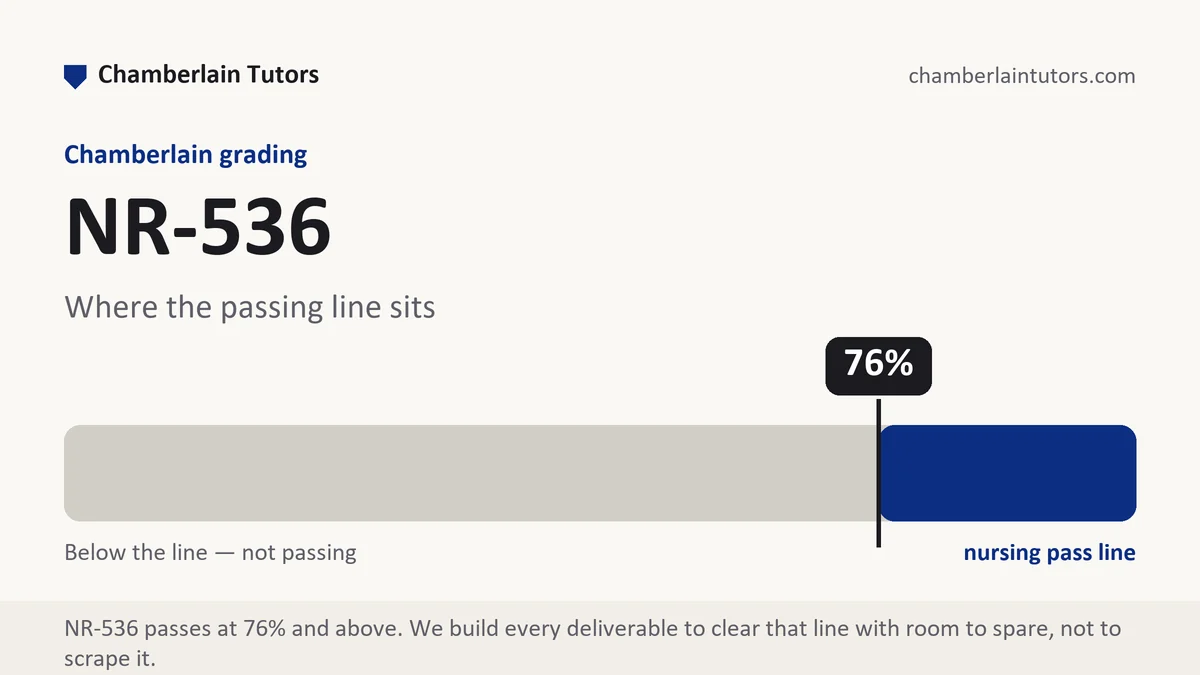
Core nursing courses pass at 76 percent, and where a track uses the nurse practitioner specialty scale, which has no C band, the last passing number is 84. Teaching plans are deceptive documents: they look finished when every box is filled, and a plan whose activities do not actually produce the stated learning still looks complete on the page.
The schedule is the usual one, sixteen week semesters split into two eight week sessions with up to six starts a year and weekly deliverables, and supplementary work cannot rescue a weak weighted average. Read the first returned plan closely for comments about alignment between activity and objective, because that comment is the one that repeats.
Turn the criterion rows into a section plan
Copy the rows into a blank file in printed order and reduce each to its verb: select, design, adapt, evaluate, justify. Those verbs become your headings in the guide's sequence, which keeps a teaching plan from collapsing into a lesson outline that answers only one row.
Then convert weight into words. Suppose the assignment caps you at 1,650 words across four rows weighted 40, 25, 20 and 15 percent, giving roughly 660 words, 412, 330 and 247. Six hundred and sixty words on the heaviest row is usually the design section, and it needs the activity described minute by minute rather than named. The 247 word row is often the rationale for the concept choice, one solid paragraph. What students most often shortchange is the 330 word adaptation row, where the same concept has to be re engineered for a different environment, and that section is impossible to fake because the constraints are specific.
Keep the target beside each heading while drafting. Title page and references sit outside the count unless your guide says otherwise, and a teaching plan grid, a scenario outline or a debriefing question list usually does too.
The shape of a concept teaching plan
Most graded writing here is a plan for teaching one concept in one or more environments, with evaluation attached. Each row below is something a grader expects to find in a usable teaching plan.
| Part | What it has to establish | How the thin version reads |
|---|---|---|
| The concept and why it matters | The recurring idea, stated so a learner could recognize it in an unfamiliar case. | A disease or a chapter title used in place of a concept. |
| Learner level and prior knowledge | Where these learners are, what they can already do, and the specific misunderstanding you expect. | An assumption that learners arrive with nothing. |
| The activity, minute by minute | What happens, in what order, with timings, so someone else could run it. | A named strategy with no description of the session. |
| Environment adaptation | How the same concept is taught differently in clinical, didactic, online or simulated settings. | One version described and the others mentioned. |
| Simulation handled properly | Objectives, prebriefing, the scenario's decision points, and a debriefing plan with actual questions. | A scenario written out with debriefing listed as a step. |
| Evaluation of learning | What the learner does afterwards that demonstrates the concept, and how it is observed or scored. | An end of session evaluation form measuring enjoyment. |
Evidence and citation craft for teaching strategies
Claims about what works in nursing education are made confidently and supported unevenly, so the handling matters.
- Simulation standards must be the current edition, named. Practice standards for simulation design, prebriefing and debriefing are revised, and a plan built on a superseded edition misses the row it was aimed at. State the version year.
- Cite the study, not the conference claim. Assertions that a strategy improves retention circulate widely without traceable origins. Follow each to the study that measured it, or leave the claim out.
- Design and sample before the finding. Write that a randomized study assigned 74 prelicensure students to two debriefing formats and measured performance on a subsequent scenario, then the result. Simulation research is small, and the sample size is part of the meaning.
- Verbs the design can pay for. Students in the structured debriefing group performed better on the follow up scenario is defensible. Structured debriefing improves clinical judgement generalizes far beyond what one study supports.
- Denominator and window on every rate. Write that 22 of the 74 students met the performance benchmark on first attempt, rather than that 30 percent did. In education research the cohort and the attempt are what make the figure interpretable.
The gap between a passing plan and a strong one
A passing NR-536 plan chooses a reasonable topic, describes an active learning strategy, and includes an evaluation. Everything is present and the plan would not survive contact with a real group, usually because the timings are impossible or the activity teaches recall while the objective claims judgement.
Strong plans name the misunderstanding they are correcting, which forces the design to do something specific rather than to cover material. They design the debriefing as carefully as the scenario, since that is where simulation learning happens, writing actual questions in sequence rather than listing debriefing as an activity. And they adapt honestly across environments, admitting what is lost when a hands on concept moves online and saying what replaces it, because that admission is where the adaptation row's marks are.
Six mistakes that cost points here
- Teaching a topic and calling it a concept. If the plan only transfers to one diagnosis, it is content teaching, and the concept row is unfed.
- Activities with no timings. A plan someone else could not run is not a plan. Put minutes against each segment.
- Debriefing as a bullet point. Write the questions, in order, with the purpose of each. That section is where the learning is.
- Objectives that outrun the activity. An objective about clinical judgement cannot be met by a matching exercise. Align them or change one.
- Online treated as posted lecture. Asynchronous teaching needs designed interaction, not uploaded slides, and graders in this course say so.
- Posting to the board from the text box. Chamberlain posts do not reopen once submitted. Draft elsewhere, check the citation, then paste.
Questions NR-536 students ask
How do I tell a concept from a topic?
What does a good debriefing plan look like on paper?
How do I teach a hands on concept in an online course?
Where NR-536 sits in Chamberlain's programs
Open the exact program map for sequence, credit, and option context. The current student schedule and syllabus remain authoritative after transfer evaluation, electives, state rules, and approved plan changes.
The weeks, one by one
Week 1
It is a concept, and the difference decides how it should be taught. Read the full Week 1 manual.
Week 2
The learner will understand fluid balance is a sentence that cannot be taught, cannot be measured and cannot be defended, and it appears in more nursing lesson plans than any other. Read the full Week 2 manual.
Week 3
You cannot show a learner a picture of perfusion. Read the full Week 3 manual.
Week 4
A concept taught in a classroom on Tuesday has to be recognized on Thursday in a patient who does not resemble any slide. Read the full Week 4 manual.
Week 5
Four learners stand around a manikin whose pressure has been falling for six minutes, and none of them has called anyone. Read the full Week 5 manual.
Week 6
Take away the room and you lose the thing concept teaching depends on most: the ability to watch a learner's face while she works out whether the concept is present. Read the full Week 6 manual.
Week 7
An examination item asking which of the following indicates inadequate perfusion tests whether a learner memorized a list. Read the full Week 7 manual.
Week 8
One concept, three environments, one document. Read the full Week 8 manual.