Perfusion is not a topic. It is a concept, and the difference decides how it should be taught. NR-536 Week 1 opens a course about teaching core nursing concepts, and the opening stage almost always turns on that distinction: what makes something a concept rather than a subject heading, what its defining attributes are, and why a learner who understands perfusion can reason about a patient she has never seen while a learner who memorized heart failure cannot. The written work asks you to define a concept rigorously and defend why it belongs at the core of a nursing curriculum. Your section may print this as NR 536 or NR536; it is the same course. Chamberlain publishes no syllabi outside Canvas. The placement here is our teaching judgment from the course's catalog arc; your section's rubric decides what your week actually asks.
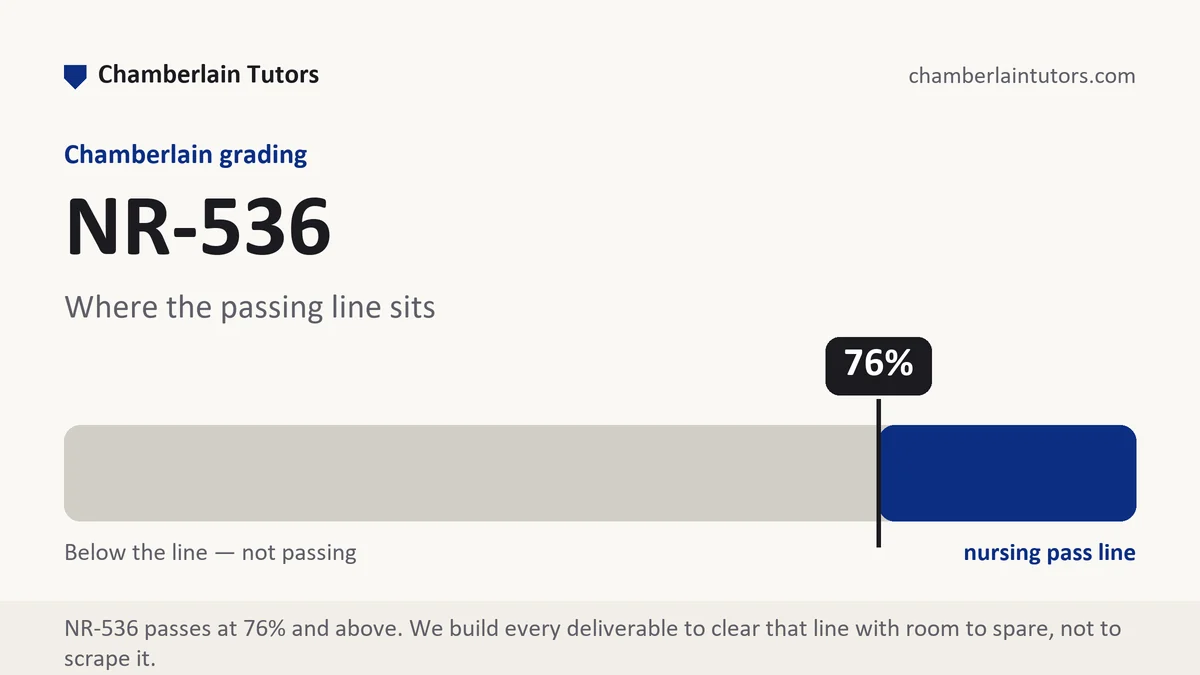
What NR-536 Week 1 asks for
A concept has structure, and the structure is what makes it teachable. It has a definition that holds across contexts. It has defining attributes, the features without which the concept is not present. It has exemplars, the cases that display it clearly. It has non-exemplars, the near misses that teach the boundary. And it has related concepts that sit near it and must be distinguished from it. A first paper in this course is usually asking you to build exactly that apparatus for one concept, and a paper that produces a good textbook summary instead will read as content knowledge rather than educational analysis.
The reason this matters is transfer, which is the whole argument for concept-based teaching. A prelicensure learner cannot memorize every disease she will meet, and the ones she memorizes rarely present the way the textbook described. If she holds perfusion as an organized concept with attributes she can look for, she can recognize inadequate perfusion in a postoperative patient, a septic patient and a patient in a fast atrial fibrillation without having studied all three separately. That is the claim the curriculum design rests on, and it is a claim with literature behind it that a graduate paper should engage rather than assume.
The second thing this stage tests is discipline about scope. Students choose concepts that are too broad, safety being the usual offender, and then cannot state defining attributes because the term covers everything. A concept you can define in one sentence and bound with three attributes is workable. A concept that expands to fill the entire profession is not, and narrowing it is the first analytic move rather than a compromise.
Deliverables at this stage tend to be a concept analysis or definition paper, sometimes with a short table of attributes and exemplars, often alongside a discussion post naming a concept and defending its place. Write posts as final copy; they do not reopen after submission in Canvas.
The NR-536 Week 1 method, step by step
Six moves that turn a familiar clinical topic into a defined teachable concept.
-
Narrow the concept until it has edges
Not safety but medication administration safety. Not oxygenation and perfusion together but perfusion alone. A concept you can bound is a concept you can teach, and the narrowing itself is analytic work worth a paragraph.
-
Write a definition that holds outside one disease
If your definition mentions a diagnosis, it is a description of that diagnosis rather than a concept. Test it against three unrelated patients; a definition that survives all three is doing the work.
-
List defining attributes and prove each is necessary
For each attribute, ask whether the concept could be present without it. If it could, the feature is common but not defining, and separating the two is the move that most often lifts an analysis row.
-
Choose one exemplar and one near miss
The exemplar shows the concept plainly. The near miss shares surface features and lacks a defining attribute, which is what teaches the boundary. A patient with a low pressure and warm extremities against one with a low pressure and mottled knees teaches more than either alone.
-
Position the concept against its neighbors
Say how it differs from the two concepts nearest to it and where they interact. Learners confuse adjacent concepts far more often than distant ones, and naming the confusion is a teaching decision.
-
Support the concept-based argument, do not assume it
Cite the curriculum literature for why concepts transfer better than content lists, and note honestly where evidence is limited. A grader in this course reads for engagement with that literature, not enthusiasm for it.
A layout and word budget for a concept definition paper
The frame our tutors keep beside an opening concept paper, sized for roughly 1,100 to 1,400 words. It is our own outline rather than anything the university issues, and your week's rubric outranks it wherever the two disagree.
| Section | What belongs in it | Word target |
|---|---|---|
| Concept and scope | The concept named, bounded, and the reason a broader version of it would be unteachable. | 140 to 170 |
| Definition | A single definition that holds across patient populations, sourced and tested against unrelated cases. | 170 to 200 |
| Defining attributes | Three attributes, each argued as necessary rather than merely common, with the test you applied. | 260 to 300 |
| Exemplar and near miss | One clear case and one that shares surface features but lacks an attribute, with the contrast drawn out. | 230 to 270 |
| Neighboring concepts | The two concepts learners confuse with this one and the distinguishing feature between them. | 170 to 200 |
| Why it belongs at the core | The transfer argument with published support and an honest note on the limits of the evidence. | 130 to 160 |
Evidence craft for concept writing
Use the concept analysis literature, not a dictionary. Nursing has established methods for analyzing concepts with published procedures and worked examples. Naming the method you followed, with its source and year, converts a definition paragraph into scholarship.
Separate the clinical source from the educational one. A pathophysiology text can support what perfusion is. It cannot support the claim that teaching perfusion as a concept produces transfer. Those are two claims and they need two kinds of evidence.
Give any figures a base and a window. If you argue that learners fail to recognize a concept in practice, report it as counts: seven of twenty-four learners missed the finding in a simulation session across one term. Percentages alone cannot be weighed.
Attribute the curriculum model. Concept-based curriculum design has documented proponents and a critical literature. Citing both, and naming where the critics have a point, is a stronger position than advocacy.
Keep every case anonymous. Exemplars drawn from real patients need no age, date, unit or diagnosis specific enough to identify. Write the clinical features the concept requires and remove everything else.
Five mistakes that cost points in this week's territory
- A disease chapter in disguise. If the paper could be retitled with a diagnosis, it never treated the concept as a concept.
- Concepts too broad to bound. Safety, communication and professionalism all collapse without narrowing, and the collapse shows up in an attributes section that lists everything.
- Attributes that are merely common. Failing to test necessity is the most frequent analytic gap at this stage, and it is easy for a grader to see.
- No non-exemplar. Boundaries are taught by contrast, and a paper with only clear cases has not shown where the concept ends.
- Asserting transfer. The claim that concept teaching produces transfer is the premise of the course and still requires citation.
Before you submit
- The concept is narrow enough to define in one sentence
- The definition holds across at least three unrelated patient situations
- Each attribute is argued as necessary, not just typical
- One exemplar and one near miss both appear, with the distinguishing attribute named
- The transfer argument carries published support and an honest limitation
- Every reference appears in the text and every in-text citation appears in the list
Starting NR-536 this week?
Send the instructions and the rubric out of Canvas. A premium original draft comes back in 24 to 48 hours with the concept bounded, the attributes tested and the exemplars chosen to teach a boundary, and revisions run until the grade lands.