NR-535 is the three theory hour introduction to the nurse educator role, educational models and instructional strategies across academic and healthcare settings. It is the course where you are expected to stop choosing teaching methods by preference and start choosing them by theory, and the rubric rows are built on that justification rather than on the method itself.
What NR-535 actually grades
The first scored move is matching a learning theory to a learning problem. Behaviourist accounts explain why practice with immediate feedback builds a reliable skill. Cognitive accounts explain why a learner cannot hold nine new steps at once. Adult learning accounts explain why an experienced nurse resists content that ignores what they already do. Social learning accounts explain why the preceptor's habits transfer faster than the policy. A paper that names one theory and applies it to everything has answered a different question than the one asked.
The second is the educator role itself, which spans more than teaching: designing, facilitating, evaluating, mentoring, and serving as a role model in settings where nobody has scheduled a class. Where a rubric row asks about the role, it wants those functions distinguished rather than described as a bundle.
The third is setting. Teaching a prelicensure cohort, orienting new hires and running an in service on a busy unit make different demands, and a strategy chosen without reference to the setting is chosen without reference to the constraint that decides whether it works.
How we help in this course
NR-535 has no clinical hours, so nothing on our side touches placement, preceptors, site paperwork or logs.
Send the prompt and the scoring guide from Canvas and a premium original draft comes back in 24 to 48 hours, planned against the criterion rows, with every instructional choice traced to a theory and to a learner group rather than to preference. The draft clears both quality reviews and the floor check, and revising stays free until it lands.
Writing this course's deliverables from the rubric
Rubric, learners, learning problem, theory, strategy. Choosing the strategy first is why so many teaching papers end up defending an activity the writer already liked.
In NR-535 right now?
Send the week and the rubric from Canvas. First premium sample free, floor-checked, back in 24 to 48 hours.
The floor in an introductory role course
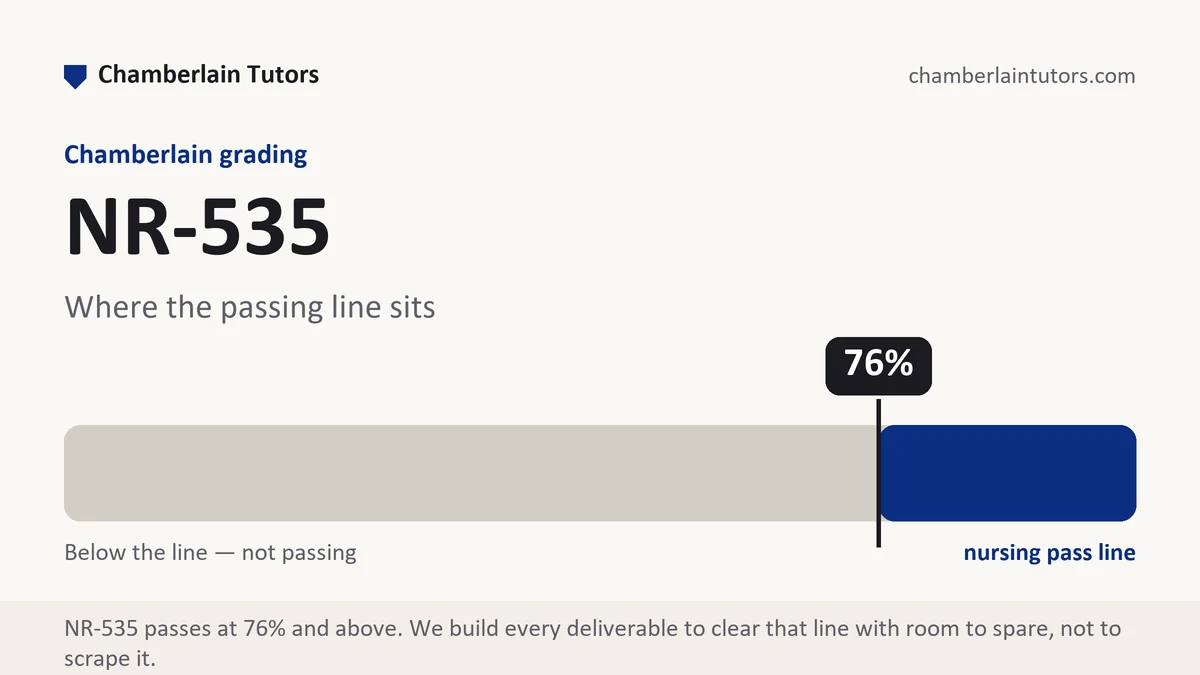
Core nursing courses pass at 76 percent, and where a track uses the nurse practitioner specialty scale, which has no C band, the last passing number is 84. Introductory courses in a specialty track carry a quiet risk: the material feels approachable, so the reading gets skimmed, and the theory rows are the first place that shows.
Two eight week sessions per sixteen week semester, up to six starts a year, weekly deliverables, and a weighted average that supplementary work cannot repair. In this course the cheapest points come from learning three or four learning theories properly in week one, because they reappear in every deliverable for the rest of the session.
Turn the criterion rows into a section plan
Copy the criterion rows into a blank file in printed order and reduce each to its verb: describe, compare, select, justify, apply. Those verbs become your headings in the guide's own sequence, which is a practical defence against writing an enthusiastic essay about teaching that never addresses a scored row.
Then price them. Suppose the assignment caps you at 1,500 words with four rows weighted 35, 30, 20 and 15 percent, giving roughly 525 words, 450, 300 and 225. If the 35 percent row is theory application, then 525 words is three or four paragraphs connecting a named theory to a specific learner difficulty, which is considerably more than the single definitional paragraph most drafts supply. The 225 word row is often the role or reflection section and takes one paragraph, while the 300 word row usually covers setting and constraints and is skipped entirely more often than any other section in this course.
Keep each budget beside its heading while drafting. Title page and references sit outside the count unless your guide says otherwise, and a comparison table of theories or strategies usually does too.
The shape of an instructional rationale
Most graded writing here is a rationale: a teaching philosophy, a strategy justification, a comparison of approaches for a given learner group. Each part below is a decision, and each decision needs a reason behind it.
| Part | What it has to establish | How the thin version reads |
|---|---|---|
| The learners | Who they are, what they already hold, and what specifically they are struggling with. | A general reference to students or staff. |
| The learning problem | What kind of difficulty this is: a skill, a concept, a judgement, a habit or a belief. | A topic named instead of a difficulty. |
| The theory, chosen deliberately | Which account of learning explains this kind of difficulty, cited, with one line on why it fits. | A theory summarized and then set aside. |
| The strategy it implies | The instructional approach the theory points at, described concretely enough to picture. | An activity chosen first and justified afterwards. |
| Setting and constraints | Time, group size, equipment, attention and shift realities, and how the strategy survives them. | A plan that assumes an uninterrupted classroom. |
| Evidence of learning | What the learner would do afterwards that they could not do before, and how you would see it. | A promise to evaluate learner satisfaction. |
Evidence and citation craft in education writing
Education research is smaller, more local and more variable than clinical research, and treating it like clinical evidence is a visible error.
- Go to the theorist, not the summary. Learning theories have primary literature. A textbook chapter is a secondary account and should be identified as one where you cannot reach the original.
- Currency, with the exception argued. Foundational learning theory is legitimately old and the sentence should say why it still holds. Findings about specific technologies, teaching formats or student populations older than five years need a stated reason.
- Design and sample before the finding. Write that a quasi experimental study compared two sections totalling 96 prelicensure students taught by different methods across one term, then the result. Education studies are usually single institution and small, which bounds what you can claim from them.
- Verbs the design can pay for. Students taught with the strategy scored higher on the end of unit examination is defensible. The strategy improves learning is a causal generalization very few education designs can support, and graders in an educator track are alert to it.
- Denominator and window on every rate. Write that 18 of the 96 students failed the first attempt in that term, rather than that 19 percent did. Cohort figures depend entirely on which cohort and which term, and a pass rate quoted without both is not evidence.
The gap between a passing paper and a strong one
A passing NR-535 paper describes learning theories accurately, advocates active learning, and explains that the educator should meet learners where they are. It is pleasant, orthodox and unspecific, which is the middle band in every scoring guide the course uses.
Strong papers diagnose before they prescribe, naming what kind of difficulty the learners actually have, because a skill gap and a belief gap need different treatment. They let the theory choose the strategy visibly, so a reader can follow the reasoning from account of learning to activity. And they design for the setting they really have, which usually means fifteen minutes, an interrupted group and no equipment, and a strategy that survives those conditions is worth more than an elegant one that does not.
Six mistakes that cost points here
- One theory for everything. Different difficulties need different accounts. Using a single favourite theory across every deliverable leaves the comparison rows unfed.
- Strategy first, justification after. The order is visible to a grader, because the theory paragraph reads as decoration when it was written second.
- Ignoring the setting. A method that needs an hour and a classroom is not a plan for a night shift in service.
- Satisfaction as evidence of learning. Enjoyment and learning are different outcomes. Say what the learner can now do.
- Confusing the educator's functions. Designing, facilitating, evaluating and mentoring are distinct, and rubric rows about the role usually want them separated.
- Posting to the board from the text box. Chamberlain posts do not reopen once submitted. Draft elsewhere, check the citation, then paste.
Questions NR-535 students ask
How do I write a teaching philosophy that is not generic?
I teach on a unit, not in a school. Does that count?
How many theories should one paper use?
Where NR-535 sits in Chamberlain's programs
Open the exact program map for sequence, credit, and option context. The current student schedule and syllabus remain authoritative after transfer evaluation, electives, state rules, and approved plan changes.
The weeks, one by one
Week 1
A charge nurse on a twenty-eight bed progressive care unit spends half of every shift teaching, and none of it is called teaching. Read the full Week 1 manual.
Week 2
Every teaching decision you have ever made carried a theory inside it, whether or not you could name the theory. Read the full Week 2 manual.
Week 3
Twelve nurses come off a night shift in a cardiac intensive care unit and sit down for a mandatory ninety-minute inservice. Read the full Week 3 manual.
Week 4
A teaching philosophy is the most misunderstood document in nurse education, because the word philosophy invites sentiment and the rubric wants argument. Read the full Week 4 manual.
Week 5
Fifty minutes, thirty-four learners, and one topic that has to survive contact with a real shift. Read the full Week 5 manual.
Week 6
An educator standing in a hallway on a surgical step-down unit at 0730 has no lesson plan that will survive the next four hours, and teaching still has to happen. Read the full Week 6 manual.
Week 7
Recording a lecture and posting it does not make a course online, and a high-fidelity manikin does not make a session a simulation. Read the full Week 7 manual.
Week 8
The closing stage of a foundations course collects seven weeks of separate arguments and asks whether they hold together. Read the full Week 8 manual.