A teaching philosophy is the most misunderstood document in nurse education, because the word philosophy invites sentiment and the rubric wants argument. NR-535 Week 4 sits at the midpoint of the session, where the theory you have been reading has to become a position you hold. The written work asks what you believe learning is, what that belief obliges you to do in a classroom or a simulation lab, and which published framework your belief descends from. Every sentence about your values should be traceable to a teaching behavior a colleague could observe. Your section may print this as NR 535 or NR535; it is the same course. Chamberlain publishes no syllabi outside Canvas. The placement here is our teaching judgment from the course's catalog arc; your section's rubric decides what your week actually asks.
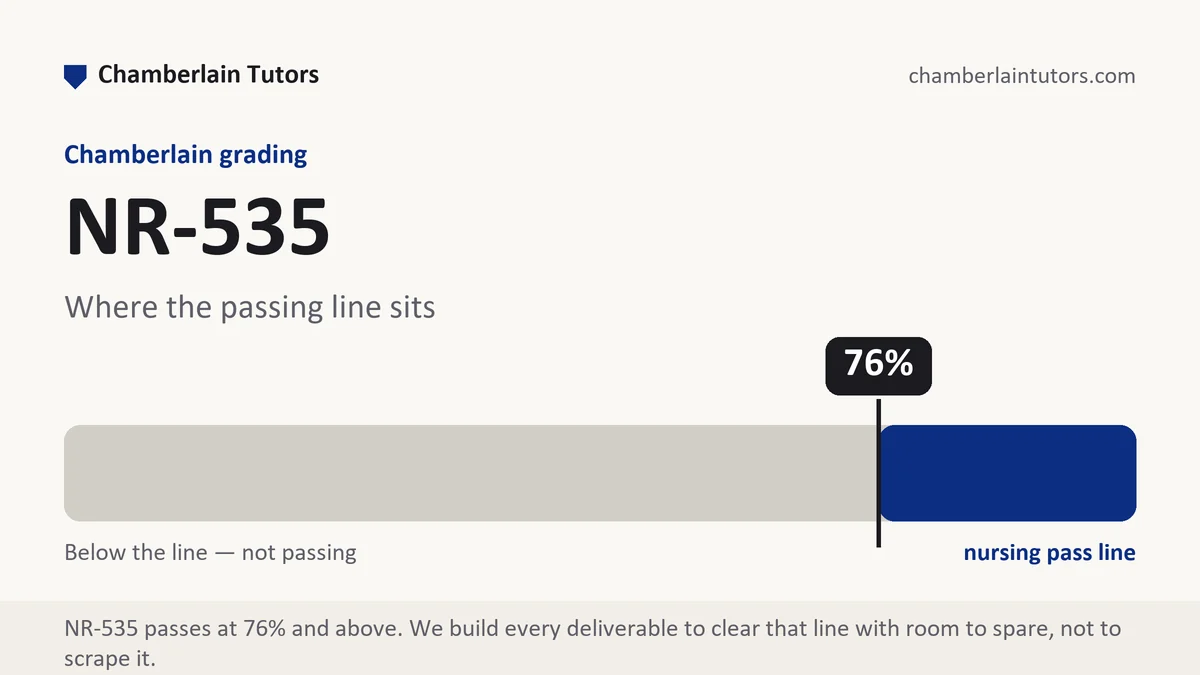
What NR-535 Week 4 asks for
The genre has a real function outside this course. Faculty applicants submit teaching philosophies with hiring packets, and search committees read them to predict what a candidate will actually do on a Tuesday afternoon with thirty students. That is the standard to write toward. A philosophy statement that could belong to any nurse in the country has told the reader nothing, and generic statements are the dominant failure at this stage.
Three components make the document work. The first is a claim about the nature of learning: what has to happen inside a learner for a change to count as learning at all. The second is a claim about the roles in the room, yours and the learner's, stated in terms of who does the intellectual work. The third is a claim about evidence: how you would know learning occurred, which is the component most students omit entirely and the one that separates a professional statement from a personal essay.
Alignment is the scored quality. If you write that learners construct understanding through experience and then describe a teaching practice built on lecture and a multiple-choice quiz, the paper has contradicted itself and a grader will name it. The reverse is equally visible: a philosophy asserting that skills require repetition and reinforcement, followed by a description of open-ended reflective seminars, reads as language borrowed rather than held.
The midpoint of an eight-week session also matters practically. By Week 4 your grader knows your writing, half the gradebook exists, and the remaining stages get heavier. Philosophy statements are usually short, often one to three pages, which makes them a rare opportunity to score well on a compact document. Take the length seriously in the other direction too: brevity here is not permission to be vague.
The NR-535 Week 4 method, step by step
Six moves for writing a philosophy statement that would survive a search committee.
-
Write your belief about learning in one sentence, without adjectives
Learning is a change in how a nurse interprets a situation. Learning is a behavior performed reliably under pressure. Both are defensible; they are not the same belief and they lead to different classrooms. Pick one and commit.
-
Trace the belief to a named framework
Your position almost certainly descends from a family you studied earlier in the session. Name it, cite it with a year, and say where you agree with it and where you depart. A philosophy with no lineage reads as untutored.
-
Convert each belief into an observable behavior
For every value you claim, write the sentence beginning in practice this means. If you value learner autonomy, in practice it might mean you do not give the answer during a simulation debrief for the first ten minutes. That sentence is what a committee reads for.
-
Say how you would know it worked
Name the evidence you would accept: performance under changed conditions, a learner's ability to justify a decision, error patterns that shift. This is the paragraph that turns a personal statement into professional writing.
-
Test every sentence against the generic swap
If a sentence would remain true after replacing nursing with accounting, it is filler. Statements about meeting learners where they are and creating a safe environment usually fail this test and should be replaced with the specific behavior they imply.
-
Fix the register before the final read
First person is normally appropriate in this genre, which is exactly why it slides. Keep the sentences declarative, cut the exclamation marks, and remove the closing paragraph about the privilege of teaching. Confirm against your writing row.
A layout and word budget for a teaching philosophy
The frame our tutors keep beside a philosophy statement, sized for roughly 800 to 1,100 words. It is our own outline rather than anything the university issues, and your week's rubric outranks it wherever they disagree.
| Section | What belongs in it | Word target |
|---|---|---|
| The core belief | What learning is, in one committed sentence, followed by the reason you hold that view rather than its rival. | 110 to 140 |
| Theoretical lineage | The framework your belief descends from, cited with a year, and the point where you part from it. | 150 to 190 |
| Roles in the room | What the learner does, what you do, and who carries the cognitive work at each stage of a session. | 150 to 190 |
| In practice this means | Three teaching behaviors a colleague could observe, each tied to a belief stated above. | 200 to 250 |
| Evidence of learning | What you would accept as proof that learning happened, and what you would not accept. | 130 to 170 |
| The line to remember | The one commitment you would want a hiring committee to remember, stated without ornament. | 60 to 80 |
Evidence craft for philosophy writing
Cite even here. Students assume a philosophy statement is source-free because it is personal. Foundations rubrics usually disagree, and one or two well-placed citations anchoring your position to a published framework will typically carry the support row on their own.
Name the departure, not just the allegiance. Saying you draw on a constructivist account except where psychomotor competency demands structured repetition is a more sophisticated position than pure allegiance, and it demonstrates you understand the limits of the framework you chose.
Use one anchoring scene, well chosen. A single teaching moment described in four sentences will do more for the document than three general paragraphs. Choose one that shows your belief operating, such as the pause you hold in a debrief before naming what went wrong.
Keep the scene anonymous and clinically clean. No identifiable learner, no reconstructable patient event, no unit named. Detail that carries the teaching point stays; detail that only carries drama goes.
Avoid claiming outcomes you cannot support. Do not write that your approach improves retention or patient outcomes unless you are citing evidence for it. An unsupported effectiveness claim in a philosophy statement is the sentence most likely to be marked.
Five mistakes that cost points in this week's territory
- The interchangeable statement. If any nurse could sign it, the document has not said what you specifically will do in a room.
- Belief and practice contradicting each other. A constructivist philosophy illustrated with lecture and testing is the alignment failure graders name most often at this stage.
- Theory absent entirely. A statement built from personal conviction alone forfeits the support row in a course explicitly about theoretical foundations.
- Autobiography instead of position. The story of the nurse who inspired you is a paragraph the rubric did not ask for and rarely credits.
- No account of evidence. A philosophy that never says how learning would be recognized has skipped the professional half of the genre.
Before you submit
- The core belief about learning is stated in one sentence, early
- A named framework with a year appears, along with where you depart from it
- Every value has an in-practice sentence describing observable behavior
- The document says how you would recognize learning when it happens
- No sentence survives the swap test with a non-nursing discipline
- Every reference appears in the text and every in-text citation appears in the list
Drafting the NR-535 philosophy statement?
Send the rubric and instructions out of Canvas. A premium original draft comes back in 24 to 48 hours with beliefs traced to a framework and every value carrying an observable behavior, and revisions run until the grade lands.