NR-534 is the three theory hour course that applies leadership and management inside complex adaptive healthcare systems in order to transform organizational culture. The phrase complex adaptive is not decoration. It commits you to writing about a system whose parts respond to each other, which means every intervention you propose has to be examined for what it will provoke as well as what it will produce.
What NR-534 actually grades
The first scored ability is seeing feedback rather than sequence. A linear analysis says that a shortage caused overtime which caused fatigue. A systems analysis notices that fatigue increases absence, absence deepens the shortage, and the loop tightens with every turn. Rubric rows about complex systems are asking for that loop to be described, and describing one honestly usually explains why a previous fix failed.
The second is treating culture as observable. Culture in this course is not a mood. It is what happens when someone raises a concern, what gets rewarded when targets and safety conflict, what is tolerated at the busiest hour, and which behaviours senior people display when things go wrong. Written that way, culture can be analyzed and changed. Written as values, it can only be praised.
The third is humility about intervention. In an adaptive system a change produces adaptation, and the strongest papers say what people will do in response to the new rule, including working around it, before proposing it.
How we help in this course
NR-534 has no clinical hours, so nothing on our side touches placement, preceptors, site paperwork or logs.
Send the prompt and the scoring guide from Canvas and a premium original draft comes back in 24 to 48 hours, planned against the criterion rows, with loops described rather than chains and culture handled as behaviour rather than sentiment. Both quality passes and the floor check happen first, and revising is free until the analysis lands.
Writing this course's deliverables from the rubric
Rubric, behaviour, loop, intervention, reaction. That last step is the one that distinguishes systems writing from ordinary management writing, and it is where the top band lives.
In NR-534 right now?
Send the week and the rubric from Canvas. First premium sample free, floor-checked, back in 24 to 48 hours.
The floor, and an abstract subject
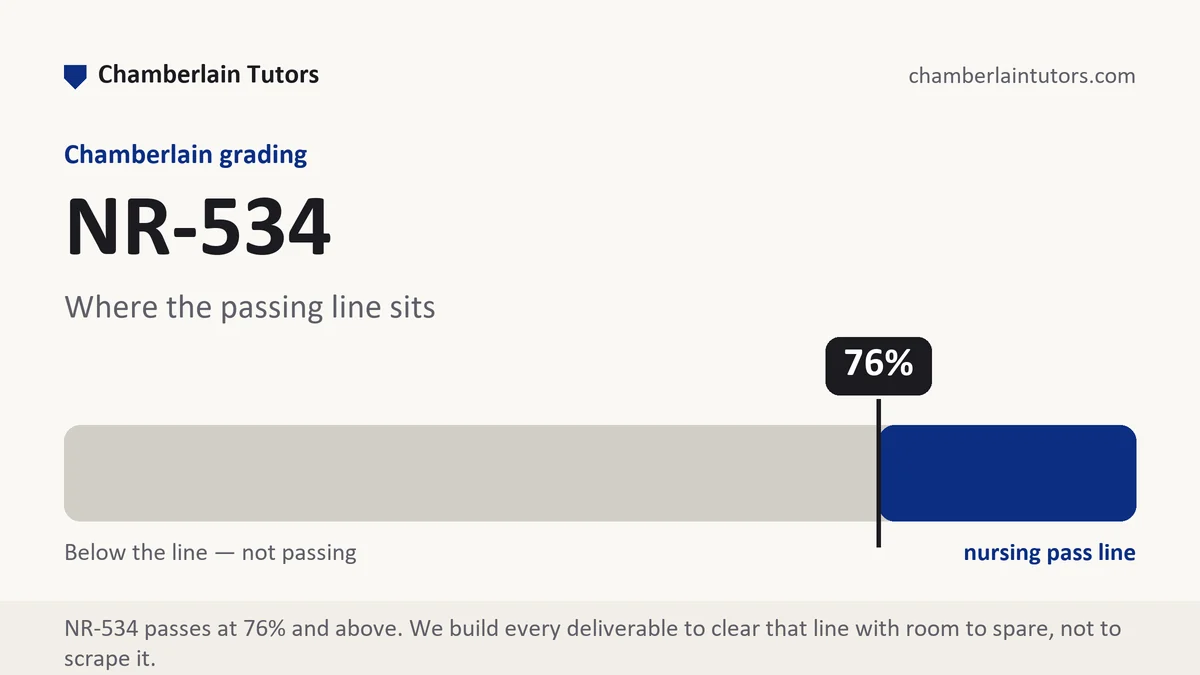
Core nursing courses pass at 76 percent, and where a track uses the nurse practitioner specialty scale, which has no C band, the last passing number is 84. Systems courses are where abstraction costs the most, because it is possible to write two thousand fluent words about complexity without describing anything that happens in a building.
Sixteen weeks divided into two eight week sessions, as many as six starts a year, a deliverable every week, and no supplementary work capable of lifting a weak average. Anchor every deliverable in one concrete behaviour by the end of the first paragraph, and the abstraction problem takes care of itself for the rest of the session.
Turn the criterion rows into a section plan
Copy the rows into a blank file in printed order and reduce each to its verb: describe, analyze, apply, propose, evaluate. Headings follow those verbs in the guide's sequence, which is a defence against the drift that systems topics invite.
Then convert weights into words. Suppose the paper is capped at 1,750 words across four rows weighted 30, 25, 25 and 20 percent, giving roughly 525 words, 437, 437 and 350. This is a flat distribution, which tells you something: no section can be treated as background, and the two 437 word rows, usually the systems analysis and the culture analysis, both need real development. The 350 word row is a substantial paragraph or two, not a closing line, and it is frequently the evaluation section that students leave until they have run out of words.
Keep each target beside its heading while drafting. Title page and references sit outside the count unless your guide says otherwise, and a loop diagram with a caption usually does too, which is the most efficient way to show a feedback structure.
The shape of a systems and culture analysis
Most graded writing here is an analysis of a persistent organizational pattern and what would change it. These parts recur, and a grader hunts for each.
| Part | What it has to establish | How the thin version reads |
|---|---|---|
| The observable pattern | Something that keeps happening, described as behaviour with a frequency attached. | An abstract problem such as a lack of accountability. |
| The parts and their connections | Which groups, systems and rules touch the pattern, and how each responds to the others. | A list of departments with no relationships between them. |
| The loop | The circular relationship keeping the pattern in place, stated so a reader can follow it round once. | A cause and effect chain with a single direction. |
| Culture, in behaviours | What is rewarded, tolerated and punished here, evidenced by what people actually do. | A statement of the organization's values. |
| The leverage point | Where a small change would alter the loop, and why that point rather than the obvious one. | A large intervention aimed at everything at once. |
| Predicted adaptation | How people will respond to the change, including workarounds, and what you would watch for. | An assumption that the change will be adopted as designed. |
Evidence and citation craft in systems writing
Systems and culture literature spans theory, safety science and organizational research, and the sources have to be handled differently from each other.
- Theory can be old if the sentence says why. Foundational work on complex systems and on safety culture remains usable, and naming its enduring contribution takes one clause. Survey results, adoption figures and outcome estimates older than five years need justification or replacement.
- Cite the instrument for culture claims. Statements about safety culture usually rest on a specific survey with specific domains. Name the instrument and the domain rather than referring to culture scores in general, because domains measure different things.
- Design and sample before the finding. Write that a survey of 12,900 staff across 40 hospitals compared reporting behaviour with perceived leadership response, then the result. Culture research is self reported and cross sectional far more often than its conclusions suggest.
- Verbs the design can pay for. Units scoring higher on the reporting domain also reported more near miss submissions is honest. Improving culture increases reporting is a causal claim, and in a systems course the direction of causation is precisely what is in question.
- Denominator and window on every rate. Write that 214 of the 1,180 staff invited completed the survey in one month, rather than quoting a percentage. Response rates in culture work decide how much the finding means, and they are omitted more often than any other figure.
The gap between a passing paper and a strong one
A passing NR-534 paper uses the vocabulary correctly, describes an organization as complex, argues that culture change requires leadership commitment, and recommends engagement and shared governance. The words are right and nothing in it could be tested, which is the middle band exactly.
Strong papers close a loop the reader can trace, so the persistence of the problem is explained rather than lamented. They evidence culture with behaviour, quoting what happens rather than what is stated in a values document. They choose a leverage point and defend the choice against a more obvious one. And they predict the workaround, because naming how people will bend a new rule is the clearest demonstration that a writer understands an adaptive system rather than a machine.
Six mistakes that cost points here
- Vocabulary without a system. Using the language of complexity while describing a linear chain is the most common failure in this course.
- Culture as values. Quoting a mission statement is not evidence. Describe what happens at three in the morning when a target and a safety concern collide.
- Intervening everywhere. A change aimed at the whole system has no leverage point and no way to be evaluated. Choose one.
- Assuming compliance. In an adaptive system people respond. A plan with no predicted adaptation misses the row that defines the course.
- Culture scores with no instrument. Name the survey and the domain, or the claim is unanchored.
- Posting to the board from the text box. Chamberlain posts do not reopen once submitted. Draft elsewhere, check the citation, then paste.
Questions NR-534 students ask
How do I describe a feedback loop without a diagram?
What evidence can I use for culture if I have no survey data?
How is this different from the leadership course on organizations?
Where NR-534 sits in Chamberlain's programs
Open the exact program map for sequence, credit, and option context. The current student schedule and syllabus remain authoritative after transfer evaluation, electives, state rules, and approved plan changes.
The weeks, one by one
Week 1
An urban clinic installs a new referral form to stop specialty referrals from going missing. Read the full Week 1 manual.
Week 2
Ask a nurse in a community health center who decides whether the diabetes education group runs on Thursdays, and the honest answer involves at least four people, none of whom appears above the other on any chart. Read the full Week 2 manual.
Week 3
Leadership writing is where graduate nursing papers most often turn into inspirational prose, and NR-534 Week 3 is the stage that has to be defended against it. Read the full Week 3 manual.
Week 4
Every community clinic has a poster in the break room listing its values and a set of rules everyone actually follows that nobody has ever written down. Read the full Week 4 manual.
Week 5
Most nurses have lived through a change that was announced at a staff meeting, resisted quietly for six weeks and abandoned without ceremony in the third month. Read the full Week 5 manual.
Week 6
A care coordination huddle at a community health center runs eleven minutes and involves a nurse, a medical assistant, a behavioral health clinician, a community health worker and a scheduler, none of whom reports to the same person. Read the full Week 6 manual.
Week 7
An abnormal lab result comes back on a Friday afternoon for a patient seen at a walk-in community clinic, and nobody looks at it until Tuesday. Read the full Week 7 manual.
Week 8
Closing week asks for the document the whole session was building toward: a plan to transform a culture, written by someone who now knows why most such plans fail. Read the full Week 8 manual.