Closing week asks for the document the whole session was building toward: a plan to transform a culture, written by someone who now knows why most such plans fail. NR-534 Week 8 pulls the systems view, the structural map, the leadership framework, the cultural diagnosis, the change theory, the team analysis and the reliability principles into one proposal for a defined setting. What earns the grade is coherence and honesty about mechanism, since culture cannot be changed by declaring it changed. It shifts when what is rewarded, tolerated, measured and modelled shifts, and a plan that names those levers concretely reads as leadership work rather than as a mission statement. Your section may print this as NR 534 or NR534; it is the same course. Chamberlain publishes no syllabi outside Canvas. The placement here is our teaching judgment from the course's catalog arc; your section's rubric decides what your week actually asks.
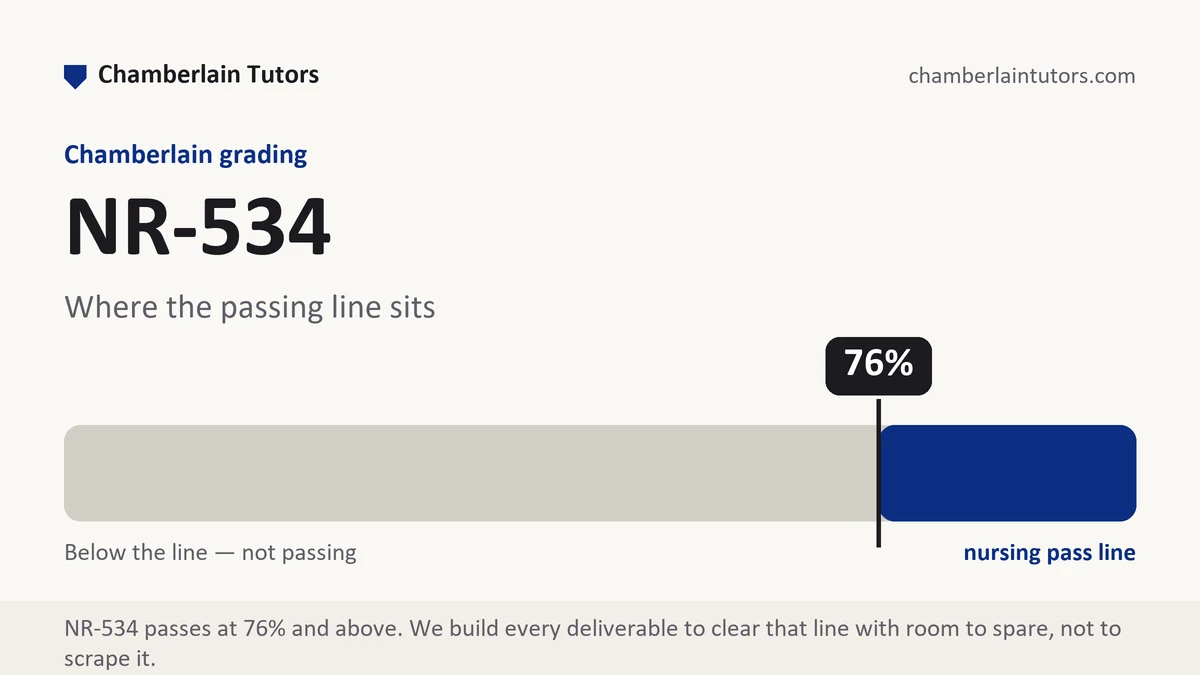
What NR-534 Week 8 asks for
Can culture be managed at all, and how do you write a plan that takes the doubt seriously? The literature is genuinely divided, and acknowledging that in a paragraph is stronger than ignoring it. One tradition treats culture as something leaders shape deliberately through what they attend to, measure, reward and model. Another treats it as emergent, historically produced and only indirectly influenceable, which is the view most consistent with the complex adaptive systems framing this course opened with. The defensible synthesis, and the one that produces the best final papers, is that culture cannot be installed but its conditions can be altered, and that a leader's real instruments are structural: what gets measured, what happens after someone speaks up, who gets promoted, what the default workflow makes easy.
A closing plan therefore needs three layers that most student versions collapse into one. The diagnosis layer says what the current culture is, evidenced rather than characterized. The intervention layer names specific changes to structures, routines and consequences, each attached to the assumption it is meant to unsettle. The evaluation layer says how anyone would know whether anything moved, using indicators that can actually be observed on a realistic timescale.
Final-week deliverables are usually a comprehensive plan, sometimes a presentation to leadership, sometimes both. Build it from what you already submitted rather than starting over, and check whether speaker notes or a narrative are expected alongside slides. The load in a final week of an eight-week session is heavy and the last thing you want is to be writing an eight-page synthesis from nothing on the final evening.
The realism test is what separates the top band. A plan that proposes changing an entire health system's culture in ninety days through workshops will be marked down by anyone who has attempted it. A plan that targets one unit, changes three concrete mechanisms, names a two-year horizon with early indicators at three and six months, and states what would count as failure is the document a chief nursing officer would actually read twice.
The NR-534 Week 8 method, step by step
Six moves for a closing plan that reads as leadership rather than as aspiration.
-
Restate the diagnosis in three sentences, with its evidence
The current assumption, what observation supports it, and what it costs the work. Everything downstream has to answer this, and a plan whose diagnosis is vague will be vague throughout.
-
Name the target state as behaviour, not as value
Not a culture of safety. Concerns raised during the shift rather than after it, near misses discussed in the huddle, a documented response when someone speaks up. Behaviours can be planned for and observed.
-
Choose the mechanisms that actually carry culture
What is measured, what is rewarded, what is tolerated, who is promoted, what leaders attend to publicly, and what the default workflow makes easy. Pick three and change them deliberately.
-
Sequence the work with early visible wins
Order the changes so that something observable happens within weeks, because a plan whose first result arrives in year two will lose its coalition before then.
-
Build the evaluation with lead and lag indicators
Lead indicators move early and imperfectly: participation, reports filed, concerns raised. Lag indicators move late and matter more: retention, safety outcomes, patient experience. Name both and say when each would be read.
-
State what would count as failure and what you would do
A named result that would mean the plan is not working, a review point at which you would look, and the alternative you would move to. Very few student plans include this and it is the clearest signal of managerial seriousness available to you.
A layout and word budget for a culture transformation plan
How do you arrange a synthesis so the plan dominates the theory? Our frame below is sized for roughly 1,400 to 1,800 words, or the narrative behind a short deck. It is our own outline rather than anything the university issues, and your week's rubric outranks it wherever they disagree.
| Section | What belongs in it | Word target |
|---|---|---|
| Setting and diagnosis | The unit, the current assumption operating in it, the evidence for that reading, and what it costs. | 250 to 310 |
| Target state in behaviours | Three or four observable behaviours that would be present if the culture had shifted. | 180 to 230 |
| Mechanisms to change | The specific structures, routines and consequences you will alter, each tied to the assumption it unsettles. | 340 to 420 |
| Sequence and sponsorship | The order of the work, who sponsors it, who owns each element, and where the early visible win sits. | 230 to 290 |
| Evaluation plan | Lead and lag indicators, when each is read, and the baseline each will be compared against. | 240 to 300 |
| Risk, failure and sustainment | What could go wrong, what result would mean failure, and what holds the change once attention moves. | 200 to 250 |
Evidence craft for the closing plan
Keep every framework from earlier stages doing work. A synthesis is not a review; each theory you carry forward should be attached to a specific section it is shaping. If a framework cannot be tied to a paragraph, it belongs in a sentence rather than a page.
Cite culture change efforts that failed as well as ones that succeeded. Health care has a substantial literature on transformation efforts that did not hold, and naming the specific failure mode you are designing against is one of the strongest moves available in a closing paper.
Attach every indicator to a baseline and an instrument. An indicator with no starting value cannot show movement, and one with no named instrument cannot be collected. Say what the measure is, where the number comes from and who would produce it.
Reconcile with your earlier submissions. If your diagnosis has evolved since the assessment stage, say so and say why in a clause. Silent revision reads as inconsistency; explicit revision reads as scholarship.
Five mistakes that cost points in this week's territory
- Values statements as intervention. A new set of stated values changes nothing unless what is rewarded and tolerated changes with it, and the literature is unambiguous about this.
- An unrealistic horizon. Culture work is measured in years, and a ninety-day transformation plan tells a reader you have not read the evidence you cited.
- Education as the whole plan. A training series with no change to structures, defaults or consequences will revert, and rubrics at this level expect you to know that.
- No evaluation, or only lag indicators. Without lead indicators nothing is observable inside the horizon of the plan, and a coalition cannot be held together on faith.
- A summary in place of a synthesis. Recapping eight weeks of theory is not a plan; the theory should be invisible except where it is deciding something.
Before you submit
- The diagnosis is stated with its evidence before any intervention appears
- The target state is written as observable behaviours rather than as values
- Each mechanism changed is tied to the specific assumption it is meant to unsettle
- Sponsorship, ownership and an early visible win are all named
- Lead and lag indicators both appear, each with a baseline and an instrument
- A failure condition, a review point and a sustainment mechanism are stated
Finishing NR-534 this week?
Send the rubric, the instructions and your earlier submissions out of Canvas. A premium original draft comes back in 24 to 48 hours with the diagnosis evidenced and the mechanisms named concretely, and revisions run until the grade lands.