NR-531 is the three theory hour course on leading and managing healthcare organizations, and the catalog names the analytic spine directly: structure, processes and outcomes. That triad is the assignment. Almost every deliverable asks you to take an organizational outcome, trace it back through the process that produced it, and land on the structure that made that process likely.
What NR-531 actually grades
The graded move is refusing to stop at the middle term. Most writing about organizations describes processes, because processes are what people experience. The rubric rows pay for going one step further back: reporting relationships, span of control, where decisions are made, how work is divided between units, which committee owns what, and how people are paid and evaluated. Those are structures, and they explain why a process keeps producing the same result after three attempts to fix it.
The second scored ability is treating an outcome as a measured thing. Organizational outcomes in this course are turnover, length of stay, readmission, satisfaction, event rates, vacancy and cost, each with a definition and a measurement window that changes what the number means.
The third is leadership theory used as an explanation rather than as a label. Naming a leadership style earns nothing. Saying which behaviours that style predicts, and whether the structure of the organization makes those behaviours possible for someone at that level, is the analysis the justification rows describe.
How we help in this course
NR-531 has no clinical hours, so nothing on our side touches placement, preceptors, site paperwork or logs.
Send the prompt and the scoring guide from Canvas and a premium original draft returns in 24 to 48 hours, planned against the criterion rows, with the analysis carried back to structure rather than stopping at process. It clears both quality reviews and the floor check before delivery, and revising is free until the paper lands.
Writing this course's deliverables from the rubric
Rubric, outcome, process, structure. Working in that direction, from the result backwards, is what keeps an organizational paper from becoming a description of a hospital.
In NR-531 right now?
Send the week and the rubric from Canvas. First premium sample free, floor-checked, back in 24 to 48 hours.
The floor, and a course of long papers
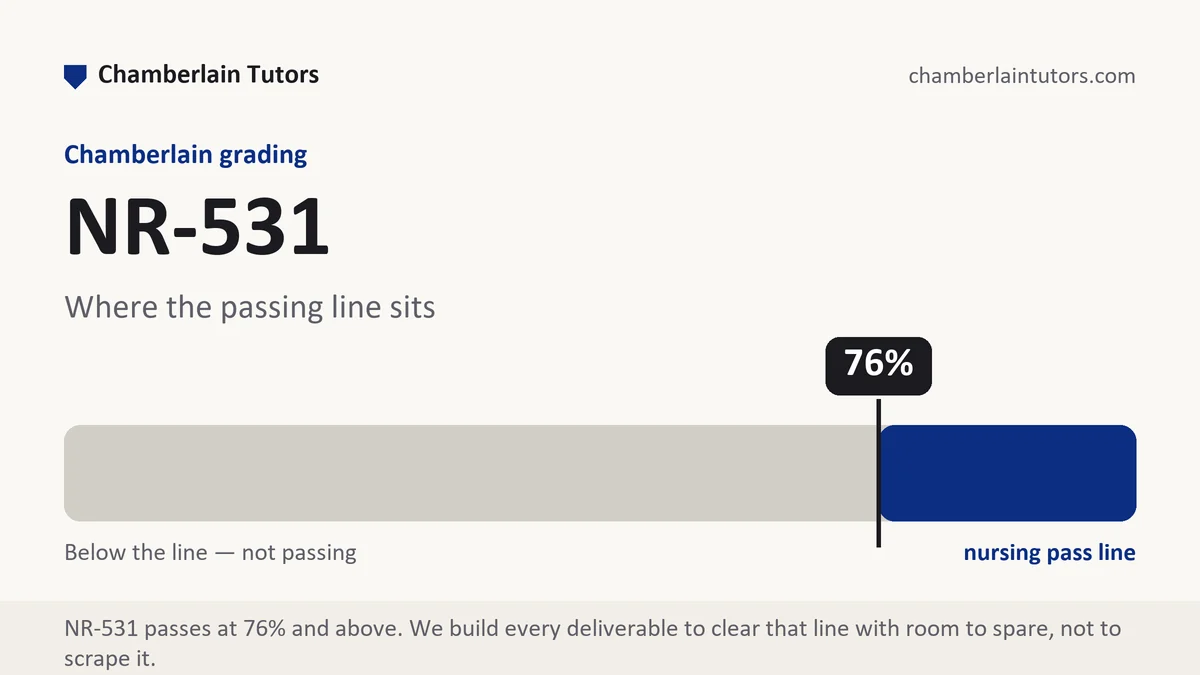
Core nursing courses pass at 76 percent, and where a track uses the nurse practitioner specialty scale, which has no C band, the last passing number is 84. Organizational papers are long, and length is where students quietly lose ground: a paper can run to its limit on description and still leave the analytic rows half fed.
The calendar is the standard one, sixteen week semesters split into two eight week sessions with up to six starts a year and weekly deliverables, and supplementary work cannot repair a weak weighted average. In a long paper course, the discipline that protects the grade is checking each section against its rubric row before writing the next one.
Turn the criterion rows into a section plan
Copy the rows into a blank file in printed order and reduce each to its verb: describe, analyze, relate, evaluate, recommend. Headings follow the verbs, in the guide's own sequence, which stops the paper from adopting the shape of an organizational chart instead of an argument.
Then convert weights into words. Suppose the assignment caps you at 1,650 words with four rows weighted 30, 30, 30 and 10 percent, giving roughly 495 words, 495, 495 and 165. Three rows of equal weight is a distinctive shape and a useful one: it usually means structure, process and outcome each carry a third, so a paper spending half its length on organizational background has already lost ground it cannot recover. The 165 word row is one paragraph, most often a personal application or a conclusion.
Keep each budget beside its heading while drafting. Title page and references sit outside the count unless your guide says otherwise, and an organizational diagram with a caption usually does too, which is a compact way to carry structural detail.
The shape of an organizational analysis
Most graded writing here is an analysis of an organization or a unit against the structure, process and outcome triad. Six parts, and the third is the one that separates the bands.
| Part | What it has to establish | How the thin version reads |
|---|---|---|
| The outcome under examination | One measured result, defined, with its base and its period, and why it matters. | A general concern such as low morale. |
| The process behind it | The sequence of work that produces the outcome, described step by step. | A description of what departments exist. |
| The structure behind the process | Reporting lines, decision rights, span of control, staffing model, incentives, committee ownership. | An organizational chart reproduced with no analysis. |
| Leadership behaviour in context | What a leader at a named level can actually influence given that structure, with theory doing the explaining. | A leadership style named and praised. |
| Evidence from the literature | What is known about this structure and this outcome, described before it is used. | Sources cited to support claims about a specific organization they never studied. |
| The structural recommendation | A change to a decision right, a reporting line, a staffing model or an accountability, with a measure attached. | A recommendation to improve communication and teamwork. |
Evidence and citation craft in organizational writing
The management literature is enormous, uneven and quoted carelessly more often than any other body of work you will use in this degree.
- Currency, with the exception stated. Foundational organizational theory ages well and the sentence should say why it still applies. Workforce statistics, turnover costs and market conditions older than five years need a reason or a newer source.
- Separate research from commentary. Trade publications, consultancy reports and professional magazines are useful for context and are not research. Label what each is, and make the load bearing claims rest on studies.
- Design and sample before the finding. Write that a multisite cross sectional study of 168 hospitals related nurse work environment scores to reported outcomes, then the result. Organizational research is usually correlational across institutions that differ in a hundred ways.
- Verbs the design can pay for. Hospitals with better rated work environments had lower turnover is defensible. Improving the work environment lowers turnover is a causal claim that cross sectional data cannot supply, and it is the most frequent overstatement in leadership papers.
- Denominator and window on every rate. Write that 27 of the 190 nurses employed on the unit at the start of the year had left within twelve months, rather than that turnover was 14 percent. Turnover definitions vary so widely that the base and the period are the only things making the number comparable.
The gap between a passing paper and a strong one
A passing NR-531 paper describes an organization competently, names a leadership theory, identifies a problem and recommends better communication, more education or a new committee. It is orderly and it never reaches the structural layer, which is the entire point of the course.
Strong papers ask why a process has survived attempts to fix it, and answer with a structure: nobody owns the step, the incentive rewards the opposite behaviour, the decision sits three levels above the person who sees the problem, or two units are measured on conflicting targets. They define the outcome before they discuss it. And they recommend a structural change, which is uncomfortable to write because it names something someone would have to give up, and that discomfort is exactly what distinguishes analysis from a report.
Six mistakes that cost points here
- Stopping at process. If the paper never reaches reporting lines, decision rights or incentives, the structure row is unfed however detailed the rest is.
- Outcomes with no definition. Turnover, readmission and satisfaction all have several definitions. Say which one, over what period.
- Leadership style as a label. Naming a style is not analysis. Say which behaviours it predicts and whether the structure permits them.
- Reproducing an organizational chart. A chart is data, not an argument. Say what the shape makes likely and what it makes hard.
- Recommending a new committee. Adding a body is the reflex answer. Changing who decides, who owns or who is measured is the analytic one.
- Posting to the board from the text box. Chamberlain posts do not reopen once submitted. Draft elsewhere, check the citation, then paste.
Questions NR-531 students ask
How do I analyze an organization I only see from the bedside?
Can I write about my own employer?
What counts as a structural recommendation?
Where NR-531 sits in Chamberlain's programs
Open the exact program map for sequence, credit, and option context. The current student schedule and syllabus remain authoritative after transfer evaluation, electives, state rules, and approved plan changes.
The weeks, one by one
Week 1
An organization is a machine for distributing authority, and NR-531 opens by asking you to describe the one you work in accurately enough that a stranger could predict how a decision would travel through it. Read the full Week 1 manual.
Week 2
Leadership theory is a set of lenses, and the second stage of NR-531 asks you to pick one up and use it rather than to summarize the catalog. Read the full Week 2 manual.
Week 3
Process is the middle term in the structure-process-outcome chain this course is built on, and the third stage of NR-531 asks you to make one process visible in writing. Read the full Week 3 manual.
Week 4
Outcomes are the third term in the chain, and the midpoint of NR-531 is where you learn to write about measurement without being sloppy. Read the full Week 4 manual.
Week 5
Good analysis does not implement itself, and the fifth stage of NR-531 turns to the political layer: who has to agree, what each of them is actually optimizing for, and where the authority to say yes really sits. Read the full Week 5 manual.
Week 6
Conflict in a hospital is usually a structural signal, and the sixth stage of NR-531 asks you to read it that way rather than as a personality event. Read the full Week 6 manual.
Week 7
Most changes in hospitals work for about six weeks. Read the full Week 7 manual.
Week 8
The closing stage of NR-531 is where seven weeks of separate analysis has to become one argument. Read the full Week 8 manual.