An organization is a machine for distributing authority, and NR-531 opens by asking you to describe the one you work in accurately enough that a stranger could predict how a decision would travel through it. That means reporting lines, spans of control, where budget authority actually sits, and which committees can say no. The graduate move at this stage is to stop writing about people and start writing about positions, because a structure that only works when a particular charge nurse is on shift is a structure with a defect. Your section may print this as NR 531 or NR531; it is the same course. Chamberlain publishes no syllabi outside Canvas. The placement here is our teaching judgment from the course's catalog arc; your section's rubric decides what your week actually asks.
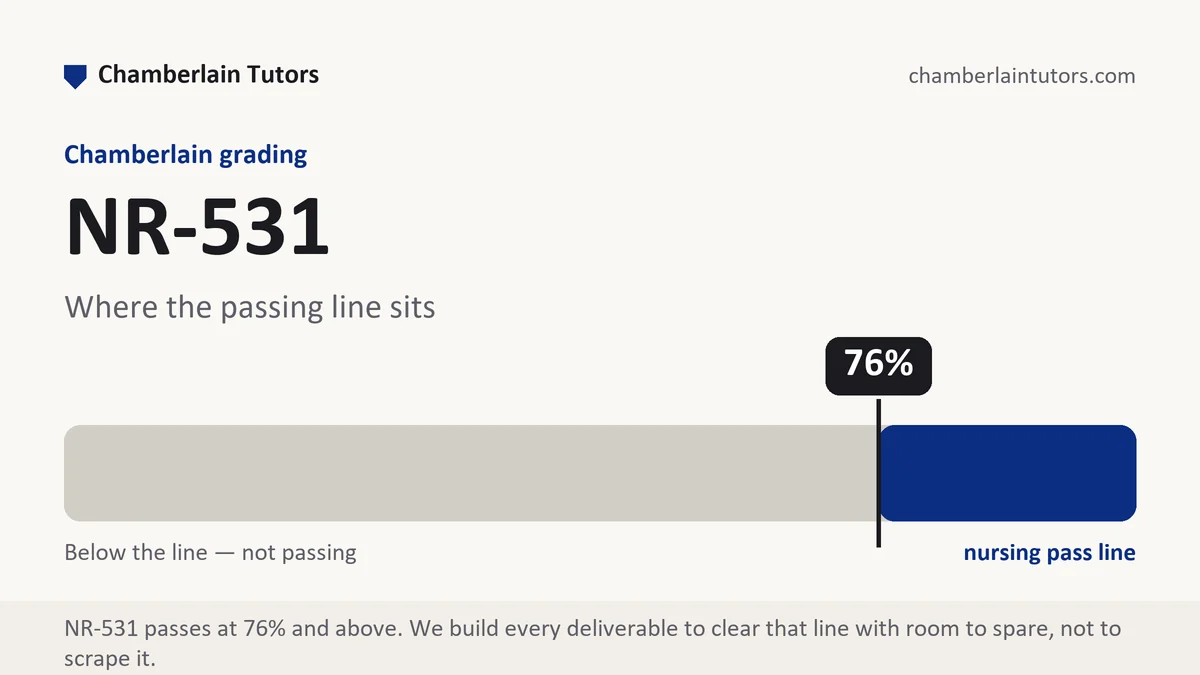
What NR-531 Week 1 asks for
A 34-bed med-surg unit runs a night shift with one charge nurse, eight staff nurses, three techs, and a house supervisor who covers four floors. Ask who decides to hold a bed and you will get five answers, and each of them is right on a different night. That ambiguity is what an opening structural analysis exists to expose. The catalog arc for this course runs structure, then process, then outcomes, and the first stage is the one that establishes the vocabulary for the other seven. Structure means the fixed features: how many layers separate the bedside from the executive suite, how wide each manager's span runs, whether the organization is arranged by function, by service line, or by some hybrid nobody drew on paper.
The written work at this depth is normally an analysis of a real organization, often your own employer, sometimes with a diagram attached. Graders reading these papers are looking for a specific movement of thought: description, then interpretation, then implication. Description says the unit manager has 62 direct reports. Interpretation says that span of control makes weekly one-on-one supervision arithmetically impossible. Implication says the coaching that would normally close a practice gap has to be delegated to charge nurses who hold no formal evaluative authority, which is why performance feedback in that setting arrives once a year and lands as a surprise.
Expect the stage to want organizational theory rather than opinion about your boss. Bureaucratic and professional bureaucracy models, matrix designs, and service-line structures all appear in the graduate management literature with named authors and known trade-offs, and a paper that identifies which of those shapes your organization approximates, then says what that shape costs, is doing the assigned analytic work. If your section runs a discussion this week, treat it as final copy: posts do not reopen after submission in Canvas, and an opening post that names a colleague rather than a position also creates a confidentiality problem you do not want on the record.
The NR-531 Week 1 method, step by step
Six analytic moves that turn an org chart into a graduate paper.
-
1. Reduce your week's rubric to its verbs before you draw anything
Copy each scoring row into a blank file and strip it to the verb it demands. Describe, analyze, evaluate and recommend sit at four different depths, and a row carrying evaluate will not be satisfied by an accurate diagram with a paragraph of narration under it.
-
2. Chart the reporting lines upward until they reach a board
Name each level by position title, from the bedside role you hold to the chief nurse and the governing body above her. Count the layers. The number itself is analytic evidence, because every layer adds a translation step to any message travelling in either direction.
-
3. Count the spans of control and say what they make impossible
Direct reports per manager is the single most useful number in a structural analysis. A span of 60 or more on a nursing unit is common and it forecasts exactly which supervisory functions get dropped. Report the count, then name the dropped function.
-
4. Separate the formal chart from the operating reality
The chart shows authority as designed. Shift practice shows authority as exercised. A telehealth triage nurse who reports to a clinical manager but takes protocol direction from a medical director is sitting in an unnamed matrix, and naming it is the paper.
-
5. Locate the decision rights that carry money and staffing
Follow one concrete decision, such as approving overtime or adding a position, and record every signature it needs. Where a decision requires four approvals and no single owner, delay is structural rather than personal, and you can now say so with support.
-
6. Convert each structural feature into a predicted outcome
Close every analytic paragraph by naming what the feature produces: slower escalation, uneven orientation quality, duplicated documentation. That predicted outcome is the hinge the whole course turns on, and installing the habit now pays through Week 8.
A layout and word budget for a structural analysis
This is the frame our tutors keep beside a first NR-531 submission, sized for a paper of roughly 1,200 to 1,500 words. It is our own outline rather than anything the university issues, and your week's rubric outranks it wherever the two disagree. Scale proportionally if your assigned length is different.
| Section | What belongs in it | Word target |
|---|---|---|
| Orientation to the organization | Type of facility, service mix, approximate size, and the unit or service you are writing from, in flat descriptive sentences. | 130 to 160 |
| The formal structure | Layers from bedside to board named by position, the design type it approximates, and the theory source you are matching it against. | 230 to 280 |
| Spans and decision rights | Direct-report counts, budget authority, and the approval path for one concrete staffing or spending decision. | 220 to 270 |
| Where the chart and the shift disagree | Two informal authority routes that operate daily and appear nowhere in the diagram, each with the situation that reveals it. | 230 to 280 |
| Structural consequences | Three effects the design produces, stated as predictions a reader could check against the unit's own data. | 250 to 300 |
| Close | The one structural feature you would examine first in the rest of the session, and why that one before the others. | 90 to 120 |
Evidence craft for organizational analysis
Cite management theory, not only nursing literature. Organizational design has its own body of scholarship, and a paper about structure that cites nothing but clinical nursing articles has skipped the discipline the assignment is drawn from. Name the theorist and the framework in your sentence, give the year, and use the framework's own terms rather than paraphrasing them into something vaguer.
De-identify the organization the way you would de-identify a patient. Describe your employer by type, region and size rather than by name unless your rubric asks for it, and never name individual managers. Write the director of medical-surgical services, not Karen. Professional confidentiality rows exist in graduate leadership courses and this is the most common way students lose them.
Every number needs a base and a period. A span of control is 62 direct reports as of the current schedule. Turnover is 11 departures out of 74 budgeted positions across the last twelve months. Bare percentages float free of anything a reader could weigh, and in a structural argument the denominator is often the more interesting half.
Mark the boundary between what you observed and what you were told. Some of your material comes from published documents, some from the chart on the break-room wall, and some from a conversation with a supervisor. Attribute each honestly inside the sentence. Personal communication is legitimate evidence when it is labelled and weak evidence when it is disguised as fact.
Five mistakes that cost points in this week's territory
- Writing about personalities instead of positions. A paragraph about a difficult manager is a complaint. The same material framed as an unworkable span of control is analysis, and only one of them is scoreable.
- Reproducing the org chart and stopping. A diagram is evidence, not argument. If every claim in the paper could be read off the picture, the interpretation layer is missing entirely.
- Theory quoted and then abandoned. Two paragraphs defining bureaucratic structure followed by four paragraphs of unrelated description is the commonest shape of a mid-seventies paper in this course.
- Naming the employer and its staff. Identifiable detail about a workplace is a professionalism issue, and it is completely avoidable at no cost to the argument.
- Recommending before diagnosing. Week 1 is a diagnostic stage. A solution proposed before the structure has been characterized has nothing underneath it and reads as opinion.
Before you submit
- Every level from bedside to board is named by position, not by person
- At least one span of control appears as an actual count
- A named organizational design framework is applied, with author and year in the sentence
- One concrete decision is traced through its full approval path
- Each structural feature is followed by the effect it produces
- No employer, manager or colleague is identifiable in the text
Starting NR-531 this week?
Send the instructions and the rubric out of Canvas. A premium original draft comes back in 24 to 48 hours written in graduate leadership register, with structure argued rather than described, and revisions run until the grade lands.