NR-529 is the three theory hour course on leadership at the point of care: decision making, management of human resources, and the patient care environment itself. It is the most practical leadership course in the sequence and the one where vague writing is most obvious, because the situations it grades are ones the reader has stood in.
What NR-529 actually grades
Decisions made under constraint. Almost every deliverable puts you in a position with insufficient staff, insufficient time or insufficient authority, and asks what you would do and why. The rubric rows reward a decision that names the trade off rather than one that avoids it, because a leader who solves a staffing shortfall without anything getting worse anywhere has not described a real shift.
The human resources strand is scored on precision about process. Delegation, assignment, performance conversations, scheduling and discipline all have rules attached, from scope of practice through employment policy, and a graduate answer says which rule governs the step rather than describing what feels fair.
The patient care environment strand asks you to see the unit as something designed. Workload distribution, skill mix, the physical layout, the noise, the interruptions, and the culture about speaking up are all management objects rather than weather, and treating them that way is the shift the course wants.
How we help in this course
NR-529 has no clinical hours, so nothing on our side touches placement, preceptors, site paperwork or logs.
Send the prompt and the scoring guide from Canvas and a premium original draft returns in 24 to 48 hours, planned against the criterion rows, with the decision made explicitly and the trade off stated rather than avoided. Both quality reviews and the floor check happen before it reaches you, and revising stays free until it lands.
Writing this course's deliverables from the rubric
Rubric, situation, decision, justification. The habit that costs marks here is writing everything a leader might consider and never saying what this leader did.
In NR-529 right now?
Send the week and the rubric from Canvas. First premium sample free, floor-checked, back in 24 to 48 hours.
The floor, and a course full of judgement calls
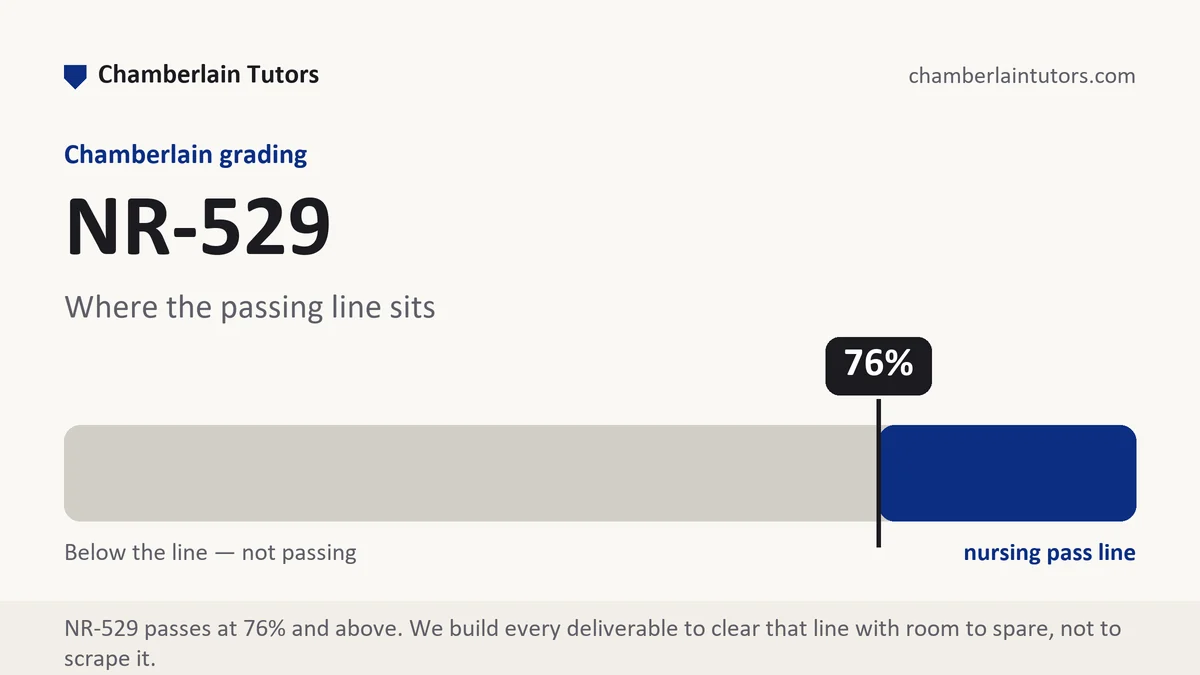
Core nursing courses pass at 76 percent, and on the nurse practitioner specialty scale, which carries no C band, the last passing number is 84. Judgement based courses feel safer than science courses and are not, because there is no right answer to fall back on and the entire grade rests on how the reasoning is written.
Sixteen week semesters split into two eight week sessions, up to six starts a year, weekly deliverables, and supplementary work cannot rescue a weak weighted average. In a discussion heavy course the discussion grade is a real part of that average, and Chamberlain posts cannot be edited once submitted, so the cheapest points in the course come from drafting posts in a document first.
Turn the criterion rows into a section plan
Copy the rows into a blank file in printed order and reduce each to its verb: analyze, decide, justify, apply, evaluate. Those become your headings in the guide's own order, which stops a case response from turning into a narrative with the analysis buried in the middle.
Then price them. Say the assignment caps you at 1,450 words with four rows weighted 35, 35, 20 and 10 percent, giving roughly 507 words, 507, 290 and 145. Two equal top rows is the shape that costs students the most, because one of the pair always gets written properly and the other gets a paragraph. Here they are usually the decision analysis and the justification from principle or policy, and the justification is the one that gets thin. The 145 word row is a single paragraph, most often a reflection, and it does not need a page.
Park the target next to each heading while the draft is in progress. Title page and references sit outside the count unless your guide says otherwise, and a staffing or assignment table, where you use one, usually does too.
The shape of a leadership case response
Most graded writing here is a case response: a situation on a unit, a decision to make, a justification to give. Six parts, and the one most often missing is the last.
| Part | What it has to establish | How the thin version reads |
|---|---|---|
| The situation and the constraint | What is happening, what is short, and what cannot be changed tonight. | A description of the problem with no limits named. |
| Your actual authority | What you may decide alone, what needs approval, and who holds the decision if not you. | A plan that assumes unlimited authority. |
| The options, honestly | Two or three real courses of action, each with what it costs and who absorbs the cost. | One preferred option and two obviously bad ones. |
| The decision | A clear statement of what you would do, in the first sentence of the section rather than the last. | A discussion that never resolves into an action. |
| The rule behind it | The scope, policy, standard or principle that makes the decision defensible, named specifically. | An appeal to patient safety in general terms. |
| Follow through | What you document, who you inform, what you watch, and what would make you revisit the decision. | The case ending at the moment the decision is made. |
Evidence and citation craft for unit management
Management writing invites confident assertion, which is why the citation habits matter more here than the topic suggests.
- Cite the current standard or policy type, dated. Scope of practice provisions, delegation rules and accreditation requirements are revised, and a decision justified by a superseded rule is indefensible. Name the version year.
- Distinguish law, policy and preference. A scope rule, an employer policy and a unit habit carry very different weight in a justification, and calling one by another's name is a common and costly slip.
- Design and sample before the finding. Write that a cross sectional survey of 21,400 hospital nurses examined the relationship between workload and reported missed care, then the result. Staffing and outcome literature is large, observational and frequently quoted without its design.
- Verbs the design can pay for. Units with richer skill mix had lower rates of missed care is defensible. Skill mix reduces missed care is not, and in a management course that overstatement is exactly what a grader is trained to catch.
- Denominator and window on every rate. Write that 46 of the 310 shifts audited over a quarter fell below the planned ratio, rather than that 15 percent did. Staffing figures depend entirely on which shifts were counted and when.
The gap between a passing paper and a strong one
A passing NR-529 paper describes a difficult situation, discusses several considerations, and concludes that the leader should prioritize patient safety while supporting staff. It offends nobody and it decides nothing, which is the middle band described almost word for word.
Strong papers decide in the first sentence of the decision section and then defend the decision, which is a harder and better piece of writing. They say what is given up: the patient who waits, the nurse whose assignment is heavier, the task that goes undone tonight. And they carry the case past the decision into documentation, communication and follow up, because a decision that is never recorded or revisited is not management, and the follow through row is the one most often left empty.
Six mistakes that cost points here
- Discussing instead of deciding. If a reader cannot state what you would do after reading the section, the decision row is unfed.
- Assuming authority you do not have. Say what you can decide and what you escalate. Naming the boundary is a scored skill, not an admission of weakness.
- Confusing delegation with assignment. They are different acts with different rules, and mixing them signals a gap in exactly the material this course covers.
- Solving staffing with volunteers. A plan that depends on someone agreeing to stay is not a plan. Say what happens if nobody does.
- Naming colleagues or units. Keep people and places unidentifiable. A case that reads as a grievance about a real manager creates a problem no grade fixes.
- Posting to the board from the text box. Chamberlain posts do not reopen once submitted, and leadership posts attract disagreement. Draft elsewhere and read it once before pasting.
Questions NR-529 students ask
I am not a manager. How do I write about decisions I have never made?
How do I handle a performance or discipline scenario safely?
Can I write about a real staffing crisis at my hospital?
The weeks, one by one
Week 1
NR-529 Week 1 opens the course where leadership courses have to open: with the styles themselves, the difference between leading and managing, and an honest look at which style you actually default to on a shift. Read the full Week 1 manual.
Week 2
NR-529 Week 2 moves from naming styles to using them, and the territory is decision making when something is short: staff, time, beds, information or authority. Read the full Week 2 manual.
Week 3
NR-529 Week 3 sits where the human resources strand of the course usually begins: delegation and assignment, the two acts that move work from one set of hands to another. Read the full Week 3 manual.
Week 4
NR-529 Week 4 usually lands on the resource that decides every other resource: people. Read the full Week 4 manual.
Week 5
NR-529 Week 5 typically carries the hardest human resources material in the course: what to do when a team member's performance falls short. Read the full Week 5 manual.
Week 6
NR-529 Week 6 usually turns to the friction inside the team itself: conflict, how it starts, what it costs, and the structured conversation that resolves it without a casualty. Read the full Week 6 manual.
Week 7
NR-529 Week 7 turns from the people to the place: the patient care environment as a designed object that produces outcomes. Read the full Week 7 manual.
Week 8
NR-529 Week 8 is where the course stops teaching in strands and asks for the whole instrument at once: a closing piece of work that runs a single situation through decision, people and environment together. Read the full Week 8 manual.
Where NR-529 sits in Chamberlain's programs
Open the exact program map for sequence, credit, and option context. The current student schedule and syllabus remain authoritative after transfer evaluation, electives, state rules, and approved plan changes.