NR-529 Week 8 is where the course stops teaching in strands and asks for the whole instrument at once: a closing piece of work that runs a single situation through decision, people and environment together. The graded skill is integration, one case argued as one argument, with the follow-through that earlier stages practiced separately. Your section may print this as NR 529 or NR529; it is the same course. Chamberlain publishes no syllabi outside Canvas. The placement here is our teaching judgment from the course's catalog arc; your section's rubric decides what your week actually asks.
What NR-529 Week 8 asks for
Closing stages in management courses tend to reward breadth held together by a spine. A rich unit situation, a sudden absence, a practice change resisted, a near miss with a staffing story underneath it, touches every strand the course has taught: a decision must be made under constraint, people must be directed, supported or corrected, and the environment that produced the situation must be read and adjusted. What the final stage grades is not whether you can still do each of those things, but whether you can do them inside one argument without the seams showing.
The spine is the decision. In an integrated case, the people material and the environment material exist to inform and then absorb the choice: who is affected, who must be told, what feature of the unit made this situation likely, and what changes so it is less likely next quarter. A closing paper that opens with its central decision and lets every section serve it reads as command; one that files three separate mini-analyses under one title reads as revision notes.
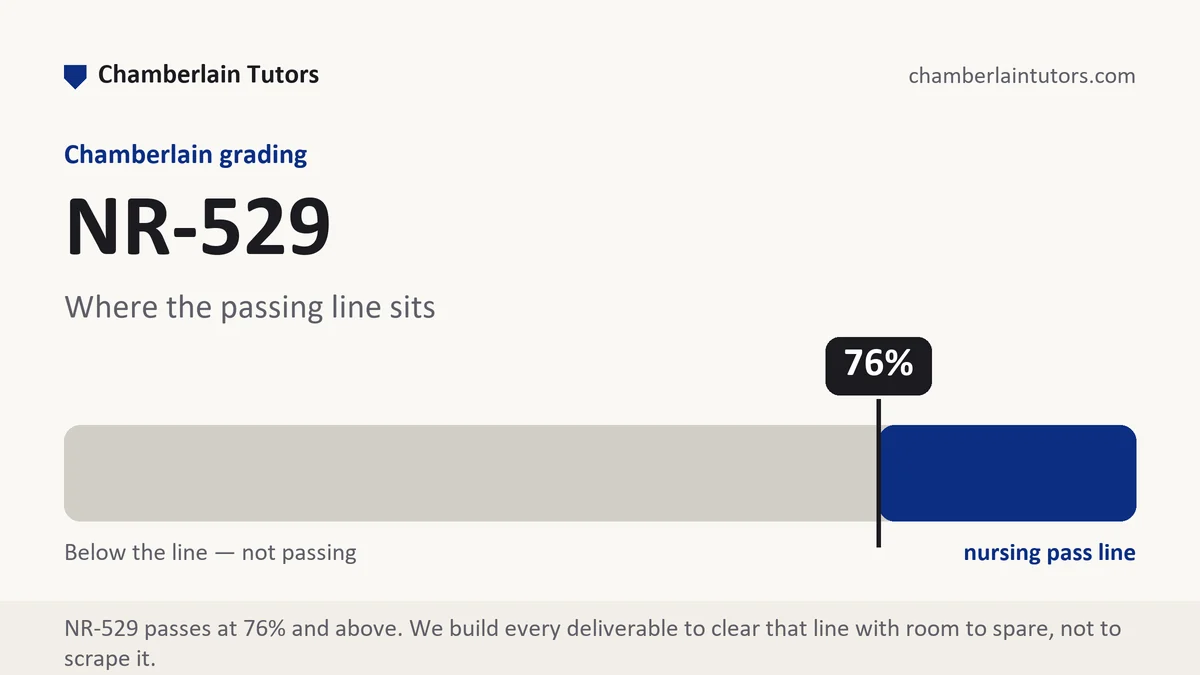
Weight also concentrates at the end of a session. Whatever your section's final deliverable turns out to be, it lands when the weighted average is nearly settled, and core courses pass at 76 percent while tracks graded on the nurse practitioner specialty scale carry no C band, making 84 the last passing number. The arithmetic of an eight week session means the closing piece is the last chance to move the number, and it deserves the week, not the weekend. If your section runs a discussion this week, expect a synthesis prompt, and draft it outside Canvas, because posts cannot be edited once submitted.
The NR-529 Week 8 method, step by step
Six moves that turn eight weeks of strands into one closing argument.
-
Build the skeleton from your week's rubric
Copy the criterion rows into a file in printed order and reduce each to its verb. Closing rubrics often price synthesis explicitly, and the row that asks you to integrate is the one your outline has to serve first.
-
Choose a case rich enough to need the whole course
Test your candidate situation against three questions: does it force a decision under a real constraint, does it involve directing or correcting people, and does the environment help explain it? If any answer is no, the case will leave a strand unfed.
-
Open with the decision and its warrant
State the choice in the first sentence of the analysis, then the rule, standard or evidence that makes it defensible. Every later section gains meaning from knowing what was decided, which is why the decision cannot wait for the conclusion.
-
Run the people dimension as consequence, not as a new topic
Who carries the redistributed work, who needs direction and what it says, who needs a private conversation afterward. Tie every people paragraph back to the decision it flows from, or the seam will show.
-
Read the environment as cause and as fix
Say what feature of the unit made the situation likely, then what change makes it rarer, scaled to your authority with the bigger fix named. This is the section that turns a good response into management.
-
Close the loop: document, communicate, measure, revisit
What is recorded and where, who is told in what order, what number shows whether the response worked, and the date you look again. Follow-through is the material most finals leave thin, and it is where the top band lives.
A layout and word budget for an integrated case
This is the frame our tutors keep beside closing-stage work, sized for roughly 1,400 to 1,800 words. It is our own outline, not anything the university issues, and your week's rubric outranks it wherever the two disagree. Scale the targets if your assigned length differs.
| Section | What belongs in it | Word target |
|---|---|---|
| The situation and the constraint | The case in brief, what is short, and what cannot be changed in the moment. | 180 to 220 |
| The decision and its warrant | The choice stated first, the options it beat, and the rule or evidence behind it. | 280 to 340 |
| The people dimension | Direction given, work redistributed, and any correction or support that follows, each tied to the decision. | 260 to 320 |
| The environment dimension | The feature that produced the situation and the scaled change that makes it rarer. | 240 to 300 |
| Follow-through | Documentation, communication order, the measure with its base and window, and the revisit date. | 200 to 250 |
| Close | What this case shows about leading at the point of care, in your voice, without new material. | 100 to 140 |
Evidence and citation craft for a closing case
Let each strand keep its own kind of authority. The decision leans on rules and standards, dated. The people material leans on scope and policy. The environment material leans on observational research with honest verbs. A closing paper that cites one kind of source everywhere reads as a habit; one that matches the authority to the strand reads as command.
Hold terminology steady across sections. If the second section calls an act delegation, the fourth section cannot call it assignment. Integrated cases are where drifted terms get noticed, because the same object appears in three lights, and the grader is reading for exactly that consistency.
Carry designs and samples even in summary. Synthesis invites shorthand, and shorthand invites overstatement. Even in a closing paragraph, a finding arrives as a design, a sample and a defensible verb, or it arrives as an assertion.
Numbers keep their bases to the last page. The measure that closes the loop needs a base and a window like every number before it: events per month against a stated baseline, over a stated quarter. A final paper that ends on an unanchored percentage undoes seven weeks of craft in its last sentence.
Five mistakes that cost points in this week's territory
- Three mini-papers in a trench coat. A decision section, a people section and an environment section that never reference each other is a filing system, not a synthesis.
- New theory in the final act. The closing stage is for integrating what the course taught, not auditioning material it did not. A new framework in the last week reads as avoidance.
- Follow-through as an afterthought. Two sentences of documentation and a vague we would monitor is the most common thin ending in management finals, and the most avoidable.
- The seams left showing. Sections that open with in terms of leadership and in terms of the environment announce that the integration happened in the headings, not the argument.
- Deadline compression. The closing week of an eight week session is short and the paper is long. A final drafted in one sitting reads like one, and the weighted average has no room left to forgive it.
Before you submit
- The decision appears in the first sentence of the analysis with its warrant behind it
- Every people paragraph ties visibly back to the decision
- The environment section names both the cause and the scaled fix
- Terminology is identical across all sections for the same acts
- The closing measure has a baseline, a base and a window
- No framework or theory appears here that the paper cannot afford to use fully
Final week of NR-529 and the case is big?
Send the instructions and the rubric from Canvas. A premium original draft comes back in 24 to 48 hours argued as one case rather than three, and revisions stay free until the grade lands.