NR-517 is the three theory hour course on national and global healthcare policy and economics, and on how nursing influences policy making and advocacy. The economics half is what surprises people. You are expected to say who pays, who benefits, what a proposal costs and who absorbs that cost, and a policy paper with no money in it is missing half of what the rubric rows are built on.
What NR-517 actually grades
Policy writing has a shape that clinical writing does not. It starts from a problem defined in numbers, moves to the mechanism that would change it, and ends with the trade off that mechanism creates for somebody. Graders are looking for all three, and the third is where most drafts stop early because acknowledging a downside feels like weakening your case.
The advocacy strand is graded on precision about the target. Nursing influences policy at several distinct points: rule making comments, professional organization positions, employer level policy, state legislation, federal regulation. A paper that says nurses should advocate has named none of them. A paper that identifies the specific decision point, the body that holds it, and the moment in the cycle when input is accepted, has done the work.
The global element is not decoration either. Where a rubric row asks for an international comparison, the comparison has to do something: another system's arrangement is evidence about whether a mechanism can work, not a paragraph of travel writing.
How we help in this course
NR-517 has no clinical hours, so nothing on our side goes near placement, preceptors, site paperwork or logs.
Send the prompt and the scoring guide from Canvas and a premium original draft comes back in 24 to 48 hours, structured against the criterion rows, with the policy sourced to primary documents and the cost reasoning stated rather than implied. Both quality passes and the floor check run before delivery, and revisions are free until the piece lands.
Writing this course's deliverables from the rubric
Read the guide, define the problem in numbers, then choose the policy. Choosing a policy you feel strongly about and reverse engineering a problem for it produces a persuasive paper that misses several rows.
In NR-517 right now?
Send the week and the rubric from Canvas. First premium sample free, floor-checked, back in 24 to 48 hours.
The floor under a writing heavy course
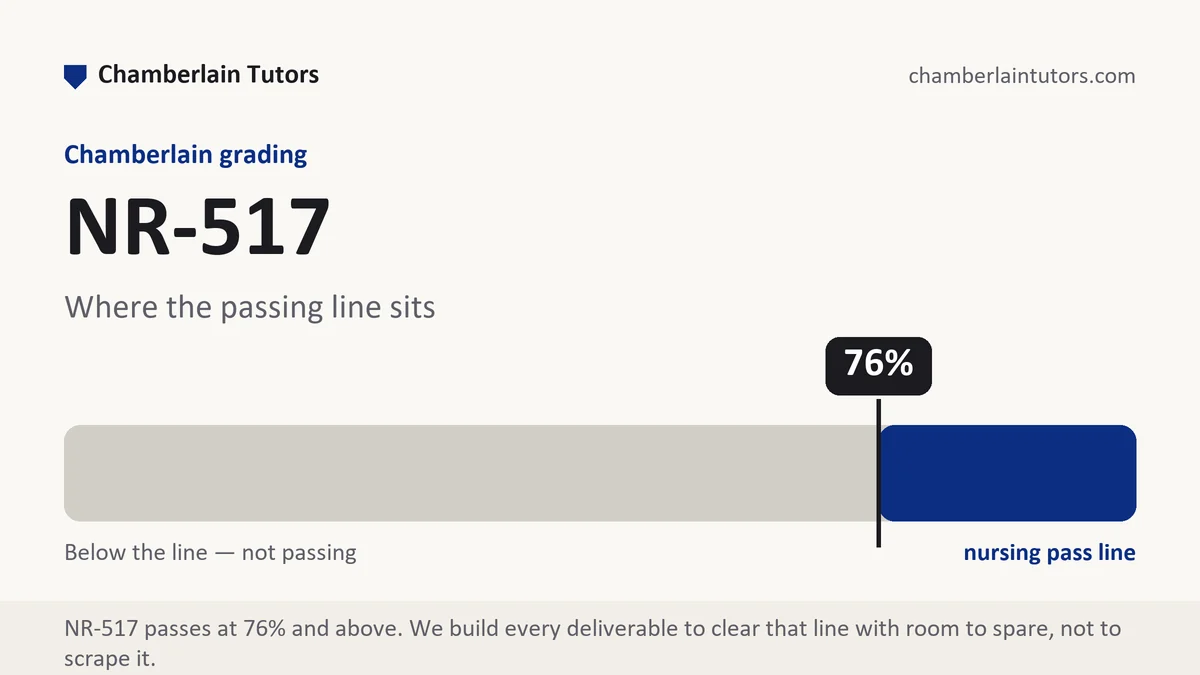
Core nursing courses pass at 76 percent, and where a track uses the nurse practitioner specialty scale there is no C band at all, which puts the last passing number at 84. Policy courses are unusually easy to underestimate because the reading is enjoyable and the writing is long, so the hours go into reading and the rubric rows go unfed.
The structure allows no catching up. Sixteen week semesters split into two eight week sessions, up to six starts a year, deliverables every week, and supplementary work cannot repair a weak weighted average. A long paper delivered thin in week five is not recoverable in week seven.
Turn the criterion rows into a section plan
Copy the criterion rows into a blank document in printed order, then reduce each to the verb underneath it: describe, analyze, compare, evaluate, propose. Those become your headings, held in the guide's own sequence so that a grader reading down the rows always lands on the matching section.
Then convert weights into a word budget, because policy assignments in this course tend to be long and long papers drift. Say the paper is capped at 1,750 words with four rows weighted 40, 25, 20 and 15 percent. That is roughly 700 words, 437, 350 and 262. Seven hundred words on one row is a real signal: the heaviest row in a policy paper is almost always the analysis of the policy itself, its mechanism and its effects, and it needs four or five paragraphs. The 262 word row is often the advocacy or the personal implication section, and it is a single tight paragraph, not the three that students write because advocacy is the easiest part to feel strongly about.
Keep the target beside each heading while you draft. Title page and references sit outside the count unless your guide says otherwise, and a summary table of costs, where you include one, usually does too.
The shape of a policy analysis
Most graded writing here is a policy analysis wearing one of several costumes: an issue brief, a comparison paper, a letter to a decision maker, a board post on a bill. A grader is checking for all six, and the missing one is usually the fourth.
| Part | What it has to establish | How the thin version reads |
|---|---|---|
| The problem in numbers | Who is affected, how many, over what period, with the figures sourced. | A claim that an issue is a growing concern. |
| The policy, named exactly | The bill, rule or program under discussion, with its identifier and its current status. | A general reference to healthcare reform. |
| The mechanism | How the policy is supposed to change behaviour: what it requires, funds, prohibits or pays for. | A statement that the policy improves access. |
| Who pays and who gains | The money trail, in whatever detail your sources allow, including the party absorbing the cost. | Benefits described with no cost side at all. |
| The evidence it works | Findings from where this mechanism has been tried, described before they are used. | An assumption that a sensible policy produces sensible results. |
| The nursing lever | The specific decision point a nurse can reach, the body that holds it, and the action with a timeframe. | A closing call for nurses to have a seat at the table. |
Evidence and citation craft in policy writing
Policy sources are political documents, and handling them well is most of the difference between a mid band paper and a strong one.
- Cite the bill or the rule, not the coverage of it. News accounts and advocacy pages compress, and the compression drops the provision your argument depends on. Name the instrument and the version, and note its status, because a proposal and an enacted law are different evidence.
- Label the source's interest. A trade association analysis and a nonpartisan budget estimate are both usable and are not the same kind of source. Saying which is which raises your credibility rather than lowering it.
- Design and population before the number. Write that a difference in differences analysis compared 14 states that expanded a program against 12 that did not over four years, then the estimate. Policy statistics are especially prone to arriving with no method attached.
- Keep the verb inside the design. Nearly all policy evidence is observational, and states choose their own policies. States adopting the change saw uninsured rates fall further is defensible. The policy reduced uninsurance is a stronger claim than most designs support.
- Denominator and window on every figure. Write that 2.3 million of the 21 million people enrolled in a given year used the benefit at least once during that year, rather than that 11 percent used it. Policy percentages without a base and a period are the easiest numbers in the world to misread.
The gap between a passing paper and a strong one
A passing NR-517 paper explains an issue, describes a policy, argues that nurses should be involved, and cites real sources throughout. It is fluent and it is a position paper, which is a category the middle band of a scoring guide describes almost exactly.
Strong papers put a price on things. They say who pays, in what form, and what is given up to fund the benefit they are advocating. They name the opposing case at its strongest rather than at its weakest, then answer it, which is the move that turns advocacy into analysis. And they end at a reachable lever: a comment period, a professional organization's position process, an employer policy, a state board rule, with a date attached.
Six mistakes that cost points here
- Writing a policy paper with no economics. If nobody pays for anything in your paper, an entire strand of the course is missing from it.
- Never naming the instrument. Healthcare reform is not a policy. A bill number, a rule, a program, a state statute is.
- Straw manning the other side. Answering the weakest objection is visible from a long way off and reads as avoidance.
- Confusing proposed with enacted. The status of a policy changes what can be claimed about its effects. Check it and state it.
- Advocacy with no address. A call to action without a named body, mechanism and timeframe is a sentiment.
- Pasting a board post into the text box. Chamberlain posts cannot be edited once submitted, and policy posts attract disagreement. Draft elsewhere and read it once before it becomes permanent.
Questions NR-517 students ask
How do I write about a politically charged issue without losing marks?
Where do I find cost figures that a grader will accept?
How much international comparison does the global part need?
The weeks, one by one
Week 1
NR-517 Week 1 starts the policy core where every policy actually starts, with a problem someone defined sharply enough to reach an agenda. Read the full Week 1 manual.
Week 2
NR-517 Week 2 brings the economics half of the course title forward, and it asks for less math and more mechanism than students fear. Read the full Week 2 manual.
Week 3
NR-517 Week 3 follows the money all the way through the system: how care is financed, through employer coverage, public programs and household spending, and how the dollars finally reach those who deliver it. Read the full Week 3 manual.
Week 4
NR-517 Week 4 puts the course's central trade off on the table: access, cost and quality, the three goals every health policy promises and no policy maximizes at once. Read the full Week 4 manual.
Week 5
NR-517 Week 5 takes the course abroad, and the catalog's global framing makes this the week for it. Read the full Week 5 manual.
Week 6
NR-517 Week 6 brings the policy course home to the profession itself, because the rules that decide what a nurse may do are policy of the most personal kind. Read the full Week 6 manual.
Week 7
NR-517 Week 7 converts seven weeks of analysis into influence, because the catalog promises nursing's part in policy making and advocacy is where that promise gets kept. Read the full Week 7 manual.
Week 8
NR-517 Week 8 collects the session into the discipline's signature document, the policy brief: a decision paper for a reader with four minutes, carrying a quantified problem, real options fairly stated, criteria applied in the open, and a recommendation with its costs attached. Read the full Week 8 manual.
Where NR-517 sits in Chamberlain's programs
Open the exact program map for sequence, credit, and option context. The current student schedule and syllabus remain authoritative after transfer evaluation, electives, state rules, and approved plan changes.