NR-516 is the three theory hour course on appraising research and using best evidence to inform care, with the legal, ethical and cultural questions that come with it. The graded skill is appraisal, not summary. A paper that reports what studies found scores in the middle. A paper that says how much those findings can be trusted, and why, scores at the top.
What NR-516 actually grades
The move this course wants is judgement about quality. Given an article, you are expected to say what design it used, whether that design can answer the question asked of it, who was in the sample and who was missing, what the authors measured and how, where bias could have entered, and what all of that means for whether a nurse should change anything on Monday.
Most students arrive able to report findings and unable to doubt them politely. The rubric rows are built on that gap. Reporting that a randomized trial found a difference is a description. Noting that the trial randomized 96 patients at a single site, lost 14 to follow up, and measured an outcome by self report is appraisal, and the second sentence is the one that pays.
The legal, ethical and cultural strand is graded alongside it. Whose consent was obtained, whether the sample resembles the population you would apply it to, and what happens when an intervention that worked in one community is transplanted into another are all scored questions rather than afterthoughts.
How we help in this course
There are no clinical hours in NR-516, so nothing on our side touches placement, preceptors, site paperwork or logs.
Send the prompt and the scoring guide from Canvas and a premium original draft returns in 24 to 48 hours, planned against the criterion rows, with each source described before it is used and the appraisal carried through to a practice implication. The draft goes through both quality reviews and the floor check first, and revising stays free until it lands.
Writing this course's deliverables from the rubric
The order that works is rubric, question, search, appraisal, implication. Students who search first end up with eight interesting articles and a rubric row about study design that none of them can fill.
In NR-516 right now?
Send the week and the rubric from Canvas. First premium sample free, floor-checked, back in 24 to 48 hours.
The floor and the eight week clock
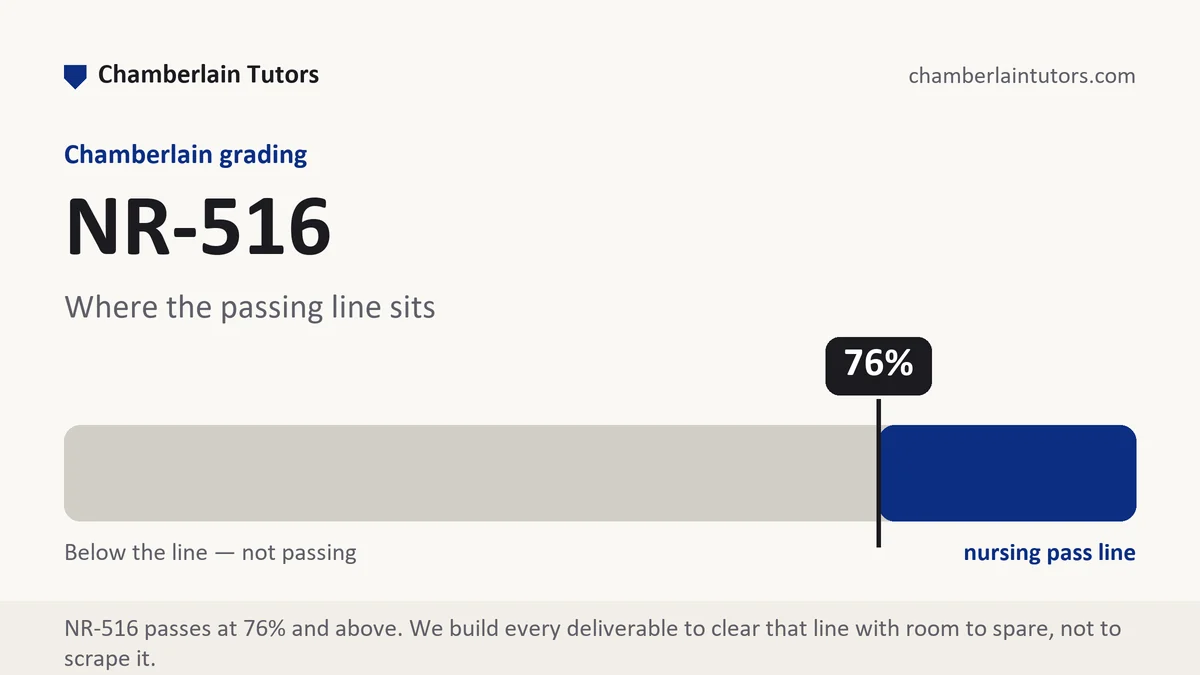
Core nursing courses pass at 76 percent, and where your track uses the nurse practitioner specialty scale there is no C band, which makes 84 the last passing number. Research courses generate more low grades than their difficulty warrants, because the writing looks like ordinary academic writing and is scored on a technical skill.
The calendar leaves no repair time. Sixteen week semesters divide into two eight week sessions, up to six starts a year, deliverables weekly, and supplementary work cannot rescue a weak weighted average. A misunderstood appraisal framework in week two repeats itself in every week after unless it is corrected immediately.
Turn the criterion rows into a section plan
Copy the rows into a blank file in printed order and reduce each to its verb: identify, appraise, synthesize, apply, justify. Those verbs become headings, kept in the guide's sequence so a grader never hunts for the section that matches the row in front of them.
Then price them. Suppose the week caps you at 1,250 words with four rows weighted 35, 25, 25 and 15 percent. That works out to roughly 437 words, 312, 312 and 187. Notice where the arithmetic points: if the 35 percent row is the appraisal, then 437 words is four or five real paragraphs about design, sample, measurement and bias, not the single paragraph most drafts allocate. The 187 word row is often the practice implication, which is exactly one disciplined paragraph rather than the page students write because implications are easier than methods.
Keep the number beside each heading while drafting. Title page and reference list normally sit outside the count, and an appraisal table, where one is required, usually does as well.
The shape of an appraisal paper
Most graded writing here is an appraisal of one or more studies attached to a practice question. Every part below answers a question a reader of evidence is entitled to ask.
| Part | What it has to establish | How the thin version reads |
|---|---|---|
| The practice question | Population, the thing being done, the comparison and the outcome, written tightly enough to be searchable. | A broad topic such as improving patient safety. |
| How the evidence was found | Databases, terms, limits and why articles were kept or dropped, in a short honest paragraph. | A claim that a search was conducted, with no detail. |
| Design, named and judged | What each study did and whether that design can answer the question you asked. | The word study used for everything from a trial to an opinion piece. |
| Sample and setting | Who was enrolled, how many, where, and who is missing from the sample that matters to you. | A sample size with no description of who was in it. |
| Measurement and bias | How the outcome was captured, what could have distorted it, and how the authors handled attrition. | Findings accepted at face value because the journal was good. |
| What it means for practice | Whether a nurse should change anything, for whom, and what remains unanswered. | A recommendation to implement, with no boundary conditions. |
Evidence and citation craft in an appraisal course
In every other course, sources support your argument. Here they are the argument, which raises the standard for how you handle them.
- Currency with a reason attached. Where your guide sets no rule, treat five years as the working boundary and justify anything older inside the sentence. A landmark trial or a methodological paper survives that test easily. A prevalence estimate does not.
- Appraise the primary study, not the review of it. A systematic review is legitimate evidence about a body of literature and useless as a stand in for a study you were asked to appraise. Where a review supplies your number, go to the study that produced it.
- Design and sample before every finding. Nine words of provenance convert an assertion into evidence: in a two arm randomized trial of 212 postoperative adults at one academic center. The sentence that omits them is an assertion in a citation's clothing.
- Verbs your design can pay for. Observational work supports was associated with, occurred more often among, predicted. Controlled experimental work supports reduced and caused. Borrowing a causal verb for correlational evidence is the exact error this course exists to remove.
- Denominator and window on every rate. Write that 38 of the 212 participants experienced the outcome within 30 days, rather than that 18 percent did. Once the base and the period are visible, the reader can judge the finding rather than accept it.
The gap between a passing paper and a strong one
A passing NR-516 paper finds relevant articles, reports what they found, and recommends the practice change they support. Everything in it is true. Nothing in it is weighed, and weighing is the entire subject of the course.
Strong papers doubt on the page. They name the specific limitation that would stop them acting, rather than closing with a generic limitations sentence. They distinguish between evidence that a thing works and evidence that it works here, which is where sample and setting earn their space. And they finish with a recommendation carrying a boundary: this population, this setting, monitored this way, revisited if this happens.
Six mistakes that cost points here
- Summarizing instead of appraising. An accurate account of findings with no judgement about quality is the middle band in every scoring guide this course uses.
- Calling everything a study. Name the design. Trial, cohort, case control, cross sectional, qualitative description, quality improvement report. The word choice signals whether you can tell them apart.
- Skipping the search description. Where a row asks how evidence was located, terms and limits are the answer. Saying a database search was performed earns nothing.
- Ignoring who was not in the sample. A trial in adults under 65 is a boundary on your recommendation. Naming it is appraisal; omitting it is oversight.
- Overstating with causal verbs. One misplaced caused can cost a row on its own in this particular course.
- Posting to the board from the text box. Chamberlain posts do not reopen after submission. Draft elsewhere, verify the citation, then paste.
Questions NR-516 students ask
How do I criticize a published study without sounding arrogant?
What if I cannot find high quality evidence on my question?
Do I need statistics I do not have?
The weeks, one by one
Week 1
NR-516 Week 1 opens the research core with the smallest and most consequential object in the whole session, which is the question itself. Read the full Week 1 manual.
Week 2
NR-516 Week 2 turns the question into a search, and a search is a documented procedure rather than an act of luck. Read the full Week 2 manual.
Week 3
NR-516 Week 3 is where the word study stops being acceptable. Read the full Week 3 manual.
Week 4
NR-516 Week 4 asks you to appraise work that was never trying to generalise. Read the full Week 4 manual.
Week 5
NR-516 Week 5 moves from who was studied to how they were measured, and both halves decide whether a finding means anything. Read the full Week 5 manual.
Week 6
NR-516 Week 6 hands you the results section, the part of an article most readers skim and the part this course refuses to let you skim. Read the full Week 6 manual.
Week 7
NR-516 Week 7 turns from how strong the evidence is to whether it was gathered and used rightly. Read the full Week 7 manual.
Week 8
NR-516 Week 8 asks for the move the whole session was building toward: taking the studies you questioned, searched, appraised and weighed, and writing what they add up to for one population in one setting. Read the full Week 8 manual.
Where NR-516 sits in Chamberlain's programs
Open the exact program map for sequence, credit, and option context. The current student schedule and syllabus remain authoritative after transfer evaluation, electives, state rules, and approved plan changes.