NR-515 is the three theory hour course on health informatics concepts, clinical information systems, and the ethical, legal and security questions that follow health data around. The third item is the one that decides grades. Anyone can describe a system. The marks are in whether you can say who is allowed to see a record, under which authority, what happens when that fails, and who is accountable when it does.
What NR-515 actually grades
This course sits one level above a foundations course, so the rubric rows stop asking what a clinical information system is and start asking you to evaluate one. Evaluation means criteria: you name what a good system does for a specific clinical purpose, then hold a real system against those criteria and report where it falls short.
The second graded strand is governance. Privacy, security and the ethics of secondary data use are not a closing paragraph in this course, they are a scored analysis. A strong answer distinguishes between a privacy question, which is about who may see information, and a security question, which is about how the information is protected from people who may not. Students who use the two words interchangeably lose points quietly across every week.
The third strand is consequence. Where a system design choice creates a risk, the graded sentence is the one that says what could reach a patient because of it: a delayed result, an override that becomes routine, an alert that stops being read.
How we help in this course
NR-515 has no clinical component, so nothing here involves placements, preceptors or hour logs, and we never enter or sit anything in a system on a student's behalf.
Send the prompt and the scoring guide from Canvas and a premium original draft comes back in 24 to 48 hours, structured against the criterion rows, with the governance analysis sourced to rules and standards rather than to blog summaries of them. Both quality reviews and the floor check happen before delivery, and revision continues free until the score is right.
Writing this course's deliverables from the rubric
Rubric first, criteria second, system third. Choosing the system before you have written down what you will judge it against is how an evaluation turns into a description, and description is the middle band in every scoring guide this course uses.
In NR-515 right now?
Send the week and the rubric from Canvas. First premium sample free, floor-checked, back in 24 to 48 hours.
The passing line and the weekly clock
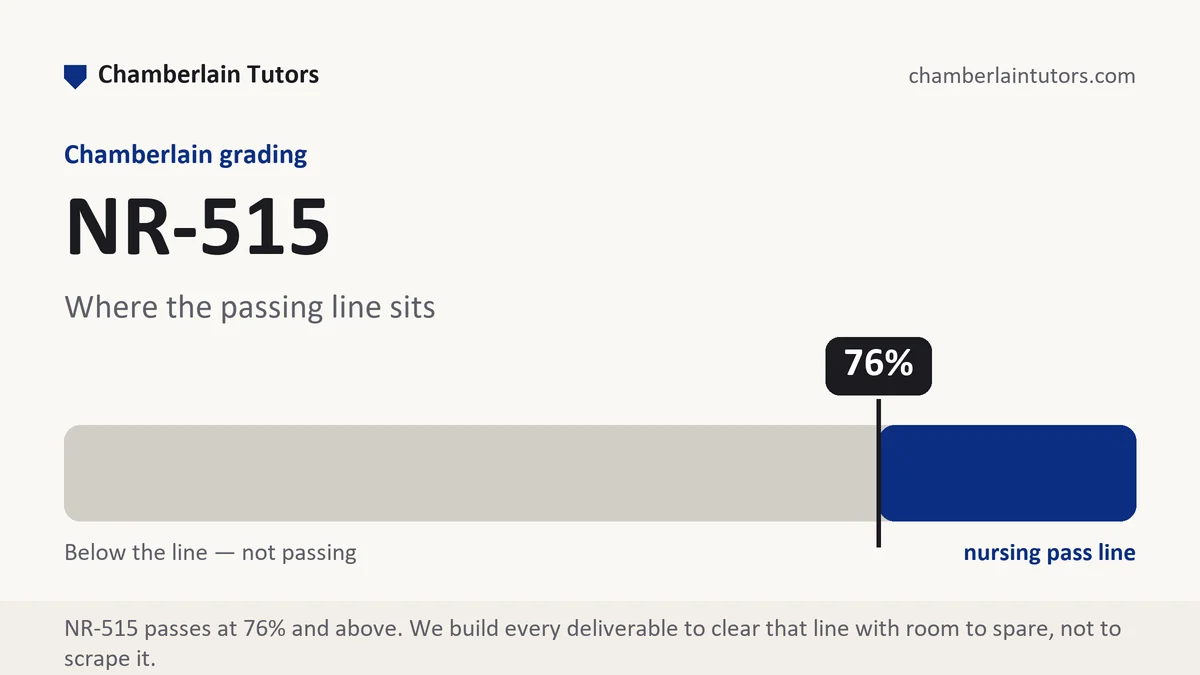
Core nursing courses pass at 76 percent, and on the nurse practitioner specialty scale, which has no C band, the last passing number is 84. Either way the mathematics is the same: supplementary work cannot repair a weak weighted average, so a soft start has to be corrected inside the graded work rather than after it.
Sixteen week semesters split into two eight week sessions, with up to six starts a year and something due each week. In an eight week session two weak weeks is a quarter of the course. Treat weeks one and two as the expensive ones and the rest gets easier.
Turn the criterion rows into a section plan
Paste the rows into a blank file in printed order, then strip each to its verb: describe, evaluate, analyze, recommend, defend. Headings follow the verbs, and the guide's order is kept, because a grader moving down the rows should never have to hunt.
Then convert the weights into words. Suppose the assignment caps you at 1,500 words with four rows weighted 30, 30, 25 and 15 percent. The arithmetic gives 450 words, 450, 375 and 225. Two rows of equal top weight is the signature shape of an evaluation assignment, and it is a warning: students almost always write one of the pair fully and the other in a hurry. If one 450 word row is the system evaluation and the other is the privacy and security analysis, both need real paragraphs, and the governance one is the one that gets rushed at eleven at night.
Keep the budget visible beside each heading. Where a guide says the title page and reference list sit outside the count, note it, along with whether an appendix or a table is excluded, since evaluation papers often carry a criteria table that is better placed outside the prose.
The shape of a system evaluation
Most graded writing here is an evaluation of a clinical information system or a data practice: a paper, a case analysis, a board post about a breach or an alert. Six parts, each of which a grader will try to locate before scoring the row it belongs to.
| Part | What it has to establish | How the thin version reads |
|---|---|---|
| Purpose, stated first | What the system is supposed to accomplish clinically, in one sentence, before anything is judged. | An opening about the digital transformation of care. |
| The criteria | Three to five named standards you will judge against, sourced rather than invented. | Judgements with no stated basis, such as user friendly. |
| The evidence of performance | What actually happens against each criterion, described concretely enough to be checked. | A general impression of how staff feel about the system. |
| Privacy analysis | Who may access which data, under what authority, and where the permission model is looser than the purpose requires. | A sentence noting that patient privacy is important. |
| Security analysis | The specific safeguards, the specific gap, and the realistic path an unauthorized person would take. | A list of security measures with no gap identified. |
| Consequence and recommendation | What could reach a patient, one change at a named level, and the measure that would show it worked. | A recommendation for more staff education. |
Evidence and citation craft when the source is a rule
Half your citations in this course are regulatory or standards documents rather than studies, and the two behave differently.
- Cite the rule, not the article about the rule. Compliance summaries drop the exception that decides your case. Where a regulation governs the point, open the regulation and name the provision and the version year.
- Currency is short in this field. Guidance, breach reporting requirements and interoperability rules are revised often, and a five year old description may be describing a superseded arrangement. Anything older should carry its justification in the sentence.
- Design and setting before the number. Write that an analysis of 1,240 reported breaches over a three year period classified causes by type, then the finding. A statistic on its own tells the reader nothing about what it counted.
- Match the verb to what was measured. Most implementation and safety informatics evidence is observational, and go live periods confound everything. Organizations with role based access controls reported fewer inappropriate record views is honest. Access controls prevent inappropriate views is not.
- Denominator and window on every rate. Write that 1,610 of the 9,400 alerts fired in one quarter were overridden, rather than that 17 percent were. Alert and breach rates are meaningless without the base and the period.
The gap between a passing paper and a strong one
A passing NR-515 paper explains the system correctly, uses the right terms, and closes with sensible recommendations about training and vigilance. Nothing in it is wrong. Nothing in it is decided either, and on a scale with no room underneath, undecided sits closer to the edge than it looks.
Strong papers announce their criteria before they judge, so the evaluation can be argued with rather than merely agreed to. They keep privacy and security separate and answer both. And they carry the analysis to a patient level consequence, because a governance flaw that never reaches a person reads as an abstraction, while one that ends in a delayed result reads as clinical reasoning.
Six mistakes that cost points here
- Describing when the row says evaluate. Description without criteria is the most common reason a well written paper lands mid band.
- Using privacy and security as synonyms. They are different questions with different remedies, and mixing them costs points in every governance row.
- Citing a compliance blog for a legal requirement. Secondary summaries omit exceptions. Go to the rule and name its version.
- Including a real screen or record. Never reproduce anything from a live system. Describe functionally instead, and keep the organization generic where the prompt allows.
- Recommending education for a design problem. More training is the reflex recommendation and the weakest one. Change the design, the permission or the workflow step.
- Posting to the board from the text box. Chamberlain posts cannot be edited once submitted. Compose elsewhere, check the citation, paste once.
Questions NR-515 students ask
Where do I get evaluation criteria that a grader will accept?
Can I write about a breach that happened at my workplace?
How technical does the security section need to be?
The weeks, one by one
Week 1
NR-515 Week 1 sets the course's two working tools side by side: the field's core concepts, defined precisely, and the evaluation criteria that turn a concept into a judgment you can defend. Read the full Week 1 manual.
Week 2
NR-515 Week 2 maps the systems themselves: what each clinical information system exists to do, how a single order travels across several of them, and where the hand-offs create the risks the later weeks will analyze. Read the full Week 2 manual.
Week 3
NR-515 Week 3 crosses the organizational boundary: what it takes for health information to move between systems and institutions and still mean the same thing when it arrives. Read the full Week 3 manual.
Week 4
NR-515 Week 4 puts the clinician back into the evaluation: usability, the study of how real people under real workload actually manage the systems built for them, and what the gap costs. Read the full Week 4 manual.
Week 5
NR-515 Week 5 studies the paradox at the center of health information technology: systems installed to prevent error create new kinds of error, and analyzing those new kinds is a discipline of its own. Read the full Week 5 manual.
Week 6
NR-515 Week 6 takes up the first half of the governance question the catalog promises: who may see health information, under what authority, and how far that permission actually reaches. Read the full Week 6 manual.
Week 7
NR-515 Week 7 takes the second half of the governance question: security, the safeguards that keep health information from people who may not see it, and the anatomy of what happens when they fail. Read the full Week 7 manual.
Week 8
NR-515 Week 8 closes the course where health data outlives the encounter it came from: secondary use, meaning quality work, analytics, research and population reporting built on records that were created to deliver care, and the ethical questions that reuse raises. Read the full Week 8 manual.
Where NR-515 sits in Chamberlain's programs
Open the exact program map for sequence, credit, and option context. The current student schedule and syllabus remain authoritative after transfer evaluation, electives, state rules, and approved plan changes.