NR-515 Week 8 closes the course where health data outlives the encounter it came from: secondary use, meaning quality work, analytics, research and population reporting built on records that were created to deliver care, and the ethical questions that reuse raises. Your section may print this as NR 515 or NR515; it is the same course. Chamberlain publishes no syllabi outside Canvas. The placement here is our teaching judgment from the course's catalog arc; your section's rubric decides what your week actually asks.
What NR-515 Week 8 asks for
Every earlier week dealt with data doing its first job, supporting the care of the person it describes. The closing territory asks what happens when the same data takes a second job. A record written at the bedside becomes a row in a quality dashboard, a case in a research dataset, a count in a public report. The clinical purpose that justified collecting it does not automatically justify each new use, and the graded skill is reasoning about that gap: who benefits from the reuse, what the patient understood would happen to their information, and what protections travel with the data when it leaves the chart.
Two ideas do most of the analytical work. The first is the distance between consent and use. A person who answered intake questions honestly was consenting to care, and each step away from care, toward operations, research or commercial analysis, stretches that understanding a little further. The second is de-identification, which is a process with limits rather than a magic word. Stripping obvious identifiers lowers risk; combining enough remaining details can raise it back, and a paper that treats de-identified as synonymous with anonymous has missed the week's hardest point.
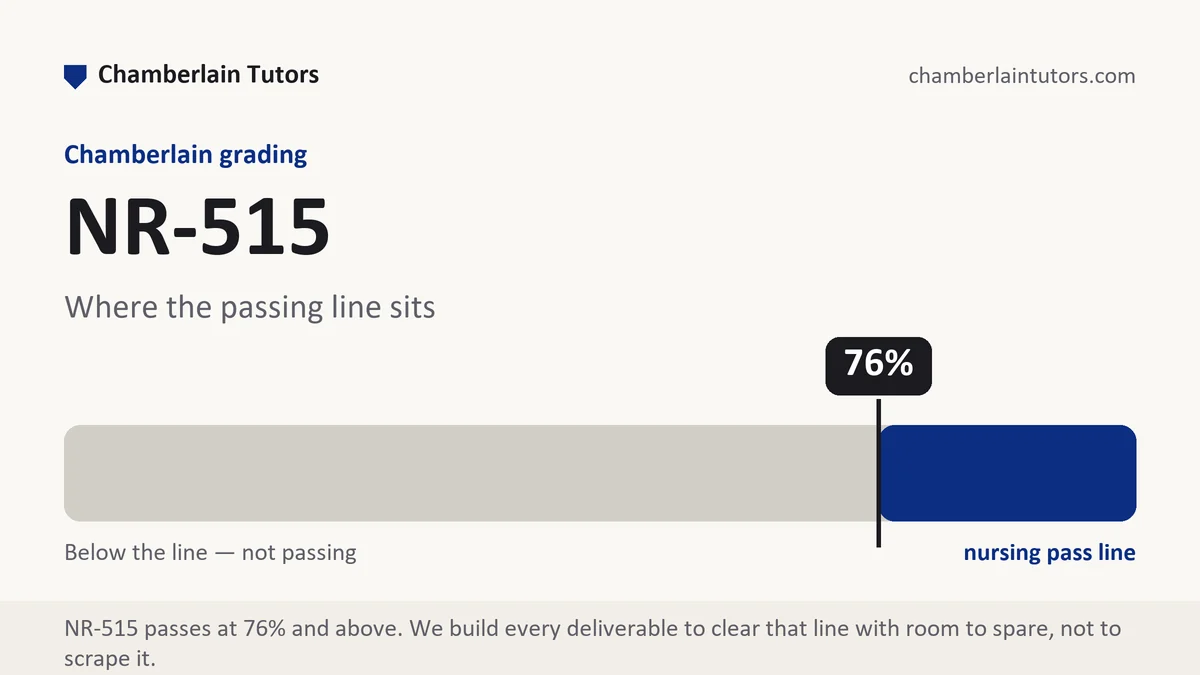
Because this is the final week of an eight-week session, expect the written work to synthesize: sections commonly close with a paper or discussion that pulls governance, security and ethics into one argument about a proposed reuse of data. Draft any post outside Canvas, since boards cannot be edited once submitted, and check your average before you budget effort, because core courses pass at 76 percent and the nurse practitioner specialty scale fails everything below 84.
The NR-515 Week 8 method, step by step
Six moves that turn an opinion about data ethics into an analysis a grader can score.
-
Read your week's rubric for the shape of the ask
Closing weeks split between a fresh ethics analysis and a synthesis that reaches back across the course. The rows will tell you whether earlier material, systems, exchange, privacy, security, is expected to reappear, and how much weight the recommendation carries.
-
Fix one dataset and its first purpose
Choose a concrete body of data, medication records, visit notes, screening results, and state plainly why it was collected. Every ethical question in the paper is measured against that first purpose, so it has to be on the page before any reuse is discussed.
-
Name the second use and who gains from it
Quality improvement, research, operational analytics and public reporting are different reuses with different beneficiaries. Say which one your scenario involves and whether the benefit lands on these patients, future patients, the organization or a third party, because the ethics shift with the answer.
-
Measure the consent distance
Ask what the person reasonably understood when the data was collected, and how far the proposed use sits from that understanding. Close uses may need only transparency; distant ones may need fresh permission or review by an oversight body. Placing the use on that line is the analysis.
-
Weigh de-identification honestly
Describe what is removed, then describe what remains, and reason about whether the remainder could identify someone when combined with other available information. Rare conditions, small communities and precise dates are the classic residual risks, and naming one concretely earns more than a general reassurance.
-
Close with a governance recommendation and its measure
Recommend one control at a named level, a review step, an access restriction, a transparency notice, a data use agreement, and say what you would watch to know it works. A closing week rewards the writer who ends with a decision rather than a sentiment.
A layout and word budget for a data reuse analysis
The frame below fits an ethics-of-reuse paper of roughly 1,100 to 1,400 words. It is our studio outline rather than a Chamberlain form; where your assignment prescribes structure, the assignment wins.
| Section | What belongs in it | Word target |
|---|---|---|
| The dataset and its first purpose | What the data is, who it describes, and the care purpose that justified collecting it. | 120 to 150 |
| The proposed reuse | The second use, stated concretely, with the beneficiary named. | 140 to 180 |
| The consent distance | What the person understood at collection, and how far this use sits from that understanding. | 200 to 250 |
| De-identification and residual risk | What is stripped, what remains, and one concrete way the remainder could still point at a person. | 200 to 250 |
| The competing goods | What the reuse could improve and what it could cost, argued rather than listed. | 180 to 220 |
| Governance recommendation | One control at a named level and the measure that would show it working. | 150 to 190 |
Evidence and citation craft for reuse questions
Anchor legal claims to the rule itself. What counts as de-identified, what a covered organization may do with data, and when review is required are defined in regulation and guidance, not in summaries of them. Where a requirement decides your point, cite the provision and its year rather than an article about it.
Re-identification claims deserve studies, not folklore. The demonstrations that supposedly anonymous data can be re-identified are published work with methods and datasets. If your risk paragraph leans on that possibility, cite a study and say what it combined, because the concrete mechanism is what makes the risk credible.
Keep benefit claims proportionate to their design. Most evidence that analytics improves care is observational and confounded by everything else the organization was doing. Organizations using readmission models reported earlier follow-up is honest; analytics reduces readmissions is a causal claim the design cannot carry.
Give every figure its base and window. Write that 3,200 of the 41,000 records in the registry came from one rural county over five years, rather than quoting a percentage alone. In reuse arguments the composition of the dataset is often the ethical point, and composition lives in denominators.
Five mistakes that cost points in this week's territory
- Treating de-identified as anonymous. The terms are not synonyms, and the gap between them is usually the exact thing the rubric wants examined.
- Arguing benefit without a beneficiary. Reuse that helps future patients, the budget or a vendor are three different ethical cases. Name whose good is being weighed.
- Moralizing instead of analyzing. A paragraph of alarm about privacy scores below a paragraph that measures one use against one collection purpose and decides.
- Importing a workplace dataset. Describe data functionally and keep the organization generic. Real extracts, counts or screens from your employer do not belong in coursework.
- Ending without a decision. A closing week paper that lists considerations and stops has done the reading but not the reasoning. Recommend a control and defend it.
Before you submit
- The dataset and its original care purpose are stated before any reuse is discussed
- The second use is concrete and its beneficiary is named
- The consent distance is argued, not assumed in either direction
- De-identification is weighed with one concrete residual risk
- Legal claims cite the rule and re-identification claims cite a study
- The paper ends with one governed recommendation and its measure
Closing out NR-515 this week?
Send the prompt and the criterion rows from Canvas. A premium original draft comes back in 24 to 48 hours, argued to a decision, sourced to rules and studies, revisions free.