NR-505NP is the nurse practitioner track's research methods and evidence based practice course. The material is appraisal and methodology; the pressure specific to an NP section is that the evidence has to end somewhere useful at the point of care. Your graded writing is judged on whether a clinical question was built well, searched properly, appraised honestly, and then answered at a strength the evidence can actually bear. This page is the manual for that sequence.
What NR-505NP actually grades
Four things, in a fixed order. Whether your question is specific enough to search, which in practice means a defined population, one comparison, and one outcome. Whether your search can be reproduced from what you wrote. Whether your appraisal reads the studies rather than their abstracts, noticing who was enrolled, who finished, how the outcome was measured and how large the difference was. And whether the recommendation you end on matches the strength of what you found, rather than the strength of what you hoped to find.
That last row is the NP specific one. Practitioners in training are being taught to act on evidence, and the discipline being tested is knowing when the evidence does not yet license action. A confident recommendation resting on two small single site studies loses more points than a hedged one, because in a clinical track overreach is the error with consequences.
How we help in this course
Send the prompt, the scoring guide from Canvas, your clinical question if you have one, and the articles if your section assigned them. The draft comes back with the question tightened until the search terms are obvious, the search written so it could be run again by a stranger, appraisal built from the methods and results rather than the summary, and a recommendation stated at a strength the studies support, with the gap named where one exists.
Everything runs the standard route: scoring guide decoded row by row, core deliverables separated from supplemental, a writer matched to appraisal and advanced practice material, a rubric pass and an independent APA and originality pass, the scale check against your section's floor, delivery inside 24 to 48 hours. The boundary we hold: written work only. Clinical hours, preceptor contact, site paperwork and logs stay entirely with you.
How to write this course's deliverables
Chamberlain publishes no syllabi outside Canvas, so this is craft rather than a schedule. It covers pricing your scoring guide in words, the columns an evidence table needs before any prose gets written, and how to appraise for clinical use rather than for a research seminar.
In NR-505NP right now?
Send the week and the rubric from Canvas. First premium sample free, floor-checked, back in 24 to 48 hours.
A scale with no middle
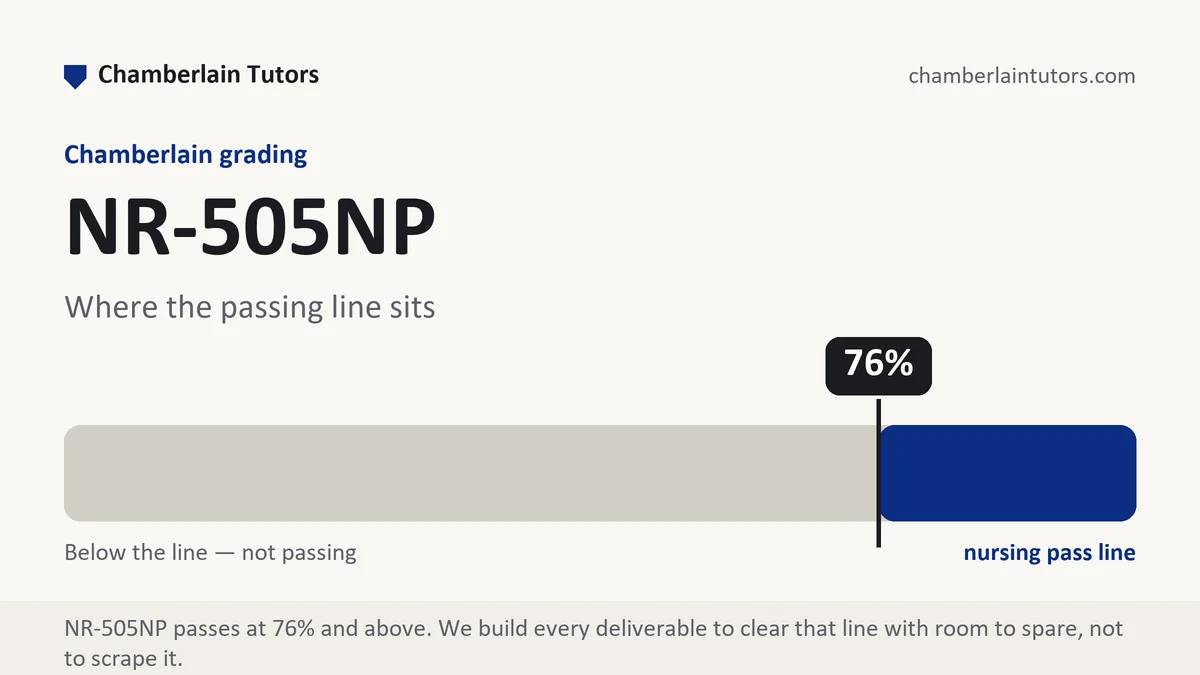
NP specialty coursework is graded on a scale with no C band, so 84 is the last passing number and there is no comfortable middle to drift into. Appraisal courses produce that drift easily, because a paper can be entirely accurate and still shallow, and shallow scores in the low eighties. Supplementary work cannot lift a weighted average after the core pieces have landed, so the margin has to be built while each piece is still being written.
The eight week session inside a sixteen week semester compresses everything, with something due weekly and no quiet stretch for recovery. One habit protects you disproportionately here: check any article your section requires against your question early. Discovering in week six that your chosen evidence does not address your population is a problem with no cheap solution, and boards do not reopen once posted, so a question stated badly in a permanent post follows you through the session.
Price the guide, then hold the line
Open the scoring guide before the databases. In an appraisal course the guide tells you how much reading you owe: a search row worth a fifth of the paper is asking for documentation, while an appraisal row worth twice that is asking you to go into the methods sections properly. Copy the rows as headings into an empty file in the guide's order, then price them against the word cap.
Take a paper capped at 1,100 words with four rows: the clinical question with its rationale at 40 percent, the search and appraisal of evidence at 30, the practice recommendation at 20, and scholarly writing with APA at 10. Multiply straight through the cap: 440 words, 330 words, 220 words, with the writing row's 110 words going to the opening and closing. Now notice what that says. Forty percent on the question means the guide expects the question to be argued, not stated, so those 440 words cover why this population, why this comparison, why this outcome, and what makes the question answerable rather than merely interesting.
Short caps punish preamble more than long ones do. At 1,100 words there is no room for a paragraph on the general importance of evidence based practice, and every sentence of background you write is a sentence removed from appraisal. Where your own guide gives points rather than percentages, divide available words by available points and use the rate, and give the extra room to whichever row uses the more demanding verb.
Build the table before you write the prose
The single most useful habit in this course is refusing to write prose until an evidence table exists. Every column below has to be filled from the article itself, and any blank you cannot fill is telling you something about the study.
| Column | What goes in it | What a blank tells you |
|---|---|---|
| Design | What kind of study this is, named precisely rather than as research | You are working from the abstract, where design language is often loose |
| Setting and population | Where it was done, in whom, with the inclusion and exclusion criteria that shaped the sample | You cannot yet say whether the finding applies to the patients you will see |
| Number enrolled and number completing | Both figures, because the gap between them changes who the results describe | Attrition is unreported, which is itself an appraisal finding |
| Comparison | What the intervention was measured against, including usual care where that is the comparator | The study may be single arm, which limits every claim you can build on it |
| Outcome and how it was measured | The instrument or definition used, not just the outcome's name | Two studies measuring the same named outcome differently cannot be pooled in your synthesis |
| Size of the difference | The actual magnitude, with the interval around it where one is reported | You have significance without size, which cannot support a clinical recommendation |
| Limitations that matter clinically | The ones that change applicability to your population, not a generic list | The appraisal has not yet reached the graded part |
Appraising for the point of care
Four habits separate an appraisal written for practice from one written to satisfy a checklist.
Ask applicability before quality. A flawless trial conducted in a population unlike yours may be less useful than a smaller study in patients who resemble your panel. Say who was enrolled, then say plainly how far that group sits from the patients your question is about. That sentence is the one an NP scoring guide is looking for and the one most papers omit.
Design first, finding second, verb to match. Nine words of provenance ahead of any result changes its status: in a randomized trial of 512 adults in primary care. Then keep verbs honest, since observational designs support was associated with, occurred more often among and predicted, while reduced, prevented and improved require an intervention applied on purpose and measured afterwards. Writing that a cohort study showed a treatment prevented something is the error most heavily marked in appraisal courses.
Rates carry their base and their period. Report that 18 of 240 patients followed for twelve months had the outcome rather than 7.5 percent had it, and check whether the denominator is everyone enrolled or only everyone who finished, because those two denominators can tell opposite stories about the same trial.
Date everything that expires. Guidelines are revised, so name the issuing body and the version year in the sentence. Where your guide sets no recency rule, treat five years as the boundary for primary studies and justify anything older where you use it. And check the data collection period as well as the publication year, because a paper published recently can describe practice that has since changed.
Passing appraisal, strong appraisal, in NR-505NP
A passing NR-505NP paper asks a reasonable question, finds relevant studies, describes them correctly, notes small samples, and recommends the intervention. Nothing is wrong with it. It also never says anything a careful reader could dispute, and on a scale without a C band that is thin ground.
A strong paper does three things instead. It defends the question, explaining why this comparison and this outcome rather than the obvious alternatives, which is where the heaviest row usually sits. It appraises evenly, applying the same scrutiny to the study whose conclusion it likes as to the one it does not. And it sizes the recommendation to the evidence, saying what could be adopted now, what deserves a trial, and what remains unanswered. A paper that names what it still does not know reads as clinically mature, and it protects every other claim in the document.
Six mistakes that cost points here
- A question with no comparison. Without something to compare against, the search returns everything and the appraisal has no axis.
- Appraising from abstracts. Enrollment, attrition, measurement and effect size all live in the methods and results, and the graded rows follow them there.
- Ignoring who left the study. Attrition changes who the findings describe, and silence about it reads as not having looked.
- Recommending adoption from thin evidence. In a clinical track, overreach is the most expensive habit on the page.
- Applicability left unstated. A study in a population unlike your own is not a problem, but failing to say so is.
- Search described rather than documented. Databases, terms, limits and counts, or the row cannot be scored.
Questions NR-505NP students ask
Can a clinical practice guideline be my main source of evidence?
My search keeps returning either nothing or thousands of results. How do I fix it?
How do I write a recommendation without claiming authority I do not have yet?
The weeks, one by one
Week 1
NR-505NP Week 1 is where the whole session gets its axis, because everything you appraise, synthesize and recommend across the next seven weeks answers a question you write now. Read the full Week 1 manual.
Week 2
NR-505NP Week 2 turns the question you wrote into a search somebody else could repeat and get your results. Read the full Week 2 manual.
Week 3
NR-505NP Week 3 is where a stack of retrieved papers stops being a pile and becomes a ranked body of evidence. Read the full Week 3 manual.
Week 4
This stage asks you to open the methods and results sections of a quantitative study and report what you found there: who was sampled and how, what instrument measured the outcome, what test was run, how large the difference was, and how much uncertainty sits around it. Read the full Week 4 manual.
Week 5
NR-505NP Week 5 asks you to appraise work that was never trying to measure anything. Read the full Week 5 manual.
Week 6
NR-505NP Week 6 is the week individual appraisals become one argument. Read the full Week 6 manual.
Week 7
NR-505NP Week 7 moves from what the evidence says to what would actually happen if you tried to use it on Tuesday morning. Read the full Week 7 manual.
Week 8
NR-505NP Week 8 closes the session by answering two questions: how would you know whether the change worked, and who needs to hear about it. Read the full Week 8 manual.