NR-446, Collaborative Healthcare, is the senior clinical course that expands your scope of practice into the leadership and management side of the professional nurse role, carrying two theory credits, two clinical credits and 96 clinical hours. Because you are on a unit while you write, the graded work is built from observation: what a real process does, where it breaks, and what a nurse at your level could change about it. This page is the manual for writing from the floor without breaching anyone's privacy.
What NR-446 actually grades
The catalog frames this course around the leadership and management aspects of the professional nurse role inside the healthcare setting, taken at the point where your scope is widening from one patient to a group of them. That shift is what the rows are actually testing. Writing about a single patient is familiar; writing about how work gets distributed across a shift is not. The deliverables keep asking you to analyze a system you are standing inside, which brings two problems no earlier course has posed: how to say something useful about a real workplace without identifying it, and how to reason about delegation in terms of scope and supervision rather than in terms of who seemed willing.
How we help in this course
The written half belongs to us: practice analyses, management papers, quality and safety write-ups, reflective pieces. The clinical half is yours from end to end. We do not complete clinical hours, contact a preceptor or a site, sign placement paperwork, or fill an hour log. Send a de-identified account of what you observed along with your scoring guide, and the draft is built on your unit rather than on a textbook ward.
Orders run the whole pipeline: guide decoded row by row, core work tagged separately from supplemental, a writer matched to leadership and quality work, a rubric pass then an independent APA and originality pass, the scale check, delivery inside 24 to 48 hours.
How to write this course's deliverables
Since section materials never leave Canvas, a week-indexed guide would be fiction with a table of contents. What travels between sections is technique, and that is what the rest of this page holds: converting your scoring guide into a plan, the anatomy of an analysis built from observation, and the handling of unit numbers and real events that keeps the evidence rows intact.
In NR-446 right now?
Send the week and the rubric from Canvas. First premium sample free, floor-checked, back in 24 to 48 hours.
A senior course with no slack in it
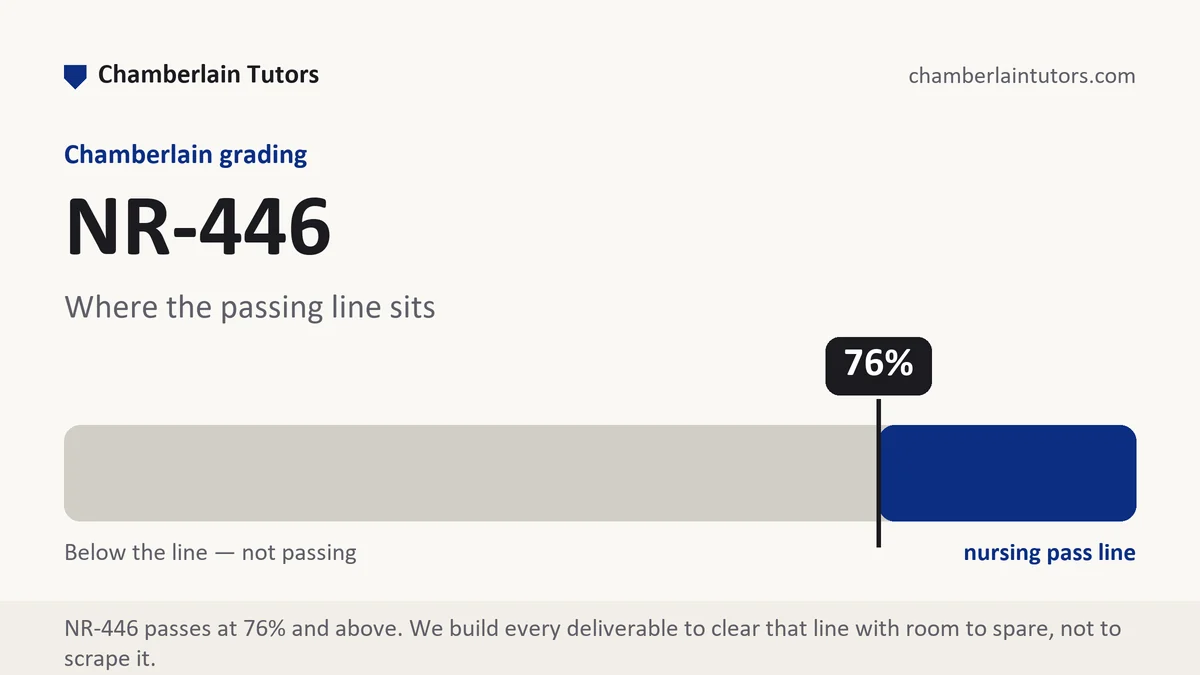
This one sits late in the program, which means the consequences of a weak session are heavier than the credit count suggests. The 76 percent floor applies: core assignments are averaged apart from the rest and that average has to reach 76 before supplemental points are counted. An average that has already dropped cannot be rebuilt with additional work. Sixteen week semesters run as two eight week sessions, so 96 clinical hours and weekly deliverables are sharing the same short calendar, and shifts do not move for a Sunday deadline. Discussion boards close on submission. Two failed nursing courses put a student into dismissal review, which is why senior clinical work is worth treating as infrastructure rather than as a hurdle to clear on the way out.
Read the rubric before the prompt, then split by ratio
Read the scoring guide before the prompt. The prompt says what to write about; the guide says what is being bought and in what proportion. Move every criterion row into an empty file as its own heading, preserve the sequence the guide uses, and attach a number to each before drafting starts.
Some guides give percentages and some give raw points, and points are often easier to reason about as a ratio. Take a 1,300 word cap with four scored rows carrying 40, 30, 20 and 10 points: the analysis of the process, the leadership or management reasoning, the proposed change, and scholarly writing with APA. The writing row is judged across everything you submit, so lift it out. The remaining three rows sit in a 4:3:2 ratio, which is nine parts in total. Set aside 130 words for opening and closing material and 1,170 words remain, so one part is 130 words. The analysis takes four parts at 520 words, the leadership reasoning three at 390, the proposed change two at 260.
Substitute your own guide's numbers and run the same division. The ratio method is worth learning here because leadership guides frequently weight analysis at twice the change proposal, while the instinct in a senior course is to spend most of the paper on what should be done. If your budget says 520 words of analysis and your draft has 200, the paper is recommending before it has finished explaining, and the heaviest row on the page is the one being underfed.
The parts of an observed-practice analysis
Whatever your section calls the deliverable, an analysis built from clinical observation has one shape. Each part proves something, and the weak version of each is where senior papers lose ground.
| Part | What it has to prove | The weak version |
|---|---|---|
| The process, bounded | One process with a start and an end: handoff, admission, discharge, medication pass, escalation of a deteriorating patient | Communication on the unit, which has no edges and therefore no failure point |
| The setting, de-identified | Unit type, approximate size, staffing pattern, shift structure, all without a name anyone could trace | Employer and unit named, or details so specific that one person is obviously described |
| The decision points | Where in the process a person chooses, and what information they hold when they choose it | A narrative of events with no decisions marked in it |
| The delegation reasoning | What was assigned to whom, judged on scope, training and the supervision available | Tasks handed to whoever was free, reported as though availability were the criterion |
| The break | The specific step where the process fails, and what conditions make it fail there | A colleague blamed, which leaves the plan row with nothing to act on |
| The standard | What a professional standard, policy or published evidence says the process should look like | An assertion about best practice with nothing cited behind it |
| The change, at your level | Something a student, a new graduate or a charge nurse could actually initiate, with its first step named | A restructuring that would require authority nobody in the paper holds |
| How you would know | An indicator the organization already collects, with a baseline and a review date | Patient safety would improve, which cannot be checked and so cannot be credited |
Evidence from the floor, handled properly
Writing built on observation has evidence problems that library-based writing does not. Four habits settle them.
De-identify before you draft, not after. Strip employer names, unit names, room numbers, dates precise enough to locate an event, and any detail that could only belong to one colleague or one patient. Write a medium-sized surgical unit on a night shift rather than the name over the door. This is not only a privacy obligation, it usually improves the analysis, because it forces you to describe the situation by its structural features rather than by its cast.
Label local numbers as local. Figures from your own unit, whether from a whiteboard, a dashboard or a manager's briefing, are unpublished and unverifiable. They are legitimate illustration and they are not evidence, so name them as reported internally and let published work carry the argument. And when you use any rate, give it a denominator and a window: falls per 1,000 patient days over the last quarter, or 7 of the 46 discharges that week, never a bare percentage floating on its own.
One shift is an observation, not a pattern. Say how many times you watched the process and over what period. Three observations across two weeks supports a cautious claim about what tends to happen. One busy Tuesday supports a description of one busy Tuesday. Graders in senior courses read for that distinction because it is the difference between analysis and anecdote.
Published work gets its shape stated first. Give the kind of study, the population and the number of participants, then the finding, and match the verb to the design. Cross-sectional surveys of nurses support was associated with, reported alongside and predicted. Only studies where something was deliberately changed and measured support reduced, improved or caused, and that distinction matters more in quality and safety writing than almost anywhere else, because the literature is full of single-site before-and-after projects that read like trials and are not.
What separates a strong analysis here
A passing NR-446 paper describes something that happened on a unit, connects it loosely to a leadership idea, and recommends better teamwork. It clears the floor and could have been written from a textbook.
The papers that score highest do three things a grader can name. It reasons about delegation in the terms the profession uses, weighing what the task requires, what the person is prepared and permitted to do, and what supervision is genuinely available, rather than describing who happened to be free. It admits the constraint of the student role instead of writing as though you held authority, and then finds the lever you do hold, which is usually information, timing, or the sequence in which you tell someone something. And it proposes a change small enough that a preceptor could try it on the next shift and specific enough that they could also refuse it, which is the test that separates a real proposal from a wish.
Six mistakes that cost points here
- Identifying detail left in. Employer, unit, colleague and patient identifiers all belong out of the draft before submission, and no rubric row is worth the risk of leaving one in.
- Analysing a person instead of a system. Character explains nothing that a plan can act on, and the analysis row is built to reward the conditions behind the behavior.
- Delegation written as convenience. Assigning by who was available, described without reference to scope, training or supervision, misses the whole point of the senior course.
- Generalizing from one shift. A single observation reported as a pattern invites the grader to discount everything built on top of it.
- Naked unit statistics. A local number with no base, no period and no label is neither evidence nor illustration.
- Posting to the board unrehearsed. Discussion contributions are permanent once submitted, so draft outside Canvas and paste the version you want scored.
What NR-446 students ask
How do I write about a real event without identifying anyone?
I mostly observed and did not lead anything. Is that enough for the paper?
Can you handle my clinical hours, my paperwork, or my preceptor evaluation?
Where NR-446 sits in Chamberlain's programs
Open the exact program map for sequence, credit, and option context. The current student schedule and syllabus remain authoritative after transfer evaluation, electives, state rules, and approved plan changes.
The weeks, one by one
Week 1
NR-446 Week 1 opens the senior clinical course where the professional nurse role widens from caring for one patient to managing the care of many, and the first written work usually turns on that widening: observing how a real unit organizes its work, describing the leadership and management. Read the full Week 1 manual.
Week 2
NR-446 Week 2 usually belongs to delegation: the professional skill of assigning work across licensure levels while keeping accountability where it legally lives, with the RN. Read the full Week 2 manual.
Week 3
NR-446 Week 3 typically takes up the collaboration in Collaborative Healthcare directly: how information moves between nurses, physicians, therapists, pharmacists and case managers, where structured tools shape that movement, and where care falls into the gaps between professions. Read the full Week 3 manual.
Week 4
NR-446 Week 4 usually turns to conflict: how disagreement arises inside healthcare teams, which styles people reach for under pressure, and how a nurse in a widening leadership role manages conflict toward patient safety rather than away from discomfort. Read the full Week 4 manual.
Week 5
NR-446 Week 5 usually brings the course to quality and safety: how units measure their own performance, how errors and near misses get analyzed as system events, and what the nurse's widening role contributes to both. Read the full Week 5 manual.
Week 6
NR-446 Week 6 usually confronts the management problem nurses feel most physically: scarcity. Read the full Week 6 manual.
Week 7
By week seven the senior clinical course usually stops asking you to describe the unit and starts asking you to propose something for it: a practice change small enough for one floor, argued from evidence rather than preference, mapped onto a recognized change model, and carried by influence rather. Read the full Week 7 manual.
Week 8
The final stage of the senior clinical course usually turns the session's analysis back on the person who wrote it: what the 96 hours changed in how you reason about a unit, which parts of the professional nurse role you can now claim, and what you intend to do in the first year of practice that. Read the full Week 8 manual.