NR-446 Week 1 opens the senior clinical course where the professional nurse role widens from caring for one patient to managing the care of many, and the first written work usually turns on that widening: observing how a real unit organizes its work, describing the leadership and management structures that make a shift run, and locating your own developing role inside them. With 96 clinical hours running alongside the writing, your unit becomes your text, which brings a discipline no earlier course demanded: analyzing a workplace you are standing in without identifying anyone in it. Your section may print this as NR 446 or NR446; it is the same course. Chamberlain publishes no syllabi outside Canvas. The placement here is our teaching judgment from the course's catalog arc; your section's rubric decides what your week actually asks.
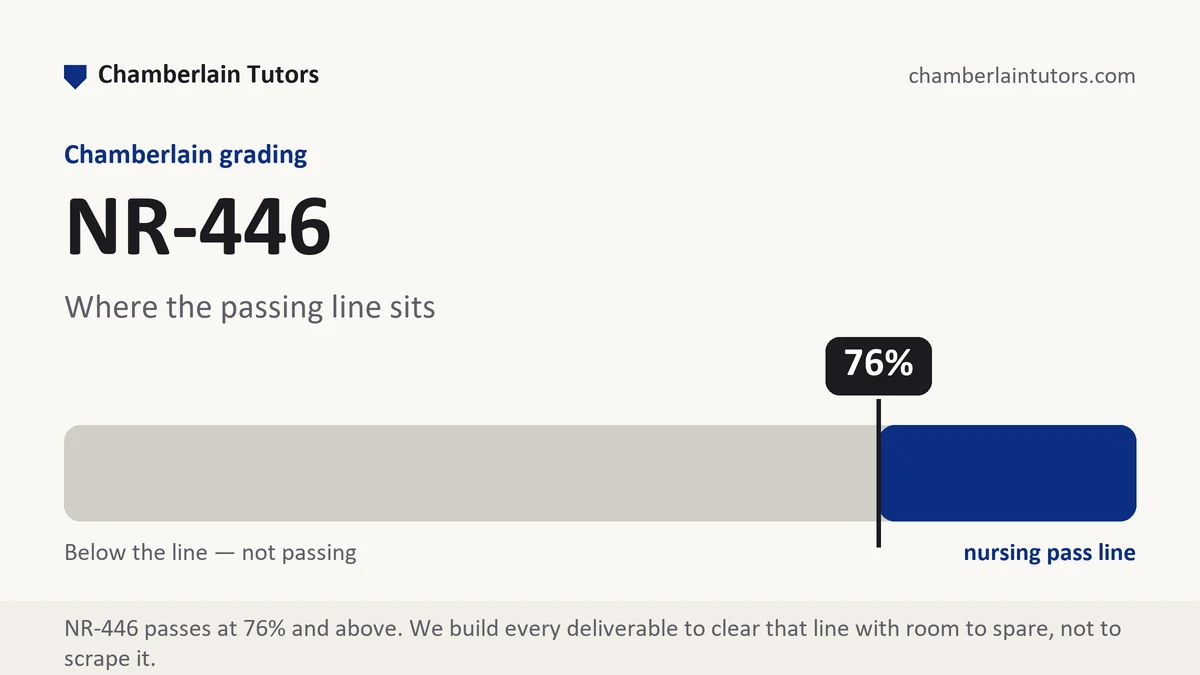
What NR-446 Week 1 asks for
What does management look like at six forty-five in the morning? Stand where a senior student stands on the first clinical day and watch the charge nurse build the assignment board. Fourteen patients, four nurses, one tech short after a call-off; two discharges promised to case management by noon; a fresh post-op back from the unit at change of shift; one nurse on her second day off orientation. The board fills in ten minutes and every square on it is a decision about acuity, competence, geography and fairness. The opening written work in a leadership course usually asks you to see exactly that: describe how care delivery is organized on a real unit, name the model in the language of nursing management, and begin analyzing why the unit runs the way it does.
Why is this harder to write than a care plan? Because the unit of analysis has changed and the vocabulary has to change with it. Care plans taught you to reason about one patient in the language of diagnoses and interventions. This course asks you to reason about a system in the language of care delivery models, span of control, skill mix, and shared governance, and the first assignment is usually where that vocabulary gets its first workout. The scoring pressure lands on precision: team nursing, total patient care and primary nursing are distinct arrangements with distinct trade-offs, and a paper that names the unit's model wrong, or names it right without evidence from observation, gives back the analysis points the week offers.
Where does the writing stop and the clinical begin? Your hours, your preceptor relationship, your attendance records and everything you sign belong to the clinical side, recorded in your own words in your own log. The written layer, the observation analyses, the role papers, the management write-ups, is what this manual supports. Anything you observed goes into the paper de-identified: no facility name unless your section permits it, no staff names, no patient details, roles instead of people. That habit starts in week one because every later assignment in this course leans harder on observation than this one.
The NR-446 Week 1 method, step by step
Six moves for turning a first clinical week into a leadership analysis.
-
Observe one full shift-start on purpose
Arrive for the huddle, watch the assignment get made, note the handoff structure, and record it all within a day: numbers, sequence, who decided what. This one hour of deliberate observation feeds half the papers in this course.
-
Name the unit's care delivery model from evidence
Match what you saw against the textbook definitions: who holds total responsibility for a patient, how tasks divide between licensure levels, how continuity works across days. State the model and cite two observed features that identify it.
-
Sketch the leadership structure as roles, not names
Charge nurse, manager, educator, preceptors, council representatives. Say what each role decides, in your observation, and where authority actually sat when something needed deciding on your shift.
-
Distinguish leadership from management on the page
The course's central vocabulary pair deserves its own paragraph: management as the formal machinery of staffing, budgets and processes, leadership as influence that moves people with or without a title, each illustrated by one de-identified observed moment.
-
Locate your own role honestly
A senior student on a unit has real but bounded scope. Write what you are authorized to do, what requires supervision, and what you observed that you are not yet ready to do. Accuracy about your own scope is itself a graded professional behavior.
-
End with one question the unit made you ask
Why does this unit self-schedule while the floor upstairs does not; why does the charge nurse take patients on some shifts. A genuine question, stated as a question, sets up the analytic voice the rest of the course wants.
A layout and word budget for a unit organization analysis
Our frame for this stage, sized for roughly 900 to 1,200 words. It is our own outline rather than anything the university issues, and your week's rubric outranks it wherever the two disagree.
| Section | What belongs in it | Word target |
|---|---|---|
| The unit, de-identified | Type of unit, approximate size, patient population in general terms, and your role on it this session. | 80 to 110 |
| One shift-start, observed | The huddle, the assignment, the handoff, told concretely with counts and sequence, no names. | 200 to 240 |
| The care delivery model | The model named, defined from a cited source, and matched to two observed identifying features. | 180 to 220 |
| Leadership and management structures | Roles and their real decision territory, plus the leadership-versus-management distinction with an observed instance of each. | 220 to 260 |
| Your scope inside the system | What you may do, what needs supervision, and what remains beyond a student's role, stated exactly. | 110 to 140 |
| The question you leave with | One genuine analytic question the observation raised, and where in the course you expect to answer it. | 60 to 90 |
Evidence craft for writing from the unit floor
De-identification is the entry fee, every time. No facility identifiers beyond what your section explicitly allows, no staff names, no patient particulars. Roles and counts carry every analytic point a name could, and one identifying slip can cost more than any content strength recovers.
Textbook terms need textbook citations. Care delivery models, span of control, skill mix: define each term from your course text or a published management source the first time it appears, then use it consistently. Leadership vocabulary used loosely reads as opinion; anchored, it reads as analysis.
Observed moments are data when they carry detail. The charge nurse reassigning the fresh post-op to the most experienced nurse is evidence about acuity-based assignment; note what happened, when in the shift, and what decision it reveals. Vague impressions of good teamwork evidence nothing.
Keep patient care detail out unless the assignment asks. This course grades systems thinking. A paragraph that slides into one patient's pathophysiology has left the course's territory, and the word count it spends there earns nothing from these rubrics.
Five mistakes that cost points in this week's territory
- Writing the unit as a setting instead of a system. Description without a named model and role structure is scenery, and scenery is not graded.
- Identifying details left in. A facility name, a staff first name, a patient's recognizable story; each is a professionalism deduction waiting to be found.
- Leadership and management used interchangeably. The distinction is the week's core vocabulary, and blurring it signals the reading went unread.
- Claiming scope you do not have. A student who writes I managed the team has misstated their role in a document a clinical instructor reads.
- Model named without evidence. Asserting team nursing without the observed features that identify it converts analysis back into guesswork.
Before you submit
- Every person appears as a role; every place is de-identified to your section's rule
- The care delivery model is named, defined with a citation, and evidenced twice
- One shift-start is told concretely with counts and sequence
- Leadership and management each get a defined term and an observed instance
- Your own scope is stated accurately, including its limits
- The closing question is genuine and analytic, not rhetorical
Starting NR-446 this week?
Send the instructions and the rubric out of Canvas, plus your de-identified observation notes. A premium original draft comes back in 24 to 48 hours with the model named from evidence and the vocabulary anchored, and revisions run until the grade lands. Your hours, preceptor and logs stay entirely yours.