NR-442, Community Health Nursing, carries two theory credits, two clinical credits and 96 clinical hours. Its distinguishing task is assessment: the catalog puts community health, wellness needs and available resources at the center, which means the graded writing is asking you to inventory what a community needs, inventory what already serves it, and then say precisely where the two do not meet. This page is the manual for writing that gap.
What NR-442 actually grades
Community health theory and levels of prevention supply the vocabulary, but the deliverable that decides most grades is an assessment document. Assessment is harder to write well than intervention, because intervention rewards imagination and assessment only rewards accuracy. The scoring rows are checking three things: whether you looked at a real bounded place, whether you separated what you observed from what is published, and whether your account of available resources goes past listing names to say how much service each one can actually supply and to whom. A resource nobody can reach is not a resource, and the gap statement is where that distinction pays.
How we help in this course
We draft the written layer: assessment reports, resource inventories, prevention plans, the reflective pieces your guide asks for. The clinical side is entirely yours. Clinical hours, any approach to a site or preceptor, placement paperwork and hour logs stay off our desk completely, and nothing we write will describe you doing something you did not do. Send your observation notes, however rough, along with the scoring guide, and the draft comes back built on the place you actually walked through.
Orders run the standard pipeline: guide decoded row by row, core work tagged apart from supplemental, a writer matched to community assessment work, a rubric pass and a separate APA and originality pass, the scale check against your section's floor, delivery inside 24 to 48 hours.
How to write this course's deliverables
There is no published syllabus to work from, so anything organized by week number would be guesswork dressed as instruction. Craft is the durable part, and it is what follows: reading the scoring guide as a budget, the anatomy of an assessment report, and the arithmetic that turns a list of local services into a defensible claim about capacity.
In NR-442 right now?
Send the week and the rubric from Canvas. First premium sample free, floor-checked, back in 24 to 48 hours.
How the grade behaves in a clinical course
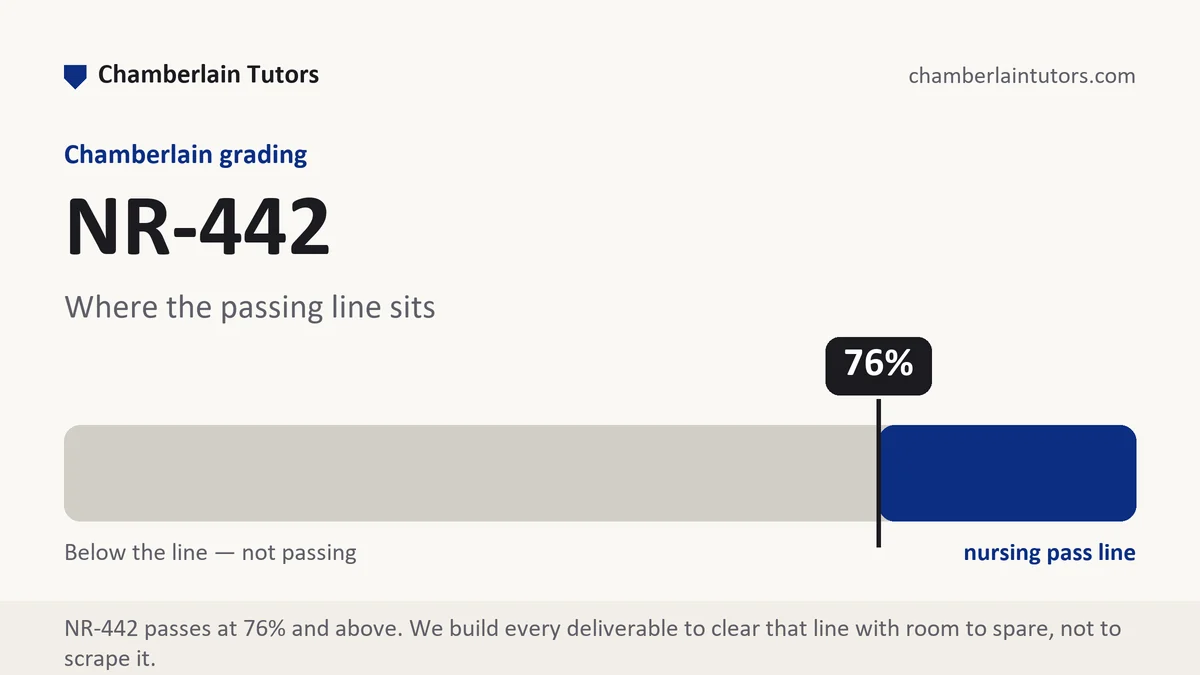
The 76 percent floor is live in NR-442. Core assignments carry a separate average that must reach 76 by itself, and the supplemental points sit behind that gate and stay there if it does not open. Work added afterwards will not raise an average that has already slipped. Sixteen week semesters split into two eight week sessions, so a four credit clinical course is producing graded work most weeks while the hours run alongside it. Boards do not reopen after submission and cutoffs run Mountain Time. The practical consequence is that assessment reports are usually written under time pressure from the hours themselves, which is exactly when the observation notes stop getting written down. Keep them anyway. A report built from memory three weeks later is where the specificity rows quietly disappear.
Read the rubric before the prompt, then ration the words
Read the scoring guide before you reread the prompt. The prompt describes the assignment; the guide records what is being bought. Paste each criterion row into a blank file as a heading, keep the guide's order so the grader meets your sections in the sequence they are scoring, then set a number against each heading before writing anything.
Work an example. Say the report is capped at 1,800 words with five rows: community description and boundaries at 25 percent, health and wellness needs at 25, available resources at 20, the gap and priority at 20, and APA with scholarly writing at 10. Take an overhead deduction first, ten percent of the cap, which is 180 words for an opening, a closing and the connective sentences between sections. Lift the writing row out, since it is judged across the document rather than in one place. That leaves 1,620 words against 90 points of content, which is 18 words per point. Round each result to the nearest 25 and you get 450 words for the community description, 450 for needs, 350 for resources, 350 for the gap and priority.
Your guide will not carry these exact rows, so substitute yours and run the same three steps: overhead off the top, cross-cutting rows lifted out, remainder divided by points. Then look at the number beside the gap heading. In most drafts that section is two sentences at the end, and the arithmetic just said it was worth a fifth of the paper. That mismatch is the most reliable reason a thorough-feeling assessment report comes back a band lower than the writer expected.
The parts of a community assessment report
Whatever your section calls the deliverable, the assessment report keeps one skeleton. Each part proves something, and the thin version of each is where the rows are lost.
| Part | What it has to prove | The thin version |
|---|---|---|
| The boundary | A place with edges you can state, and the number of people inside it | The surrounding community, which no published figure can be attached to |
| What you observed | Things you saw yourself, dated, with the route or setting named, and labeled as observation | Impressions written in the same voice as the published data, so the reader cannot tell them apart |
| What is published | Figures from named sources with their collection years, describing the same boundary you drew | State-level data used to describe a neighborhood it does not resolve to |
| Wellness assets | What is already working: the walkable park, the food pantry with a working schedule, the church that runs a van | A deficit-only portrait, which fails the wellness language the catalog uses |
| The resource inventory | For each service: what it provides, how much of it per week, who qualifies, when it opens, how people get there | A list of names and phone numbers, which proves the services exist and nothing else |
| The gap, priced | Demand set against capacity in the same units, so the shortfall is a number rather than an adjective | A statement that services are limited, unsupported by any count |
| The priority, with criteria | The standard you used to rank problems, stated before the ranking, then applied | The first problem you noticed, presented as the obvious one |
| The nurse's next step | One action at a named level of prevention, with the partner who would carry it | Further assessment is needed, which returns the reader to where they started |
Capacity arithmetic, and citing it so it stands
The resource and gap rows are won with numbers rather than adjectives. Four habits do most of the work.
Express services in units of supply. A clinic is not a quantity. Appointment slots per week, beds, seats in a class, meals distributed per month, hours the door is unlocked: those are quantities, and they let you say something a grader can check. Where the exact figure is not published, say what you were told and by whom, and label it as reported rather than as measured.
Separate availability from eligibility from access. A service can exist, exclude the people you are writing about, and still appear in a naive inventory as coverage. Record who qualifies, what it costs, what documents are required and whether a bus reaches it. Most real gaps in a community assessment sit in that second and third column, not in the first.
Size a study out loud before you lean on it. When you bring in research to support a need, say how big it was and who was in it before the result appears. Then match the verb to the design. Observational data supports was associated with, occurred more often among, predicted. Only work where something was changed on purpose and measured supports caused, reduced or prevented, and one overreaching verb can cost an evidence row the paragraph had already earned.
Every rate carries a denominator and a window. Write 18 per 1,000 residents in 2023, or 40 of the 220 households contacted over eight weeks, and note whether a rate is crude or age adjusted before comparing it to a benchmark. Hold the aggregate at the aggregate level too: a tract-level figure describes the tract, and a report that slides from that number down onto one family has made the error the analysis row was written to catch.
What separates a strong assessment report
A passing NR-442 assessment describes an area, lists health problems, names some agencies and concludes that resources are insufficient. It clears the floor and gives a reader nothing to act on.
The reports that score at the top do three things visibly. It prices the gap, so instead of limited services the report says the pantry distributes roughly 300 boxes a month against an estimated 900 eligible households, and the argument is now made of arithmetic. It labels its own evidence, so observation, reported figures and published data are visibly different in the text and the reader knows which claims are firm. And it names what already works, because a community with assets is a community somebody can partner with, and the plans that follow an asset-aware assessment are the only ones that ever get carried out.
Six mistakes that cost points here
- A boundary you never actually drew. Without stated edges and a population figure, no published dataset attaches to your report and the description rows have nothing to reward.
- A resource list with no capacity. Names and addresses prove existence. The row is paying for how much service, for whom, on what schedule.
- Observation written as fact. If the reader cannot tell what you saw from what you read, both lose credibility, and labeling costs one clause.
- Priorities with no stated criteria. Ranking problems without first saying how you ranked them turns analysis into preference.
- Deficit-only portraits. The course language is health and wellness, and an assessment with no assets in it has answered a narrower question than the one asked.
- Boards drafted in the reply box. Posts are permanent once submitted, so write elsewhere, read it cold, then paste the version you want scored.
What students ask in NR-442
How much of the report can be my own observation?
The service I found has a six month waiting list. Is that a resource or a gap?
Do I have to use a community assessment model or framework?
Where NR-442 sits in Chamberlain's programs
Open the exact program map for sequence, credit, and option context. The current student schedule and syllabus remain authoritative after transfer evaluation, electives, state rules, and approved plan changes.
The weeks, one by one
Week 1
NR-442 Week 1 introduces the idea that gives the whole course its shape: the community itself is the client. Read the full Week 1 manual.
Week 2
NR-442 Week 2 typically maps the machinery: how public health is organized across local, state and federal levels, what the core public health functions and essential services are, how these agencies are funded and governed, and where a community health nurse actually sits inside all of it. Read the full Week 2 manual.
Week 3
NR-442 Week 3 is where the course's central deliverable usually begins: assessing a real community's health status, wellness needs and available resources. Read the full Week 3 manual.
Week 4
NR-442 Week 4 usually turns from what a community needs to what it already has: the services, programs and organizations available to it, how people actually reach them, and where the referral pathway breaks. Read the full Week 4 manual.
Week 5
NR-442 Week 5 usually shifts the unit of care one step down from the community to the family, and one step out from the clinic to the home. Read the full Week 5 manual.
Week 6
NR-442 Week 6 usually hands you the measurement and control toolkit: incidence and prevalence, the epidemiologic triangle, the chain of infection, herd immunity and vaccination coverage, reportable conditions and how surveillance actually operates in a county. Read the full Week 6 manual.
Week 7
NR-442 Week 7 is usually where assessment becomes action on paper: a community nursing diagnosis drawn from your own data, measurable population-level objectives, a teaching or program plan matched to a learning theory, and a delivery design that fits the community you assessed. Read the full Week 7 manual.
Week 8
The final written work tends to combine evaluation of the plan you built, with process and outcome measures kept separate, and a professional reflection on how the course and your 96 clinical hours changed the way you understand nursing when the client is a population. Read the full Week 8 manual.