NR-442 Week 3 is where the course's central deliverable usually begins: assessing a real community's health status, wellness needs and available resources. The written work at this stage tends to combine your own systematic observation from the field, published secondary data matched to your community's boundary, and what residents and workers themselves say. The observing, the driving or walking, the conversations at your placement and every logged hour are your own clinical work; this manual covers only how the write-up is built. Your section may print this as NR 442 or NR442; it is the same course. Chamberlain publishes no syllabi outside Canvas. The placement here is our teaching judgment from the course's catalog arc; your section's rubric decides what your week actually asks.
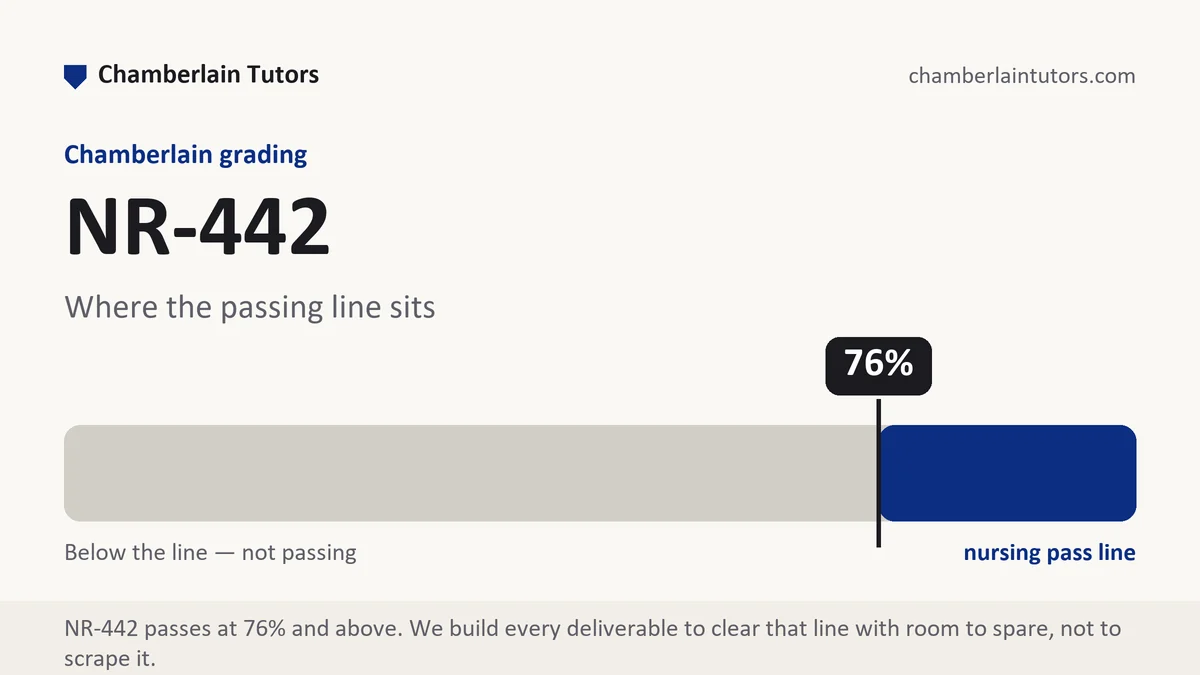
What NR-442 Week 3 asks for
A telehealth nurse reviewing a month of after-hours calls noticed that a third of them came from four adjacent ZIP codes and nearly all arrived between five and eight in the evening. The pattern turned out to have a mundane explanation: the only clinic in that corridor closed at four thirty, and the next nearest option was a forty-minute drive. Nothing in any patient's chart said access problem. The pattern said it, and only aggregation revealed the pattern. Community assessment is the deliberate version of that aggregation, done in advance rather than in hindsight, and this week asks you to perform it in writing for a defined place.
The assessment write-up braids three kinds of evidence. Observation is what you systematically saw during your own time in the community: housing conditions, transport, commerce, gathering places, health facilities, signage, visible hazards and the ordinary rhythms of a weekday. Secondary data is published: census demographics, county health rankings, state dashboard indicators, school and safety statistics. Community voice is what people who live or work there say their needs are. The catalog framing for this course specifically pairs health and wellness needs with available resources, so a strong write-up gives resources equal billing rather than treating them as an afterthought.
The discipline that separates strong write-ups from weak ones at the pre-licensure level is the wall between observation and interpretation. Empty storefronts on a block is an observation. Economic decline is an interpretation. Reduced retail food access in a walkable radius, evidenced by observation plus a cited food environment measure, is a finding. Papers that let interpretation drift into the observation section lose the assessment row even when the underlying fieldwork was careful, because the grader cannot tell what you saw from what you assumed.
The NR-442 Week 3 method, step by step
Six moves for turning fieldwork into a gradable assessment.
-
1. Fix the boundary in checkable terms first
State the census tracts, the ZIP codes, the school catchment or the service area you are assessing, and say in one sentence why that boundary. Every rate you cite later needs a denominator, and the boundary is where denominators come from.
-
2. File every observation under a framework category
Use whatever observation framework your section provides and make its categories your headings. Sort notes before drafting rather than after, because the empty categories tell you exactly what secondary data has to cover.
-
3. Inventory resources with the same rigor as problems
List the clinics, pharmacies, food programs, transit routes, schools, faith organizations and social service agencies that serve your boundary, with hours, eligibility and location where published. The catalog arc of this course names resources explicitly, and a thin resource section is a visible gap.
-
4. Match every secondary figure to your boundary or flag the mismatch
Where only county or state data exists for a neighborhood-level question, use it and say so in a clause. An unflagged mismatch between a figure's geography and your community's is the most common data integrity deduction in this territory.
-
5. Record community voice by role and never by name
A sentence from a school nurse, a pantry coordinator or a transit driver, attributed by role only, is legitimate evidence gathered through your placement. Never include names or identifying details, never invent a quotation, and label paraphrase as paraphrase.
-
6. Rank candidate needs and defend the order
Close with two or three health or wellness needs your three strands jointly support, ordered by magnitude, severity and community priority. That ranked close is what the planning weeks will build on, so write it as evidenced claims rather than as a list of topics.
A layout and word budget for a community assessment
Our frame for an assessment write-up of roughly 1,200 to 1,500 words. It is our own outline rather than anything the university issues, and your week's rubric outranks it wherever they disagree. If your section splits the assessment across two submissions, divide this frame after the resource inventory.
| Section | What belongs in it | Word target |
|---|---|---|
| Boundary and rationale | The community defined in checkable terms with a one-sentence justification for the boundary chosen. | 100 to 130 |
| Observation record | Systematic field observations by framework category, dated and timed, with no interpretation present. | 260 to 310 |
| Population and health profile | Demographics and leading health indicators, each with source, year, denominator and boundary match. | 240 to 290 |
| Resource inventory | Services serving the boundary with hours, eligibility and location, plus which needs each one touches. | 200 to 250 |
| Community voice | What residents and workers name as needs, attributed by role, including where they differ from the data. | 140 to 180 |
| Ranked needs | Two or three prioritized needs, each supported by observation, data and voice, with the ranking defended. | 180 to 220 |
Evidence craft for assessment writing
Observations carry a date, a time and a route. A commercial corridor at ten on a Tuesday and the same corridor at six on a Friday are different data. Writing the conditions of observation into the record is what makes the observation honest and what lets a reader weigh it.
Resource claims need hours and eligibility, not just names. A clinic that exists but closes at four thirty is a different resource from one open until eight, and a program with a documentation requirement is unavailable to part of the population. These operational details are exactly what turns a list of names into an assessment of access.
Triangulate before you conclude, and report disagreement. The findings that survive grading are those where observation, published figure and community voice converge. Where they diverge, say so and treat the divergence as a finding; residents naming a concern the dashboard barely registers is real information, not an inconvenience.
De-identify by default. Roles instead of names, areas instead of addresses, no detail that would let a reader identify a household. The written layer of community work is judged in part on whether you can be trusted with what a community shows you, and a single identifying detail can cost more than a whole content row.
Five mistakes that cost points in this week's territory
- Interpretation smuggled into the observation section. Judgments written as sightings make the whole record unusable as evidence.
- A resource list with no operational detail. Names without hours, eligibility or location say nothing about whether anyone can actually reach the service.
- Geography mismatch left unflagged. State figures standing in for a neighborhood without acknowledgment quietly invalidates the profile.
- The community's own voice missing. An assessment assembled from a car window and a spreadsheet skips the strand this course's arc explicitly names.
- Unranked, undefended conclusions. A flat list of problems defers the prioritizing work that the closing section is graded on.
Before you submit
- The boundary is stated in checkable terms with a rationale
- Observations are dated, timed and free of interpretation
- Every figure carries source, year, denominator and a boundary match or a flagged mismatch
- The resource inventory includes hours, eligibility and location
- At least one community voice appears, attributed by role and de-identified
- The closing needs are ranked, defended and supported by all three strands
Writing up the community assessment?
Send the rubric and your de-identified field notes out of Canvas. A premium original draft comes back in 24 to 48 hours with observation and interpretation cleanly separated and every figure matched to your boundary, and revisions run until the grade lands.