NR-436, Community health practicum course in the RN to BSN path, gets the same promise as every course we cover, with the Chamberlain-specific machinery this school's rules demand.
What NR-436 actually grades
The RN-to-BSN's community, public, and population health course, carrying a practicum project alongside substantial written work, with a state-variant sibling in NR-435. Hours and writing share the same weeks by design.
How we help in this course
We draft the written layer, assessments, project documents, reflections, while your hour logistics run their own track, and the session map keeps the two from colliding. The floor check applies; this is still a nursing course.
Orders run the full machinery: rubric decoded, core-versus-supplemental tagged, a program-matched writer, rubric QA then a separate APA and originality pass, the scale check, delivery inside 24 to 48 hours.
How to write this course's deliverables
Chamberlain keeps section materials inside Canvas, so any manual organized by week number would be a guess wearing a guide's clothes. What does hold across sections, sessions and both course codes is the craft: how to convert your own scoring guide into a plan, what a community project document has to contain, and how population numbers have to be handled before a grader will let them carry an argument. The second half of this page is that manual, and it is written to be used against the rubric open in front of you this week.
In NR-436 right now?
Send the week and the rubric from Canvas. First premium sample free, floor-checked, back in 24 to 48 hours.
Hours on one track, writing on the other
NR-436 carries a practicum project alongside substantial written work, hours and prose sharing the same eight weeks by design, with NR-435 as its state-variant sibling. The desk runs the two tracks separately on purpose. The written layer, community assessments, project documents, reflections, moves through the standard pipeline in 24 to 48 hours. The hours side stays entirely yours: your site, your preceptor, your logs and your compliance paperwork, none of which we complete, sign or submit. Keeping the tracks apart is what stops the writing waiting on the hours and the hours stalling the writing.
The floor still applies to a practicum course
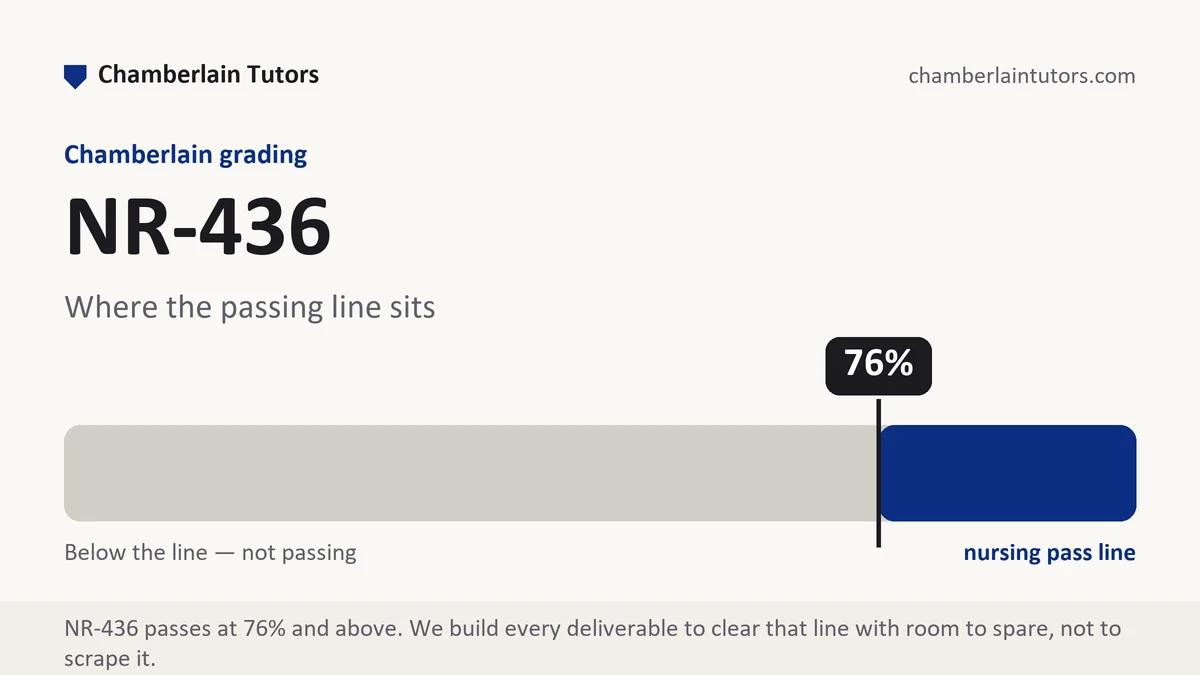
This remains a nursing course, which means the 76 percent core-assignment floor is live: core work is averaged separately and must clear 76 before supplemental points count at all. Every 436 order is tagged core or supplemental at intake for exactly that reason, and drafts aimed at core deliverables get the strictest scoring pass. Boards stay uneditable, cutoffs stay Mountain Time, and nothing curves. Recovery math on a floor breach gets computed the day a score posts, not at session's end when the options have thinned.
What should the first message include for this course?
Your section's syllabus with the weighting visible, the current week's materials, and whether you are in the 436 or 435 variant, since the project documents differ by state context.
Can I try the writing side before arranging the hours side?
Yes. The free first sample covers any single written deliverable, and the practicum conversation can start in chat whenever you are ready.
Turn the scoring guide into a word budget
Open the scoring guide before you read the prompt a second time. The prompt tells you the subject; the guide tells you where the points are kept. Copy each criterion row into a blank document as its own heading, in the guide's order, and write underneath it. Two things happen at once: the grader stops hunting for the place you answered a row, and you can see which rows are worth defending.
Then convert the weights into words before you write a sentence. Say your paper is capped at 1,500 words and your guide splits into five rows: the community and its data at 30 points, the priority problem and its evidence at 25, the intervention plan at 20, the evaluation plan at 15, and APA with scholarly writing at 10. The writing row earns no paragraphs of its own, since it is judged across everything you submit, so lift it out of the division. Reserve roughly 150 words for the introduction and conclusion and 1,350 words remain to spread over 90 points of content, which is 15 words per point. The community section gets 450 words, the priority problem 375, the intervention plan 300, the evaluation plan 225. Your scoring guide will not carry those exact numbers; substitute yours and run the same arithmetic. Done first, it stops the paper ending in three rushed sentences about evaluation because the word count ran out.
What a community project document has to contain
Community and population work in the RN to BSN keeps one shape whatever your section calls the pieces. Every part exists to prove something specific, and a part that proves nothing is exactly where the points leave.
| Part | What it has to prove | How it fails |
|---|---|---|
| The community, bounded | You are writing about a real population with edges: a census tract, a zip code, a county, with its size stated | "My community" with no boundary, so no published dataset can be attached to it |
| The data picture | Your description rests on what you observed plus what is published, each figure carrying a source and a data year | Impressions only, or figures with no year, which leaves nothing a grader can check |
| The priority problem | One problem was chosen out of several, and the reason it won is on the page | The first problem you thought of, presented as though it were the only one |
| The evidence base | What you propose has been studied in a population close enough to yours to matter | One source, or sources describing a different population entirely |
| The intervention plan | Somebody could run it: who does what, where, with what resources, on what schedule | An aspiration such as increasing awareness, with no owner and no venue |
| The evaluation plan | The measure, its baseline and its window are named before any change is claimed | Success measured by improved outcomes, which names nothing |
| The reflection | Something in your own practice is different now, and you can say what | A summary of the assignment written in the first person |
Population numbers, cited so they hold up
Community writing rises or falls on how you handle other people's numbers. Four habits carry almost all of it.
Check the data year, not just the citation. Population figures age faster than clinical evidence. A prevalence number drawn from a decade-old release describes a community that has since changed its age structure, its insurance mix and sometimes its borders. Use the most recent release your source publishes, and put the data year in the sentence rather than only in the reference list.
Design and sample before findings. When you bring in a study, say what kind it was, in whom, how many and where, before you report what it found. A forty-patient pilot in one clinic and a multi-site trial of several thousand cannot earn the same verb, and a grader reading for evidence quality is looking for that exact sentence.
Match the verb to the design. Community-level data is almost never causal. Write that a rate was higher, that two things occurred together, that an outcome was associated with an exposure. Keep reduced, caused and prevented for designs that earned them. One overreaching verb can lose an evidence row the rest of the paragraph had already won.
Denominator and window before any rate. A number without a denominator is not a rate. Write per 100,000 residents in 2023, or per 1,000 live births across the three-year period, and say whether the figure is crude or age adjusted. Then hold that line through the comparison: county-level patterns describe the county, not the individual families inside it, and a paper that reads an aggregate rate down onto one household has made the error the analysis row exists to catch.
Passing paper, strong paper, in this course
A passing community paper describes a population, names a problem, proposes something reasonable and cites sources. It clears the 76 percent floor that core nursing work has to clear, and nothing is wrong with it except that it could have been written about anywhere.
A strong one differs in four visible ways. The numbers do the choosing: it shows why this problem rather than the other two by setting the community's own figures beside a state or national benchmark and letting the gap make the argument. The intervention is sized to what already exists locally, a school nurse, a church hall, a mobile unit that visits on Thursdays, instead of a program the county could never staff. The evaluation names a measure somebody could genuinely collect, with the baseline stated and a follow-up window that fits inside a realistic horizon. And the reflection is specific: not that the project was eye-opening, but that you now ask a question at intake you never asked before, and here is the encounter that taught you to ask it.
Six mistakes that cost points here
- An unbounded community. With no geographic edge and no population size, no dataset attaches, and the data rows have nothing to score.
- Rates with no denominator or date. A bare number invites the grader to ask per what, and when, and every unanswered question drops a band.
- An intervention nobody could run. Plans with no owner, no venue and no sense of cost read as topics rather than proposals.
- Treating the reflection as filler. Reflective rows are scored from the same table as everything else, and they are the cheapest points in the course to leave behind.
- Posting before proofreading. Discussion contributions cannot be edited once submitted, so the version you paste is the version graded. Draft it elsewhere and read it cold first.
- Letting the paper and the project drift apart. When the document describes work your practicum hours did not actually support, the two halves of the course start contradicting each other in front of the person grading both.
Questions students ask in this course
My paper and my practicum project have drifted apart. Which one do I change?
How recent does a source have to be for community work?
I am registered in NR-435 rather than NR-436. Does any of this change?
Where NR-436 sits in Chamberlain's programs
Open the exact program map for sequence, credit, and option context. The current student schedule and syllabus remain authoritative after transfer evaluation, electives, state rules, and approved plan changes.
The weeks, one by one
Week 1
NR-436 Week 1 is the stage where a pre-licensure student stops thinking in single patients and starts thinking in populations: what community health nursing is, where it happens, and why the unit of care is a neighborhood rather than a bed. Read the full Week 1 manual.
Week 2
NR-436 Week 2 usually belongs to epidemiology: rates, incidence and prevalence, surveillance, and the discipline of reading a community's numbers before forming an opinion about its health. Read the full Week 2 manual.
Week 3
NR-436 Week 3 typically carries the community assessment: systematic observation of a real community, often through a windshield-survey style drive or walk, merged with published data into a written diagnosis of what the community needs. Read the full Week 3 manual.
Week 4
NR-436 Week 4 usually turns to the social determinants of health: the conditions of housing, income, education, transportation, food, and safety that set a population's health before any clinician is involved. Read the full Week 4 manual.
Week 5
NR-436 Week 5 usually moves from diagnosing a community to planning for it: a health promotion intervention or teaching plan aimed at a specific population, built on the assessment and determinants work of earlier weeks. Read the full Week 5 manual.
Week 6
NR-436 Week 6 usually belongs to the community's acute threats: communicable disease, the surveillance and reporting machinery that tracks it, and the disaster cycle that organizes a community's response when the threat is a flood or a chemical release rather than a virus. Read the full Week 6 manual.
Week 7
NR-436 Week 7 usually narrows the lens to the populations averages hide: people whose circumstances stack risks faster than services reach them, and the settings, homes, schools, workplaces, shelters, correctional facilities, where community health nursing actually meets them. Read the full Week 7 manual.
Week 8
NR-436 Week 8 usually closes the session with evaluation and synthesis: judging the intervention or teaching work of the earlier weeks against the criteria set for it, and pulling seven weeks of community-focused writing into one argument about what population-level nursing is and what you can now do inside it. Read the full Week 8 manual.