NR-351 is the three credit entry course of the RN to BSN sequence, lecture only, no clinical block. It covers the knowledge, skills, attitudes, theory and roles of the professional nurse, and it also teaches the habits that make an online student survive. The grade comes from writing about your own profession in an academic register that most working nurses have not used since their associate degree.
What NR-351 actually grades
Two things at once, which is why this course surprises people who have been nursing for a decade. The first is subject matter: professional roles, nursing theory, the standards that define scope, and the knowledge, skills and attitudes expected of a baccalaureate prepared nurse. The second is academic practice, because the catalog places the skills for succeeding as an online student in this course on purpose. You are being taught how the next several courses will work while being graded as though you already know.
The consequence for your writing is specific. Personal experience is welcome here in a way it will not be in later courses, but it is welcome as evidence, not as a story. A paragraph about the night you caught a medication error is worth nothing on its own and worth a great deal the moment it is attached to a role, a standard, or a theory concept and used to argue something. Nurses arriving with years of practice tend to write the story beautifully and forget to attach it, which is the single most common reason a confident clinician gets a mediocre first grade.
How we help in this course
NR-351 has no clinical hours, so nothing here touches placement, logs or paperwork of any kind. The work is entirely written, which is exactly the layer we cover.
We take the week's rubric and prompt, build the section plan the rows are asking for, draft the paper or the post, and mark up the mechanics so the format stops costing you points by week three. For most students the real value in this particular course is the reference formatting and the shift into scholarly voice, because those two carry forward into every RN to BSN course after it, including the practicum course NR-436, or its state specific alternative NR-435, waiting at the end of the sequence.
How to write this course's deliverables
Below is the working method. Rubric first, plan second, experience third. If you have been away from academic writing for a while, that order matters more than anything else on this page, because it stops you from writing a strong essay that answers a question nobody asked.
In NR-351 right now?
Send the week and the rubric from Canvas. First premium sample free, floor-checked, back in 24 to 48 hours.
The first course and the 76 percent floor
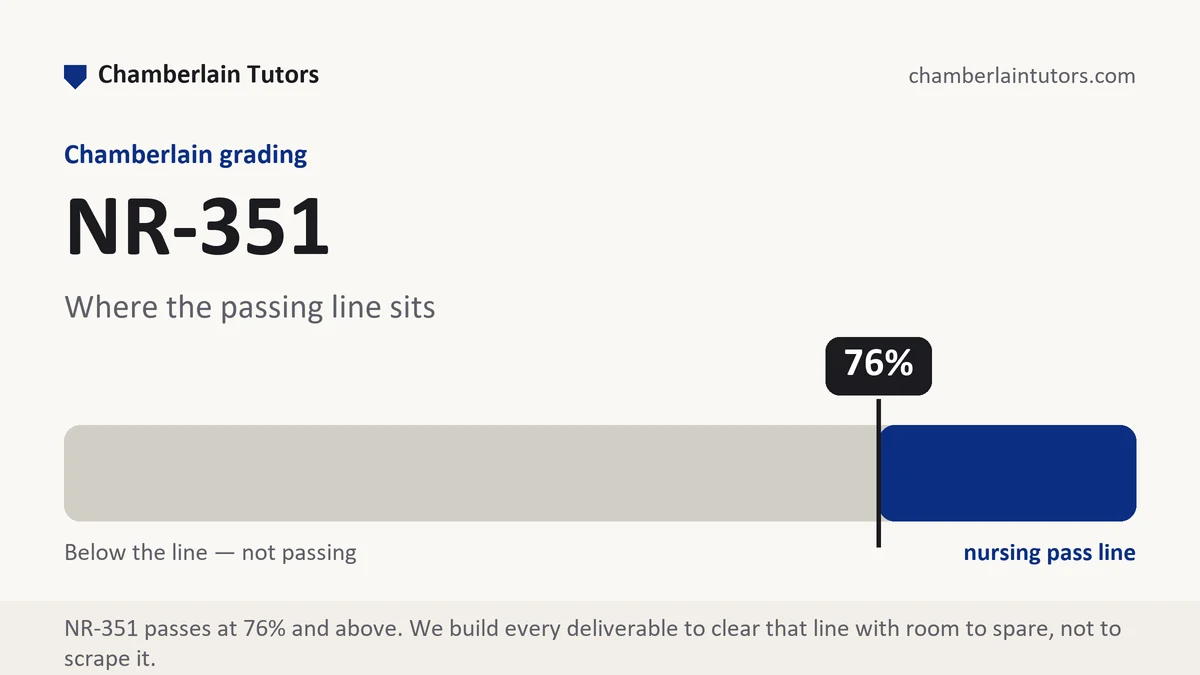
Core nursing courses pass at 76 percent. In an entry course that number does something psychological as well as arithmetic: the grade you earn in NR-351 sets what you believe about the rest of the degree, and a rough start convinces capable nurses that they are not academic people. They are. They are simply out of practice at a specific format.
The structure gives you little runway. Chamberlain runs sixteen week semesters divided into two eight week sessions with up to six starts a year, and deliverables arrive weekly. That means your first graded submission lands before you have finished remembering how references work, and supplementary work cannot repair a weighted average later. Treat weeks one and two as the expensive ones, get the format right immediately, and the rest of the session gets easier rather than harder. Discussion posts deserve the same care, because at Chamberlain a post cannot be edited once it is submitted. Write it in a document, fix the citation, then paste it in.
Turn the criterion rows into an outline
The prompt is a description. The scoring guide is the contract. Copy the rows into a blank document in order, leave a blank line under each, and treat every row as a heading you are obliged to fill. Rows in a foundations course tend to be numerous and small, which changes the tactics considerably.
Suppose the week caps you at 1,050 words with six rows weighted 25, 20, 20, 15, 10 and 10 percent. Multiplied out, that is roughly 262 words, 210, 210, 157, 105 and 105. Notice what the shape tells you. No single row dominates, so there is no section you can afford to write beautifully at the expense of another, and the two small rows at the end are usually the ones students skip entirely on a busy week. Skipping a 10 percent row costs more than writing a merely adequate 25 percent row, every time. A section that only needs 105 words is often a single tight paragraph, which is good news at eleven at night.
Put the number in brackets after each heading while you draft and delete it when the section is fed. If your guide states that the title page and references sit outside the word count, note that too, since padding a paper toward a limit that never included your reference list is a common way to write four hundred unnecessary words.
The shape of a professional role paper
Most graded writing here is some version of the professional role paper: your practice examined against a standard, a role, or a theory. These parts recur, and each is a thing a grader is looking to find.
| Part | What it has to establish | How the thin version reads |
|---|---|---|
| The frame | Which role, standard or concept you are examining and why it applies to your setting, in two or three sentences. | A general opening about the importance of nursing. |
| The concept, defined from a source | The idea stated in the words of the profession, cited, not paraphrased from memory or from a lecture slide. | A definition offered with no citation, or one built from a dictionary. |
| Your practice, described briefly | Enough of your setting that the reader can judge fit. Unit type, patient population, your actual scope. | A career history that runs half a page. |
| The comparison | Where practice and standard align, and the specific place they do not, named without defensiveness. | An assertion that your unit follows all standards fully. |
| Evidence beyond yourself | Literature showing this gap or this role matters, cited properly and described before it is used. | Personal opinion carrying the whole argument alone. |
| What changes | One thing you would do differently, at your level of authority, with a way to tell whether it worked. | A recommendation aimed at administrators you cannot influence. |
| Close on the frame | A short return to the opening claim, now supported rather than restated. | A summary paragraph that repeats every heading. |
Evidence and citation craft for the returning RN
The format work in this course is not busywork. It is the entry fee for every paper you will write for the next two years, and five habits carry most of it.
- Cite the current edition and say which one. Professional standards documents are revised on their own schedule, and a paper quoting a superseded edition is quoting something that no longer governs practice. Anything older than five years needs a reason stated in the sentence, and for standards that reason is almost never good enough.
- Go to the theorist, not the summary of the theorist. A textbook chapter about a nursing theory is a secondary source and reads as one. Where you can reach the original work, cite it. Where you cannot, say plainly that you are working from a secondary account rather than implying otherwise.
- Describe the study before you use its number. Write that a cross sectional survey of 21,000 hospital nurses examined the relationship between staffing and outcomes, then give the finding. A number arriving alone with a year after it carries no weight at this level.
- Keep the verb honest about the design. The literature on nursing education and patient outcomes is observational almost without exception. Hospitals with a higher proportion of baccalaureate prepared nurses had lower mortality is a defensible sentence. Baccalaureate education reduces mortality is not, and in a course about professional roles it is the overstatement instructors watch for.
- Give every percentage a denominator and a window. Write that 1,120 of the 4,000 nurses surveyed in 2023 held a graduate degree rather than that 28 percent did. Workforce figures move, and a percentage with no year and no base is not evidence of anything.
The gap between a passing paper and a strong one
A passing NR-351 paper is sincere, organized and formatted well enough. It defines the concept, tells a relevant story from practice, and ends with a sensible recommendation. It is also interchangeable with two hundred other papers in the same session, which is why it sits where it sits.
Strong papers do three specific things. They make every experience earn its place by attaching it to a named idea, so no anecdote appears without a job. They tell the truth about the gap between their practice and the standard, because a paper claiming perfect alignment has nothing to analyze and the analysis is what is being scored. And they aim the recommendation at something the writer can actually control, since a bedside nurse proposing a staffing overhaul is writing a wish, while the same nurse proposing a change to handoff content is writing a plan. Attach, admit, and aim within reach.
Five mistakes that cost points in this course
- Writing the memoir instead of the analysis. Years of practice give you material, not an argument. Every story needs a concept bolted to it, and the concept has to come first in the paragraph.
- Quoting a theory without applying it. A block quote from a theorist followed by a new topic is a citation, not an application. The sentence after the quote is where the points live.
- Assuming your APA is still current. Reference formatting shifts between editions, and habits carried over from an associate degree program are often a full edition behind. Check one reference against the current guide before you copy the pattern across twelve more.
- Treating the study skills content as filler. The material about succeeding online is in the catalog description of this course. It shows up in graded work, and skipping the reading because it feels obvious is how experienced nurses lose easy points.
- Submitting a board post straight from the text box. Posts do not reopen at Chamberlain. A missing citation or a sentence that reads sharper than you meant is permanent, so compose everything elsewhere.
What returning RNs ask about NR-351
I have been a nurse for twelve years. Why is my grade lower than I expected?
I have not written in APA since my associate degree. Where do I start?
How personal should a reflection in this course be?
Where NR-351 sits in Chamberlain's programs
Open the exact program map for sequence, credit, and option context. The current student schedule and syllabus remain authoritative after transfer evaluation, electives, state rules, and approved plan changes.
The weeks, one by one
Week 1
NR-351 Week 1 is where a working registered nurse becomes a student again, and the opening written work usually turns on two transitions at once: from licensed practitioner to degree candidate, and from the bedside's spoken world to the online classroom's written one. Read the full Week 1 manual.
Week 2
The written work usually asks you to analyze these roles against your own practice, with published professional standards as the measuring stick. Read the full Week 2 manual.
Week 3
The written work typically asks you to analyze one or more competencies against your own practice, with the framework cited rather than assumed. Read the full Week 3 manual.
Week 4
The written work usually asks you to select a theorist, present the theory accurately from sources, and apply it to a de-identified situation from your own practice. Read the full Week 4 manual.
Week 5
The written work usually asks you to find a credible source on a practice topic, summarize it faithfully, and present it in correct academic form. Read the full Week 5 manual.
Week 6
The written work usually asks you to analyze an ethical situation through the code's own provisions rather than through personal conviction alone. Read the full Week 6 manual.
Week 7
The written work usually asks you to analyze a communication breakdown or apply a structured format to a practice scenario. Read the full Week 7 manual.
Week 8
The written work is usually that plan, sometimes paired with a reflective synthesis of the course. Read the full Week 8 manual.