The midpoint of a foundations arc, in our teaching judgment, belongs to theory: what a nursing theory is, why the discipline built its own instead of borrowing medicine's, and how a named theory changes what a nurse notices and does. The written work usually asks you to select a theorist, present the theory accurately from sources, and apply it to a de-identified situation from your own practice. NR-351 is lecture-only, so the application happens entirely on paper. Your section may print this as NR 351 or NR351; it is the same course. Chamberlain publishes no syllabi outside Canvas. The placement here is our teaching judgment from the course's catalog arc; your section's rubric decides what your week actually asks.
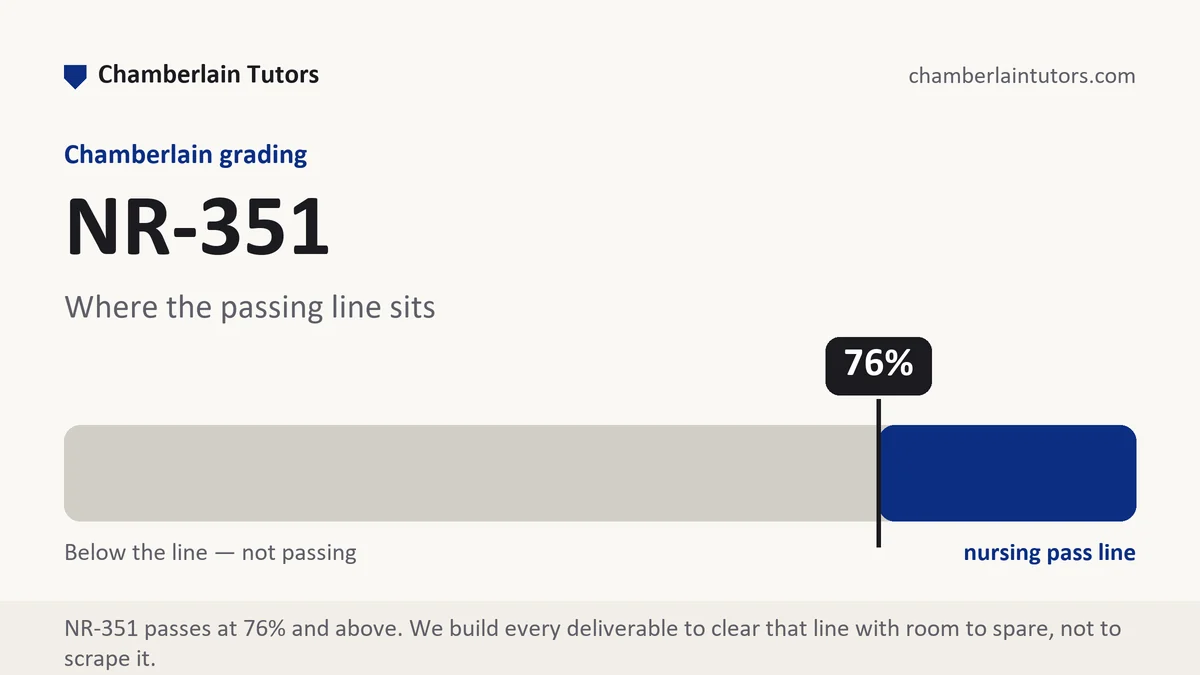
What NR-351 Week 4 asks for
Is theory really something a working nurse uses, or just something a student survives? Ride along on the home visit our tutors describe. A hospice-adjacent home health nurse sits at a kitchen table with a woman caring for her husband through late-stage heart failure. The medication box is perfect; the wife's answers are exhausted. The nurse spends the visit's last ten minutes not on the husband's ankles but on the wife's sleep, her sister who could take Tuesdays, the neighbor who already offered. Ask the nurse why and she might say it seemed like what mattered. But there is a hundred-year-old body of thought behind that instinct, theories of self-care capacity, of caring as the discipline's center, of the environment as nursing's oldest tool, and Week 4 asks you to make the connection explicit: to show that what looked like kindness was also, describably, nursing theory operating at a kitchen table. Papers that make that connection concrete are what the week is fishing for.
The territory has two halves that grade separately. The first is accurate presentation: a theory's core concepts, its view of person, health, environment and nursing, summarized faithfully from your course text and attributed to its theorist without distortion. Faculty read this half closely because theory summaries are where paraphrase discipline shows, and where papers drift into either quotation mosaics or confident misstatement. The second half is application: a de-identified situation from your practice re-described through the theory's vocabulary, so that the theory visibly organizes the case, picking out what matters, naming the goal, suggesting the nursing response. The application is where working nurses have an advantage no generic student possesses, because your weeks are full of kitchen tables.
Expect an essay assignment as this stage's centerpiece, sometimes with a discussion asking why theory matters to practice at all. For that question, resist the ritual answer. The honest, scoreable argument is that theory is compressed noticing: a theorist spent a career deciding what nursing should attend to, and borrowing that attention changes your assessment before it changes anything else. Write that argument through your own example and the week stops feeling like a hoop and starts scoring like one mastered.
The NR-351 Week 4 method, step by step
How do you write theory without drowning in it? Six moves.
-
Choose the theory that fits a case you already have
Read the week's theory survey with one question: which of these describes something my practice actually contains? A self-care framework fits a home health caseload; a caring-centered one fits end-of-life work. Choosing by fit gives you an application section that writes itself.
-
Summarize the theory from the text, concept by concept
Present the core concepts in your own words with citations, and cover the theory's stance on person, health, environment and nursing if your text frames it that way. Accuracy beats depth: a modest summary that never misstates outranks an ambitious one that does.
-
Select and de-identify the practice situation
Pick a moment with a real nursing decision in it, not just a memorable patient. Strip names, places, dates and identifying combinations, then write the situation plainly in three or four sentences before any theory touches it.
-
Re-describe the situation in the theory's vocabulary
This is the graded pivot. Walk through the same scene naming what the theory names: the self-care deficit, the caring moment, the environmental adjustment. Every borrowed term gets used precisely or not at all.
-
Show what the theory changed
Say explicitly what the theoretical lens picked out that a task-list reading would have missed, the wife's depleted capacity, the environment as intervention. This paragraph answers the why-theory question inside the application, which is where it persuades.
-
Note one limit without demolishing your choice
One honest sentence on what the theory handles awkwardly, and why it still earned its place in your paper, reads as maturity. Skip the limit and the paper reads as advertisement; overdo it and the application undercuts itself.
A layout and word budget for a theory application paper
What does the two-half structure look like in practice? Our frame for a theory paper of roughly 850 to 1,050 words follows. It is our own outline rather than anything the university issues, and your week's rubric outranks it wherever the two disagree.
| Section | What belongs in it | Word target |
|---|---|---|
| Why this theory | The theorist named, and the honest fit between the theory's territory and your practice setting. | 80 to 110 |
| The theory presented | Core concepts paraphrased with citations, including the theory's view of person, health, environment and nursing. | 220 to 260 |
| The situation, plainly told | A de-identified practice moment with a nursing decision in it, written without theoretical language first. | 110 to 140 |
| The re-description | The same scene walked through the theory's vocabulary, each borrowed term used precisely. | 200 to 240 |
| What the lens changed | What the theory picked out that task-based reading would miss, and the nursing response it suggests. | 130 to 160 |
| A limit and a verdict | One honest boundary of the theory and why it still fits, closing the argument rather than restarting it. | 70 to 100 |
Evidence craft for theory writing
Who gets cited when you present a theory? The source you actually read. Most foundations students meet theorists through the course text's survey chapters, and citing the text as your source for the theorist's ideas is both honest and correct form. If the week's materials include a theorist's own writing, cite it directly with its year. What fails is citing the original work you never opened, a shortcut faculty detect through the survey chapter's telltale phrasing.
Keep the theorist's terms in quarantine until defined. Every theory carries loaded vocabulary, and the rule that keeps papers clean is simple: no borrowed term appears in your prose before your summary has defined it, and after definition, the term is used exactly as defined. Casual use of technical vocabulary is the most common precision error in theory weeks.
The practice example follows the same privacy law as always. De-identify past reconstruction: no names, facilities, dates or unique detail clusters. A kitchen-table scene needs only the clinically relevant furniture, an exhausted caregiver, a stable patient, a visit's final minutes, to do its full analytic work.
Claims about theory's value need support too. If your paper argues that theory-guided practice improves attention or outcomes, that is a claim about nursing, and your course text makes versions of it you can cite. The one paragraph where students routinely editorialize without support is the why-theory-matters paragraph, and it is also the easiest to anchor.
Five mistakes that cost points in this week's territory
- The quotation mosaic. A theory summary assembled from strung-together quotes demonstrates locating skills, not understanding. Paraphrase with citation is the graded mechanic.
- Vocabulary without precision. Sprinkling the theorist's terms over ordinary sentences misuses the framework and reads instantly as decoration.
- A situation with no decision in it. Applying theory to a scene where nothing was at stake gives the lens nothing to change, and the application section stalls.
- Application as compliment. This theory reminds me why nursing is special is sentiment. The re-description through the theory's vocabulary is the assignment.
- Grand claims for one framework. Declaring your chosen theory explains all of nursing overclaims what no theory attempts, and the missing limit sentence costs the maturity points.
Before you submit
- The theory is summarized from the source you actually read, cited
- Every borrowed term is defined before it is used, then used precisely
- The practice situation is de-identified past reconstruction
- The re-description visibly reorganizes the scene, not just relabels it
- One paragraph states what the lens changed about the nursing response
- One honest limit appears without undercutting the application
Wrestling the theory week of NR-351?
Send the prompt and the rubric out of Canvas. A premium original draft comes back in 24 to 48 hours with the theory summarized faithfully and the application built from your material, and revisions run until the grade lands.