NR-341 Complex Adult Health is a four credit course, three of them theory and one clinical, with 48 clinical hours attached. The catalog puts it on adult patients with unstable, emergent critical illness. Three quarters of the credit sits in the theory column, so what gets graded is your written account of recognizing deterioration, choosing an order of action, and defending that order.
What NR-341 actually grades
The catalog describes NR-341 as the care of adults with unstable, emergent, critical illness, integrating comprehensive assessment, advanced nursing skills, and clinical judgment. Every one of those phrases lands in the writing. Comprehensive assessment means you are expected to report what you looked at and what you deliberately ruled out, not just the abnormal number. Advanced skills means the intervention has to be described at the level a nurse performs it, with the monitoring that surrounds it. Clinical judgment, the phrase that carries the most points, means the paper has to show a decision being made rather than a plan being recited.
The practical difference from a stable medical surgical course is time. A stable patient permits a paper written as a list. An unstable patient does not, because the whole question is what you did first and why the alternative could wait ninety seconds. Writing that treats a deteriorating patient as a set of parallel problems, each with its own tidy intervention, misses the row the course cares about most.
How we help in this course
The clinical side is yours. We do not complete clinical hours, contact your site or faculty, sign anything, or enter time in a log. That line is fixed and there is no arrangement that moves it.
Our work sits on the theory side, which in NR-341 is where three of the four credits live. We take your week's rubric and prompt, build the section plan the rows imply, draft the analysis in the register a critical care instructor reads all term, and mark up the reasoning so you can see where the judgment sentences are doing the scoring. Students who arrive here after a hard adult health course usually have the content and lose points on order and defense, which is a writing problem more than a nursing one.
How to write this course's deliverables
What follows is the method itself. Read the scoring guide, convert its rows into a plan with a word budget attached, then pour the patient into that plan. Doing it in reverse produces a paper that tells a good story and scores in the middle.
In NR-341 right now?
Send the week and the rubric from Canvas. First premium sample free, floor-checked, back in 24 to 48 hours.
Where the 76 floor bites here
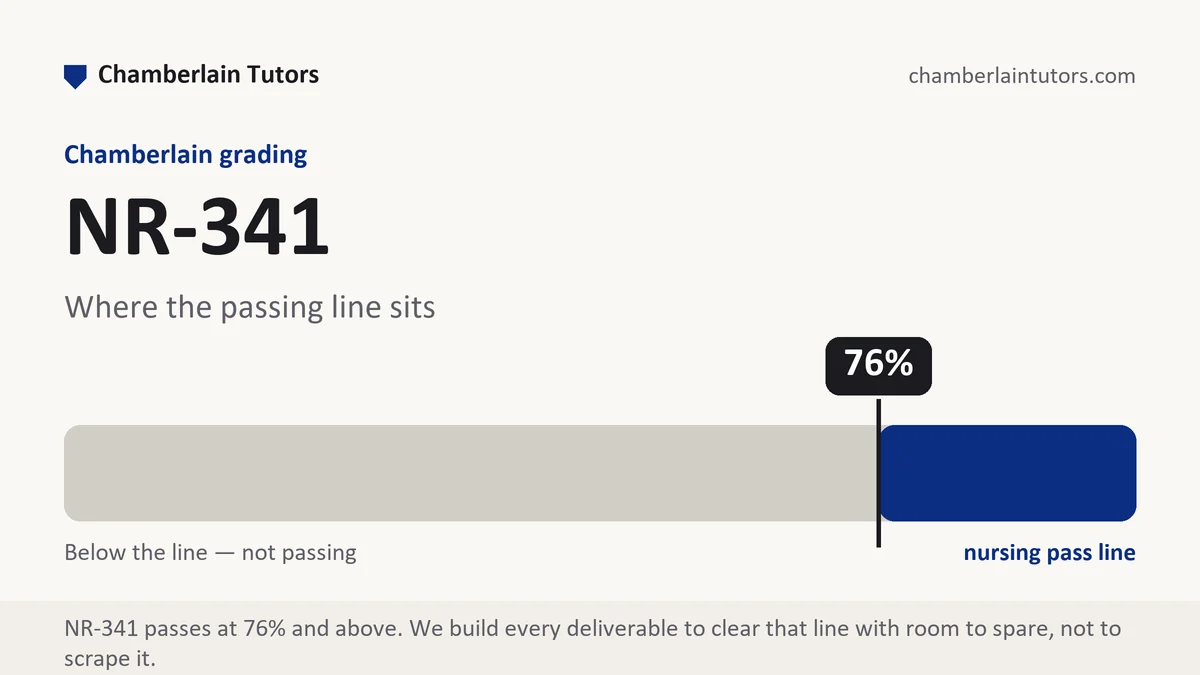
Core nursing courses pass at 76 percent, and NR-341 has an unusual shape around that number. Only one of its four credits is clinical, so the graded surface is small and almost entirely written. Fewer graded pieces means each one swings the average further, and supplementary work cannot rescue a weak weighted average once the term is underway.
The session compresses it further. Chamberlain runs sixteen week semesters split into two eight week sessions, with up to six starts a year and deliverables landing weekly. Eight weeks is not long enough to recover slowly. Two soft weeks in a row is the pattern that puts students in front of a calculator, and the fix is always the same: get the heaviest rubric row right on the next submission rather than adding volume across all of them.
Build the section plan from the criterion rows
Rubrics in this course are written by people who grade for judgment, which means the rows are usually verbs of reasoning rather than topics. Pull them into a blank document and keep them in the guide's order. Then price each one, because the weight column is telling you how many words the row deserves.
Take a week capped at 900 words with four rows weighted 35, 30, 20 and 15 percent. The math gives you about 315 words for the first row, 270 for the second, 180 for the third and 135 for the last. Now look at what that does to a critical illness paper. If the 35 percent row is the judgment row, it is asking for more than three hundred words of nothing but decision making, which is roughly four times what most students give it. The background section, which usually swells to five hundred words because it is the easiest part to write, is entitled to whatever row actually names it, and often that row is the 15 percent one.
Put the target word count in brackets beside each heading and remove the bracket only when the section hits it. If the judgment section is still 120 words when the background is 400, you have written a good paper for a different rubric.
The shape of an unstable patient analysis
Most graded writing here is an analysis of a patient who changed. Whatever the week calls it, these parts show up, and each is a place a grader either finds reasoning or does not.
| Part | What it has to prove | The version that loses points |
|---|---|---|
| The starting picture | What the patient looked like before the change, in enough numbers that the change is measurable later. | A history section with no baseline values in it. |
| The cues that mattered | The findings that signaled instability, separated from the findings that were merely abnormal and stable. | Every value in the chart reported at equal weight. |
| Interpretation | What you believed was happening physiologically and what else it could plausibly have been. | A diagnosis asserted with no competing explanation considered. |
| The order of action | What you did first, second, third, with the reason each one outranked the others at that moment. | A bulleted intervention list that could be performed in any sequence. |
| Escalation | Who you called, at what threshold, and what you handed over in what order. | Notified the provider, with no trigger and no content. |
| Response and reassessment | What you rechecked, how soon, and what result would have changed the plan. | The patient improved, offered as a conclusion rather than as data. |
| What you would do differently | One honest change, tied to a specific moment rather than to a general resolve to be more vigilant. | A closing paragraph of self improvement language with no event in it. |
Evidence craft when the patient is unstable
Currency, because acute care guidance moves
Treat anything over five years old as needing a stated reason to appear, and check that reason twice for anything protocol shaped. Resuscitation, sedation, and hemodynamic guidance are revised often enough that a source from the last decade can be confidently wrong. If your unit protocol and the literature disagree, say so in one sentence and cite both rather than quietly picking the one that suits your paragraph.
Design and sample before the finding
Introduce a result with the study that produced it. A multicenter cohort of 1,940 adults admitted with septic shock is a different animal from a single unit chart review of 60, and a grader in a critical illness course knows it. Naming design and sample size first costs you a clause and buys you the reader's trust for the sentence that follows.
Verbs sized to the design
Observational evidence supports was associated with, occurred more often in, and preceded. Controlled trials support reduced, prevented, and caused. Acute care literature is heavy with retrospective work, so the temptation to promote an association into a cause is constant. A sentence claiming that early lactate measurement reduced mortality, when the study observed lower mortality among patients who happened to get one, is the error most often circled in red here.
Denominator and window before any rate
Rates in critical care are meaningless without a clock. Write that 14 of the 96 patients meeting the trigger were transferred to intensive care within six hours, not that 15 percent escalated. The first version tells your reader who was counted and how long the window was, which is exactly the information a deterioration paper is about.
Where the strong papers pull ahead
A passing NR-341 paper is correct and complete. It names real findings, attaches real interventions, cites real sources, and reads as though nothing was overlooked. It also reads as though the patient was never actually in danger, because everything in it happened at the same speed.
Strong papers add three things. They carry a time line, so the reader can tell which findings arrived before the decision and which arrived after it. They defend the order, meaning every prioritized action comes with a sentence explaining what would have gone wrong had it come second. And they state a trigger, a specific number or observation that would have moved the patient from monitoring to escalation. Time line, defense, trigger. Those three convert a competent description into evidence of clinical judgment, which is the phrase the catalog uses and the row the guide usually weights hardest.
Five mistakes that cost points here
- Reporting values with no trend and no time. A blood pressure means nothing alone. The same reading taken twenty minutes after the previous one, in a patient who was thirty points higher, is the whole paper.
- Writing parallel problems instead of a priority. If your interventions could be shuffled into any order without damage, you have written a care plan for a stable patient in a course about unstable ones.
- Escalating in the passive voice. The provider was notified hides the two graded facts: what threshold made you call, and what you said in the first fifteen seconds.
- Spending the word budget on the diagnosis. The condition is context. The deterioration is the assignment, and the rows are weighted accordingly.
- Typing a discussion post directly into Canvas. Posts cannot be edited once submitted at Chamberlain, so a rushed post is permanent. Compose it in a document, check the citation, then paste.
Questions from NR-341 students
My patient never actually deteriorated. Can I still write the paper?
How much pathophysiology belongs in a paper about an unstable patient?
I observed the event rather than performing the interventions. How do I write it?
Where NR-341 sits in Chamberlain's programs
Open the exact program map for sequence, credit, and option context. The current student schedule and syllabus remain authoritative after transfer evaluation, electives, state rules, and approved plan changes.
The weeks, one by one
Week 1
The course carries 48 clinical hours, far fewer than the med-surg courses before it, which makes the written case work carry more of the course's weight, not less. Read the full Week 1 manual.
Week 2
Unstable and emergent illness almost never arrives unannounced, and this genre grades whether you can read the announcement in writing. Read the full Week 2 manual.
Week 3
Most students will never stand in a real crisis during 48 clinical hours, which is exactly why the write-up exists; the paper and the simulation laboratory are where the rehearsal happens. Read the full Week 3 manual.
Week 4
It is the week where advanced assessment becomes advanced literacy, and with 48 clinical hours in the whole course, the single day you may spend near this equipment has to be harvested deliberately. Read the full Week 4 manual.
Week 5
Unstable patients rarely fail in one place; they fail in sequences, and this genre grades whether you can write the sequence. Read the full Week 5 manual.
Week 6
Most students will not witness such a conference during 48 clinical hours, which is precisely why the analysis happens on paper. Read the full Week 6 manual.
Week 7
Stepping down is a decision with its own evidence standards, and the transfer is the highest-risk seam a recovering patient crosses. Read the full Week 7 manual.
Week 8
The closing week also carries the final examination, so the method below treats the paper and the review as one plan. Read the full Week 8 manual.